Blogs » Society » Rustic, rusty, industrial rock -- the urbanizing rhythms of Mamer and IZ
Blogs » Society » Rustic, rusty, industrial rock -- the urbanizing rhythms of Mamer and IZ |

- Rustic, rusty, industrial rock -- the urbanizing rhythms of Mamer and IZ
- ‘Stop Exaggerating China’s Slowdown’: Bill Powell
- Russia and China again veto Syria resolution
- If You Break An Unwritten Law In The Illegal Taxi World, You’re Gonna Have A Bad Time
- Gallery showcases paths between India and China
- Front page of the China Daily for sale
- 16-year-old boy convicted of rape for living with 13-year-old girlfriend
- Watch: North Korean troops dance for Marshall Kim Jong-un
- Got A Pretty Penny? The China Daily Front Page Can Be Yours
- Hu Woos Warily Welcoming Africa
- China’s Dentention Of Foreigner For Customs Violation Should Be A Strong Warning
- Public fears check Chinese nuclear
- If You’re Not Doing KTV Like This, You’re Doing It Wrong
- Rupert Murdoch and Wendi Deng's former nanny tells all
- Hong Kong National Education Promotes the Worship of Chairman Mao
- Asian Mother Viciously Belittles Son For Getting Math Question Wrong
- Filmmaker, blind boy, shed light on rural China's plight
- Trainwreck DJ Uffie apologises to Shanghai fans for non-performance
- Tibet closed for routine maintenance
- A Makeshift Swimming Pool In Wuhan Brings Out The Young And Old
| Rustic, rusty, industrial rock -- the urbanizing rhythms of Mamer and IZ Posted: 19 Jul 2012 08:00 PM PDT  It's the sound of cityscape and countryside colliding, grinding, sparking anew. Xinjiang troubadour Mamer started his career plucking out nimble traditional notes on a goose necked, two stringed dombra. It`s a lilting but minimalist instrument used by countless acoustic acts hailing from that far western, Kazakh speaking, remotely autonomous Chinese region. [ more › ] It's the sound of cityscape and countryside colliding, grinding, sparking anew. Xinjiang troubadour Mamer started his career plucking out nimble traditional notes on a goose necked, two stringed dombra. It`s a lilting but minimalist instrument used by countless acoustic acts hailing from that far western, Kazakh speaking, remotely autonomous Chinese region. [ more › ]     |
| ‘Stop Exaggerating China’s Slowdown’: Bill Powell Posted: 19 Jul 2012 06:07 PM PDT
 Bill Powell Bill Powell of Fortune does a great job of putting China's economy into perspective in 'Stop Exaggerating China's Slowdown.' And, he has a good doing it: 'Some of the last words I hear before nodding off to sleep most nights here in Shanghai are uttered by a pasty-faced guy in the United States, nattering on CNBC about how the sky is falling (economically speaking) in China.' Mr. Powell kicks off where I always do (no doubt why I like this article): China's economy for the past year has been slowing out of necessity. Its consistent 10%-plus real GDP growth rates for most of the past decade had contributed to a broad inflation, as well as severe distortions in the economy's composition (a significant over reliance on fixed asset investment as the driver of growth). The government tightened policy as a result, and put shackles in particular on the residential housing market, which was at once overbuilt and still unaffordable for the vast majority of Chinese, thus contributing to social tensions here. (Overbuiltand overpriced is, to be sure, an economic oxymoron, but we'll leave the explanation for that for later.) In other words, the Chinese government, like good government's everywhere, has other priorities besides GDP. And, another set of mantras I repeat: The more important point is that Beijing can do more if needed. … …despite the mind-bending amount of capital investment that's taken place here over the past ten years, China's total stock of fixed capital –infrastructure, industrial plants and housing — is still not all that high compared to the size of its economy or its overall population. … China can, and indeed should, continue to invest for at least another decade. Have a look and see the great details I edited out. |
| Russia and China again veto Syria resolution Posted: 19 Jul 2012 06:00 PM PDT Via AP: "Russia and China again vetoed a Western-backed U.N. resolution Thursday aimed at pressuring President Bashar Assad's government to end the escalating 16-month conflict in Syria." [ more › ] |
| If You Break An Unwritten Law In The Illegal Taxi World, You’re Gonna Have A Bad Time Posted: 19 Jul 2012 05:00 PM PDT In Hong Kong, millions take the Peak Tram every year, making it one of Hong Kong Island's biggest tourist draws. And where there's tourists, there'll be vendors who try to capitalize. Unregistered taxi drivers, for instance. There must be several unwritten rules among such drivers, which I won't pretend to know, but one such rule seems to be obvious: don't bargain with potential customers until those in front of you have done so first. What happens when someone breaks that rule? Watch the above. Fists fly from all directions. Youku video for those in China after the jump. |
| Gallery showcases paths between India and China Posted: 19 Jul 2012 04:00 PM PDT  In the past they've been divided by Himalayan heights, border skirmishes, and a race to become the world's next superpower. Today their economic rivalry may be neck in neck, but in the art world there's no contest-- India is losing ground to China. [ more › ] In the past they've been divided by Himalayan heights, border skirmishes, and a race to become the world's next superpower. Today their economic rivalry may be neck in neck, but in the art world there's no contest-- India is losing ground to China. [ more › ] |
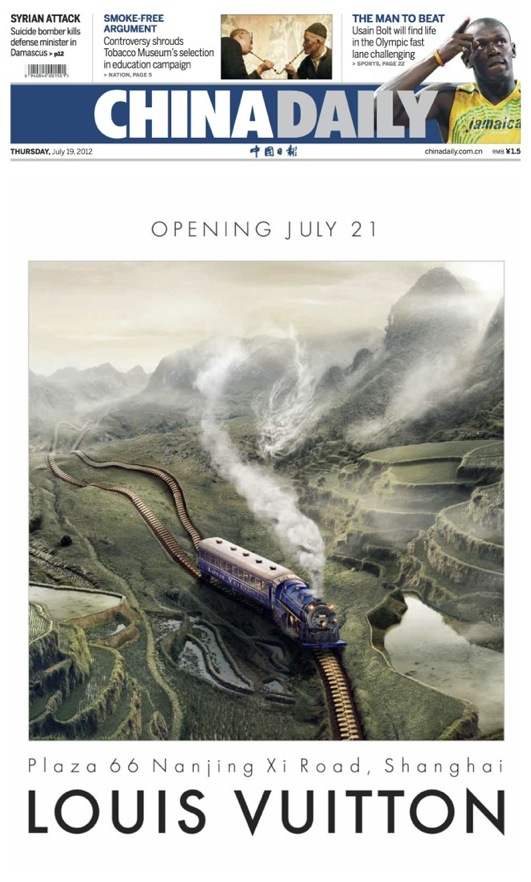
| Front page of the China Daily for sale Posted: 19 Jul 2012 08:49 AM PDT by Allison Carroll Goldman on July 19, 2012  The front page of the China Daily English newspaper today is taken up by a full page ad for Louis Vuitton. The ad announces a new store opening in Shanghai that will open this Saturday, on July 21. Three small headlines are displayed in a row above the newspaper title: One is about a recent suicide bombing in Syria, one relates to controversy surrounding a Tobacco Museum in Shanghai, and the last is about an athlete's prospects in this year's Olympics. The headline about the Tobacco Museum in Shanghai points the reader to page 5, where an entire page is dedicated to smoke-related questions. The article itself is called "Decision to honor museum questioned." It describes how Shanghai residents and experts have questioned their city's decision to honor a tobacco museum for its service educating teenagers. The China Tobacco Museum in Shanghai was built by the country's tobacco industry, and opened in 2004. It includes exhibits on the history of the development of the tobacco industry, tobacco farming, tobacco trade, tobacco management, tobacco and smoking control and tobacco culture. The museum was recently honored for its excellent performance in service as the city's education base from 2010 to 2011. The honor was given by the Shanghai Municipal Education Commission, the Shanghai Municipal Education Commission and the Shanghai Committee of China Communist Youth League. One critic was reported as saying, "It's widely known that tobacco is harmful to your health and may cause various diseases. How can such a museum be selected as patriotic education base? Supervision departments should pay more attention to it." Meanwhile, Tang Weichan, an official from the museum, told the China Daily "Many of those who are against the museum have never visited the museum, which provides a platform for people to understand the stories behind tobacco." Page 5 also includes a story on how the "WHO urges China to tax smokers," and how an anti-smoking organization in Beijing is seeking the recal of an award presented to the China National Tobacco Corp. in June in recognition of its contributions to the environment. Links and Sources  |
| 16-year-old boy convicted of rape for living with 13-year-old girlfriend Posted: 19 Jul 2012 02:54 AM PDT
From Baidu news: Recently, a typical rape case with warning significance was tried in Shenzhen Luohu District Court. A 16-year-old boy (at the time of the crime) was in love with a 13-year-old girl and had lived together. Although both parents did not take further legal action, the boy was prosecuted by the authorities. First instance trail convicted him of rape, the court sentenced him 1 year and 3 months imprisonment. They are boyfriend and girlfriend The boy in the case Xu, born in August 1995,was only 16 years old at the time of the crime in 2011. According to the prosecutorial office, Xu and the victim Cheung (female, born on Jun 11, 1998, was 13 at the time of the crime) met in early August 2011 and became boyfriend and girlfriend since then. In the evening of August 5, 2011, knowing Cheung was under 14 years of age, Xu still had sexual intercourse with her at his place. Therefore, the prosecutorial office charged Xu with rape. During the hearing in the Luohu District Court, the defense attorney of Xu claimed that Xu was under18 at time of the offense. He should be subjected to a lighter punishment. Plus, he had been in a good behavior after being arrested and he showed a sense of remorse. Furthermore, Xu did not cause other serious consequences to the victim. The defense attorney also emphasized that the educational level of the defendant was not high and he was still very young. With unhealthy trends in the society, he might not be good at adjusting and at self-control as adults. In addition, the victim and he were in a relationship and the sex was consensual. Hence, subjectively a less severe crime, and less harmless to the society. The defense attorney hoped the court gives less than one year of prison sentence. During the time of the crime he was on probation Although the court agreed with the defense attorney's reasons of lighter punishment, but did not take his advice on the sentencing. Xu was arrested and taken into custody after a robbery case on September 7 2010 and was then released on bail on March 9 2011. The Court thought that when someone committing a new crime during probation period, according to the law shall revoke his probation and receive punishment for both crimes. Therefore, the court charged Xu with rape and sentenced him to 1 year and 3 months. He was also found guilty of the robbery and sentenced to 10 months with 1000 yuan fine. The total sentence was 2 years and 1 month. China's Criminal Law (number two hundred and thirty six, paragraph 2) states: having sex with young girl under age of 14 constitutes rape regardless of being consensual or not, shall be severely punished. |
| Watch: North Korean troops dance for Marshall Kim Jong-un Posted: 19 Jul 2012 01:44 PM PDT Via AP: "Hundreds of soldiers danced in Pyongyang's plazas after North Korea announced that its leader Kim Jong Un has been named marshal, state media reported." [ more › ] |
| Got A Pretty Penny? The China Daily Front Page Can Be Yours Posted: 19 Jul 2012 10:35 AM PDT
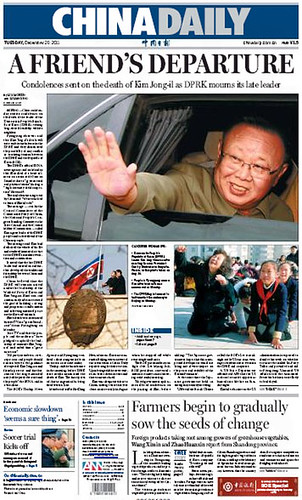
No one would confuse China Daily for a real newspaper — the kind that doesn't write "A Friend's Departure" on its front page when North Korea's leader dies — but the company undoubtedly has real journalists on staff, veteran reporters who quietly toil within China's noxious media environment to produce respectable work, and it's those journalists I currently feel for. In yesterday's edition of China Daily, Louis Vuitton is the front page. Not a story about LV, or a quarter-page ad, or even an ad jacket. Just Louis Vuitton, its address (Plaza 66 Nanjing Xi Road, Shanghai), and the words "Opening July 21." Why is this a big deal? Other papers have done this, you say. Yes, other papers, like Richmond Times-Dispatch. China Daily is China's top English-language publication, and I doubt it's hurting for cash, judging by the size of the paper. Quite recently it's expanded to the US and Europe, and is seeking to launch its African edition. It's given Louis Vuitton the front page simply because, I'm guessing, Louis Vuitton nuzzled up against its marketing department, charming some pants off. Then LV offered lots of money. As far as ads go, this one is brilliant. Whatever LV paid, it's not enough. Because a lot of people — myself, McClatchy Newspapers Beijing bureau chief Tom Lasseter, Danwei — are talking about it, and it's generating amazing publicity. Reuters even did a story about LV's nebulous "opening." We'll let marketers applaud LV, though. As for China Daily, the newspaper: I suppose it's easy selling your soul when you never had one. But frankly, I preferred bumbling, clueless China Daily, following porn sites on Twitter (on an account now deleted, by the way), instead of this current version: a slut for commerce that follows whoever's willing to throw down the right wad of cash. |
| Hu Woos Warily Welcoming Africa Posted: 19 Jul 2012 09:09 AM PDT China is giving the triennial two-day ministerial Forum on China-Africa Cooperation in Beijing the full-court diplomatic press. President Hu Jintao, seen above addressing the gathering against a backdrop of African flags, promised to have doubled China's credit lines for African governments to $20 … Continue reading →  |
| China’s Dentention Of Foreigner For Customs Violation Should Be A Strong Warning Posted: 19 Jul 2012 08:25 AM PDT The New York Times, in its inimitable style, is shocked (shocked, I tell you) and appalled (appalled, I tell you) about China's recent detention of a German (and his "Chinese associate") on charges that they undervalued imported art to avoid USD$1.6 million in customs duties. I have a very different take on the whole thing. First off, let me state right off the bat that I have no facts regarding the guilt or the innocence of these two individuals. None. Zero. Zilch. Nada. So this post is not so much about them. It is instead, about the countless companies that have come to my international law firm with plans to undervalue their imports with Chinese customs, based on the belief that "this is what everyone is doing." Before I talk about what we see on this front, let me give some of the background regarding this particular fine arts customs case, and what better way to do so than to let the New York Times set the stage:
Needless to say, this experience has not been pleasant for Mr. Jennrich, as the New York Times makes all too clear:
And the New York Times blames China because, apparently:
The CEO of Jennrich's company had this to say:
According to "legal experts," "art handling firms simply work with the values provided by their clients, but that Chinese law is murky on whether individuals employed by shipping companies can be held liable for undervaluing a work." The New York Times then quotes from Jennrich's lawyer and the Chinese associate's fiancé:
The New York Times then seems to justify whatever wrongdoing may have occurred:
As much as I feel for those arrested, I cannot help but have a different take on things. Let me explain some of my beefs with the New York Times' article and then I will discuss why this case could very well matter for YOU. I doubt very much that many jails are particularly nice places to stay and we do not need the New York Times reminding us of that. I mean, how often does the New York Times mention jail conditions in its other stories, and in a way designed to evoke sympathy for the person detained? And I just love how the Times mentions how these two defendants are "languishing" in prison on a smuggling charge, "a crime normally associated with the illegal importation of drugs or arms." Really? I have always thought of "smuggling" as importing or exporting something contrary to customs laws and, hey, guess what, Meriam Webster agrees with me on that. It defines it as importing or exporting "secretly contrary to the law and especially without paying duties imposed by law." And the bit about this arrest putting "a spotlight on the mercurial Chinese legal system" and harming China's lack of integration with the world economy is a bit over the top (O.T.T.). I really get the sense from this (and from much of the rest of the article) that the New York Times is essentially saying, "hey, these people love art and so even if they did violate the law, we should let them go because that is how we here in the West would handle this sort of thing." But where the article really falls short is when discussing the core question. If these two defendants did undervalue the art, did they do anything wrong? They say legal experts find the law "murky" but then, Ms. Murphy, a lawyer involved in this case on the side of Mr. Jennrich (and a very fine lawyer, I might add) seems to say that his defense plan is not going to be that he did nothing wrong, but instead to seek mercy from the court because he didn't make much money on the deal. Mr. Chu's fiancé hints at the same thing. It would have been good if the article had given us more insight into their possible defenses. The article then talks about how difficult it is to stay within the law because the paperwork can be onerous and because so many cultured and sophisticated art buyers just really don't like paying up to 35% duties on fine art. Come on. Now let's talk about the more quotidian world in which my law firm deals. A few years ago, we were approached by someone wanting to import art who was essentially seeking our imprimatur for them to undervalue their incoming art shipments. We wanted nothing to do with this client, who kept trying to assure us "that this is what everyone in China does" and that "you have to do this if you are going to import art into China." I do not remember our exact response in this instance, but I am going to assume that it was the same as the one we always give to people in similar circumstances, which is something along the following:
We have received a number of similar requests outside the art world as well. I apologize for the lawyer related digression here, but I cannot resist mentioning a great China Hearsay post from a few months ago on the lawyer's role in when confronted with a client who intends to violate the law. The post is entitled, Should You Fire Your Corrupt Client, and the conclusion is that lawyers should, for their own benefit:
Back to our regular programming and to how all of this relates to you, the company doing business in or with China. Here are the basics you need to know:
In The Sentencing Of Matthew Ng. A Very Long "No Comment," we spoke of the risks of criminal activity and the almost blithe attitude too many foreigners have about it:
Similarly, in Avoiding Chinese Jails. I'm Talkin' To You, we had this to say about the need to follow the laws in China:
And when it comes to customs in China, we are seeing a huge increase in customs people trying to turn even honest mistakes into criminal matters. We have successfully handled a number of these cases and we have done so by responding to the problem immediately, by taking the problem very seriously, and by getting as much information to Chinese customs quickly as possible and in as helpful and proper a form as possible. By proper, I mean that customs wants everything appostilled and consularized, so that is how we do it. We have found that customs initial assumption is that there has been criminal activity, but that if you work with them, they absolutely can be convinced that it was really just an honest mistake (presuming that you have real proof that it was just an honest mistake). When it comes to customs, we have found that the key is to deal with any problems early and head-on. I have absolutely no idea whether that would have even been possible in the art case discussed above (I doubt that it would have been), but it usually is. Overall, in the last six months we have seen an absolutely unprecedented increase in China's tightening down on its laws as they apply to foreigners. (It is possible that China is cracking down on its laws with respect to everyone, but because my law firm just represents foreigners in China or doing business with China, as opposed to Chinese citizens in China, we do not know if that too is the case.) China is shutting down improperly formed WFOEs like never before. Beijing is left and right shutting down WFOEs that do not have the proper facilities or are operating outside their scope of business. And we hardly need to tell you about the recent crackdown on foreigners in China without proper visas. There is an easy explanation for all of this and we have seen it before (though never to such an extent). It's the economy, stupid. Bottom Line: I hate to sound so trite, but the key for you if you are doing business in China is simple: follow the law no matter what. What do you think? What are you seeing?
|
| Public fears check Chinese nuclear Posted: 19 Jul 2012 09:10 AM PDT A new nuclear safety plan for China has been treated as a signal the sector is returning to favour. But old problems still plague the industry, writes Cui Zheng. In mid-June, following a 15-month moratorium on construction of new nuclear facilities, China published the results of a nuclear safety audit and a fresh nuclear safety plan, signalling a possible end to the post-Fukushima freeze. |
| If You’re Not Doing KTV Like This, You’re Doing It Wrong Posted: 19 Jul 2012 05:00 AM PDT There's no logical reason for me to enjoy this video, "Karaoke in Beijing," by YouTube user dimitrivandillen. But I do. And I'm not sorry. Have a pleasant Thursday evening, everyone. Youku version for those in China after the jump. |
| Rupert Murdoch and Wendi Deng's former nanny tells all Posted: 19 Jul 2012 03:08 AM PDT  In an exclusive interview given to Gawker, a former nanny and tutor for Rupert and Wendi Murdoch, has spoken up for the very first time on what life was like working for the power couple of the media world. The picture that emerged of Wendi Deng, the "Tiger Wife" who was applauded for the way she came to the protection of her husband when a protestor attempted to attack him last year, was especially unkind. Working for Deng was a "relentless nightmare", as Gawker put it: "Screaming tantrums, nannies discarded by the side of the road on a whim, no benefits, unpaid overtime, young girls body-shamed by their mother—and near abandonment for workers injured on the job." [ more › ] In an exclusive interview given to Gawker, a former nanny and tutor for Rupert and Wendi Murdoch, has spoken up for the very first time on what life was like working for the power couple of the media world. The picture that emerged of Wendi Deng, the "Tiger Wife" who was applauded for the way she came to the protection of her husband when a protestor attempted to attack him last year, was especially unkind. Working for Deng was a "relentless nightmare", as Gawker put it: "Screaming tantrums, nannies discarded by the side of the road on a whim, no benefits, unpaid overtime, young girls body-shamed by their mother—and near abandonment for workers injured on the job." [ more › ] |
| Hong Kong National Education Promotes the Worship of Chairman Mao Posted: 19 Jul 2012 01:58 AM PDT On last Sunday, Beijing-backed primary school teacher Yu Yee-wah 余綺華 threw a temper tantrum at a 15 year-old anti-national education student in the live TV debate "City Forum".
Her childish behavior drew both criticism and interest from netizens. Out of curiosity, netizens investigated Yu's background as she represented National's Little Vanguard 國民小先鋒 in the debate. The investigation leaded to shocking revelations about the rifle holding and red/yellow scarf wearing National's Little Vanguard, which is under the lead of the Chinese Communist Party. As mentioned in the previous post, through Yu's connection with Education Employees General Union, netizens discovered that 18 Catholic primary schools participate in a national education programme called 匯通國民教育 Blended Learning Curriculum Design for HK National Education, which has just been found out that it promotes the worship of Chairman Mao. Netizens are extremely disgusted by this Mao-worshipping programme.  18 Catholic primary schools that participate in "匯通國民教育 Blended Learning Curriculum Design for HK National Education" The following is the syllabus of national education of these 18 Catholic primary schools. The content of chapter 5 "Culture Arts – Learn Calligraphy Together" is "The Artistic Attainment of Mao Zedong's Calligraphy 毛澤東的書法造詣" and one of the learning targets/learning focuses is "learn the spirit of Chairman Mao , which is never give up and assiduous."  "The Artistic Attainment of Mao Zedong's Calligraphy 毛澤東的書法造詣" is on the syllabus of 18 Catholic primary schools' national education programme. Comment from House News
God Save the Queen was played when Lee Lai-shan won her gold medal for Hong Kong in 1996.  Netizens' comments
  |
| Asian Mother Viciously Belittles Son For Getting Math Question Wrong Posted: 19 Jul 2012 12:56 AM PDT As Louis CK says in one of his shows, children can be assholes (and "buckets of disease"). But is it worth screaming "kill you" at them for getting a math problem wrong? This video's a bit old, from two years ago, but it recently went viral and found new life on Viral Viral Videos. Forget Amy Chua; it's Asian mothers like this who give Asian moms a bad rep. And it quite possibly might be child abuse, as BlackRoseStar333 points out in the video description. "What do you know?" the mom shouts. "Do you want to go to college? No you don't! You're a total idiot!" I grew up in an Asian household, and my mother once threatened to tie me to a chair and burn me, but that's because I was misbehaving. She was down to her last resort. (Before you act so shocked, realize that parenting standards really are different in Asia.) But my mom would never threaten to kill me for getting a few math questions wrong. After all, it's normal to be wrong sometimes. It's part of growing up and the learning process. And… it's MATH. No wonder Asian kids are stereotyped as unimaginative and passive: all their energies are spent getting math questions correct, lest their mothers freak out. Youku video for those in China after the jump. |
| Filmmaker, blind boy, shed light on rural China's plight Posted: 19 Jul 2012 01:30 AM PDT  It took a little blind boy to help Carol Liu truly see rural China's agony. The documentarian's latest feature, Restoring the Light, deeply contrasts most mainstream media accounts of the nation's rampant development. Her movie, (which will be screened July 21 at 7pm at Beijing's Redwall Jingshan Garden Hotel), is about those literally left in the dust- from farmer families as parched as their crops, to cash strapped fringe hospitals that can barely afford to tend to the those impoverished patients. [ more › ] It took a little blind boy to help Carol Liu truly see rural China's agony. The documentarian's latest feature, Restoring the Light, deeply contrasts most mainstream media accounts of the nation's rampant development. Her movie, (which will be screened July 21 at 7pm at Beijing's Redwall Jingshan Garden Hotel), is about those literally left in the dust- from farmer families as parched as their crops, to cash strapped fringe hospitals that can barely afford to tend to the those impoverished patients. [ more › ] |
| Trainwreck DJ Uffie apologises to Shanghai fans for non-performance Posted: 19 Jul 2012 12:10 AM PDT  Uffie, the trainwreck of a DJ and supposed socialite that some local party promoters had the good (mis)fortune of inviting to Shanghai recently, has broken her silence on what happened at Mao Livehouse last weekend. [ more › ] Uffie, the trainwreck of a DJ and supposed socialite that some local party promoters had the good (mis)fortune of inviting to Shanghai recently, has broken her silence on what happened at Mao Livehouse last weekend. [ more › ] |
| Tibet closed for routine maintenance Posted: 18 Jul 2012 11:44 PM PDT Lhasa (China Daily Show) – Tibet is to be closed for routine cleaning and repairs, the Chinese Foreign Ministry told reporters yesterday. |
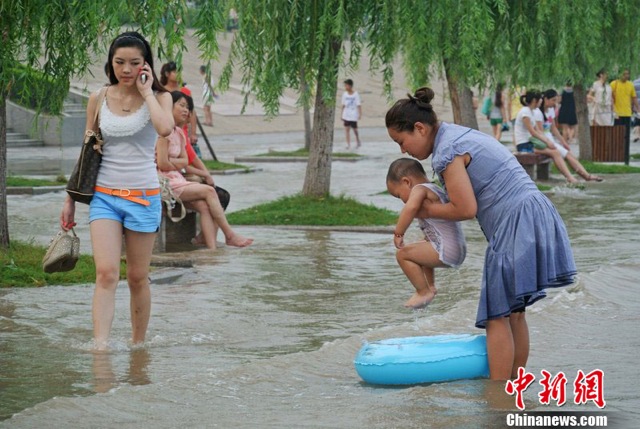
| A Makeshift Swimming Pool In Wuhan Brings Out The Young And Old Posted: 18 Jul 2012 10:57 PM PDT  Via CFP Remember the boat-rowing dad with his young son? And the kid swimming in the back of a van? Continuing on that theme, here's a toddler in an inflatable swim ring floating down a flooded road in a Wuhan park. According to China News, plenty of families have brought their children out to play in the overflowing Yangtze water. But not just children! Look:
You're only young once. Live it up.
(H/T Alicia) |




| You are subscribed to email updates from Update » Blogs » Society To stop receiving these emails, you may unsubscribe now. | Email delivery powered by Google |
| Google Inc., 20 West Kinzie, Chicago IL USA 60610 | |

Comments