Blogs » Politics » Ai Weiwei: I “Morally” Won
Blogs » Politics » Ai Weiwei: I “Morally” Won |

- Ai Weiwei: I “Morally” Won
- Female Korean Judge Blocked Sumsung Pad
- Photo: Charging Coal, by LHOON
- Xinhua Dictionary Reflects Social Change
- China’s Per Capita Carbon Emissions Match EU’s
- New Oriental, Schooled in U.S. Stock Market, Still Makes the Grade at Home
- Rock in China: An Insider’s Journey
- Q&A: Chen Kaige on the Future of Chinese Film
- What if you found your husband is a gay?
- The Daily Twit – 7/20/12: SAFE Bails Out GM, iPad Launches, and New Oriental Fires Back
- Pictures: Bus driver has a narrow escape from death in Gansu
- China’s Health Care Workers and Smoking
- Bus driver puts knife to his own throat to seek renewal of contract
- Second Blind Activist Freed From Chinese Custody
- Street vendor holds chengguan officer’s leg for restoration of his confiscated item
- Trained the wrong way
- INAUGURATION DAY FOLLOW-UP: President Hu’s Message for Hong Kong
- Houston Hoping Linsanity Channels Yao
| Posted: 20 Jul 2012 11:31 PM PDT Ai Weiwei may have lost his appeal of a multimillion-dollar tax evasion fine, but he tried to look at the glass as half-full when speaking to the Daily Beast's Dan Levin on Friday:
Today, award-winning filmmaker Alison Klayman's documentary about Ai debuted in New York. The New York Times calls Klayman's film, Ai Weiwiei: Never Sorry, a "classic case of being in the right place at the right time":
© Scott Greene for China Digital Times (CDT), 2012. | Permalink | No comment | Add to del.icio.us |
| Female Korean Judge Blocked Sumsung Pad Posted: 20 Jul 2012 09:18 AM PDT  A federal judge banned Korean manufacture Samsung's Galaxy Pad from selling in the US, citing a patent dispute. A same claim made by Apple in the UK was thrown out by the court. Further, Apple was ordered to place a statement on its website to clarify that Samsung did not infringe upon its IP. Last month, an American federal court judge dismissed Apple's IP claim case Korean American Judge Lucy H. Koh became a federal judge for the Northern District of California in 2010. More than often, with few exception, Asian descendants go beyond reasonable to prove their determination to separate their past.  |
| Photo: Charging Coal, by LHOON Posted: 20 Jul 2012 02:32 PM PDT  Charging Coal © Samuel Wade for China Digital Times (CDT), 2012. | Permalink | No comment | Add to del.icio.us |
| Xinhua Dictionary Reflects Social Change Posted: 20 Jul 2012 02:52 PM PDT With over 400 million copies printed since its first edition was issued in 1953, The Xinhua Dictionary (新华字典, literally "New China Dictionary") is mainland China's authoritative lexicon and the world's most popular reference work. China Daily reports on the 11th edition, released earlier this month, and how its contents have been modified to reflect society. While a surplus of newly-coined terms can now be found in its pages, many sensitive words have also disappeared, displaying the social and political spirit of of the times:
The 3,000 new words come from slang spoken on the streets of China, and from the collection of Internet terms that swells along with China's ever-growing netizen population (which reportedly just hit 538 million). The Telegraph's Malcolm Moore explains a few more of the newly added terms, and why some have recently disappeared:
In a piece for Foreign Policy, Eveline Chao explains the social significance of some of these new additions:
Other new entries that made it onto Foreign Policy's list reflect topics long covered by CDT: fangnu (房奴), those "house slaves" bound to their mortgages; PM 2.5, an addition that speaks to a growing concern about the environment; NBA, reflecting China's obsession with the American basketball league; and zhainan/nv (宅男/女), describing China's "Internet freaks". For more on China's linguistic zeitgeist, browse CDT's entire Grass Mud Horse Lexicon, or see our Sensitive Words series. © josh rudolph for China Digital Times (CDT), 2012. | Permalink | No comment | Add to del.icio.us |
| China’s Per Capita Carbon Emissions Match EU’s Posted: 20 Jul 2012 02:14 PM PDT According to a new report (.pdf) by the PBL Netherlands Environmental Assessment Agency, China's per capita carbon emissions have reached a similar level to the EU's. Global total emissions continue to rise, with the balance increasingly shifting from developed to developing countries. From PBL:
The data are subject to several caveats, however, as The Guardian's Duncan Clark reports. For example, the figures count emissions from a product's manufacture against Chinese workers rather than European consumers.
Sam Geall commented at chinadialogue:
Much of the rise in China's emissions comes from an increase in coal burning to power the country's economic growth. Surging coal use now shows some signs of tailing off: the formidable growth in imports cited by PBL has slowed to a projected 8.4% this year, the lowest since 2008. This, together with corresponding drops in electrical output growth, has helped fuel fears of a sharp economic slowdown: vice premier Li Keqiang famously places more trust in these figures than in official GDP as measures of economic health. At Caixin, however, Yu Hairong suggests other explanations: "an easing, evolving" and less carbon-intensive Chinese economy, and a shift to alternative power sources.
chinadialogue recently posted an overview of the fierce debate over hydropower expansion (via CDT), with proponents insisting that China's rivers remain underexploited and critics arguing that they already "can hardly breathe" under the weight of existing dams. Two more recent posts at the site examine the prospects for other coal alternatives. One is natural gas. The PBL report cites a modest shift towards gas from other fossil fuels as a factor in declining US carbon emissions. Although still made of crushed plankton and regarded as a short-term solution at best by environmentalists, it does burn more cleanly than coal or oil in terms of both carbon and particulate matter. This makes it an attractive alternative for cities like Beijing, but as An Geng and Xu Nan explain, natural gas adoption elsewhere will be hindered by cost and supply issues.
Also at chinadialogue, Cui Zheng discusses nuclear energy's possible resurgence following the publication of a new safety plan. The public opinion fallout from the Fukushima disaster, combined with a rising tide of environmental protests, may dissuade authorities from allowing a potentially destabilising revival ahead of this year's leadership transition.
Still, China's beleaguered nuclear industry may have other avenues to explore. According to The Guardian, talks are underway for the £35 billion construction of up to five power stations in the UK. © Samuel Wade for China Digital Times (CDT), 2012. | Permalink | One comment | Add to del.icio.us |
| New Oriental, Schooled in U.S. Stock Market, Still Makes the Grade at Home Posted: 20 Jul 2012 12:34 PM PDT  What "plunge" looks like. No finance degree required The Chinese education giant New Oriental has learned a lesson from the international capital market. Its shares, listed on the New York Stock Exchange under the symbol EDU, plunged from about US$22 per share on Monday to about US$9.50 per share on Wednesday; it has since recovered some lost ground and climbed to about US$12.5 on Friday. The company was hit by the double whammy of an SEC investigation and an analyst report by short-seller Muddy Waters that alleged fraud by its management and auditors. Investors in the U.S., already skittish over a series of scandals of China-based companies, engaged in panicked sell-off.  Happier days. New Oriental's listing ceremony on the NYSE in 2006 However, judging from sentiments on China's social media, New Oriental still gets high marks at home. Many China-based observers see an opportunity to scoop up shares of a Chinese blue chip company on the cheap. Liu Shengjun (@刘胜军改革), a columnist for the Financial Times' Chinese edition, tweeted on Sina Weibo, China's Twitter, "Great time to buy up New Oriental at the bottom." [1] Stanley Gao (@高晓虎Stanley), a senior investment manager at Innovation Works, tweeted, "Before I got off work, I told my colleague six times to buy New Oriental once the market opens. Sell your house and buy New Oriental once the market opens!" [2] Yang Zhiwei (@杨志伟_金沙江创业投资) believes U.S. investors do not know the full picture: "Who is selling? The lack of information caused panic. The stock is seriously undervalued." [3]  Michael Yu, from lowly English teacher to multi-millionaire Much of the goodwill stems from trust in New Oriental's founder, Michael Yu, who perfected the formula of turning exam-prep classes into a combination of stand-up comedy, inspirational speech and rote memorization. Mr. Yu's rags-to-riches story is also the stuff of legend among the school's many alumni. Since New Oriental's start in early 1990′s, almost all of China's best and brightest attended its classes before taking standardized tests required for admission into schools overseas, such as the GRE or the TOEFL. Mr. Yu (@俞敏洪) also used Sina Weibo to defend his company and called the accusations in the Muddy Waters Research report "baseless." Li Lei (@力波村的劳伦斯), the former CFO of Shengyuan Dairy, puts in a vote of confidence: "I never liked New Oriental's approach to turn education into an industry, but I believe Michael Yu. Its structure is definitely legal and its audits are also solid. Those who dabble in the U.S. stock market should buy New Oriental." [4] Ling Daihong (@凌代鸿), an angel investor, shared his observation, "Haha, we are in the same building as New Oriental, and we see tons of people downstairs all day and we know that their business is doing great." [5] Li Zhi (@八百客李智), a founder of Li Zhi, tweeted, "How many of students who went to study in the U.S. in the early years have not attended Michael Yu's classes? New Oriental has a lot of alumni support. [6] @暖橙C-陈宇 agreed, "As an alumni of New Oriental who studied financial management, I really want to throw away the books and buy some New Oriental stocks." [7] Wang Ran (@王冉), the CEO of China E-Capital, was more cautious. "I am too scared to buy on the cheap now. When international investors group most Chinese entrepreneurs with fraudsters, there is always a new low in stock prices. There are other issues too, China's growth is slowing down and Chinese law is unfriendly to private enterprises, and also a few bad apples have spoiled the entire bunch. [8] Du Xuan (@榴莲_杜旋), a director at CCTV's finance channel, tweeted, "New Oriental is much better than many of the other Chinese companies listed in the U.S., this is still what it gets. I think the whole world is short on China." [9] For his part, Mr. Yu continued to court his home base. After promising to respect the SEC investigation and try his best to protect investors' interest, he tweeted, "No matter what happens, we put the interests of our students and employees above all else." [10] Footnotes (? returns to text)
|
| Rock in China: An Insider’s Journey Posted: 20 Jul 2012 11:08 AM PDT Over the past 30 years, many a foreigner has headed into the middle kingdom to find fortune in the brisk economy of a rapidly changing nation. When Jonathan Campbell went to China over a decade ago, he was searching for the sounds that describe an era. While many of his peers were huddled around business banquets pulling and piling guanxi, Jonathan was getting up-close and personal with China's young but dynamic yaogun (摇滚), or rock-and-roll scene. After publishing Red Rock: the Long Strange March of Chinese Rock and Roll last year, Jonathan has become China's unofficial rock-and-roll ambassador to the English speaking world. In February, Book Club in a Box interviewed Jonathan about his time in China and relationship with its contemporary music scene:
Jonathan recently told The Wall Street Journal's Jason Chow how China's rock music carries the sub-cultural sound of hope that may have faded from its sonic counterparts in the West, and compiled a list of six albums to demonstrate his point:
Click through to hear the many shades of sound that make up China's rock scene. Also see Jonathan's Yaogun 101: A Chinese Rock Primer. For more on rock music in China, see Rock 'n Roll With Chinese Characteristics or Cui Jian: Still Rocking, via CDT. For more on musical diplomacy, see Building US-China Relations by Banjo, also via CDT. © josh rudolph for China Digital Times (CDT), 2012. | Permalink | No comment | Add to del.icio.us |
| Q&A: Chen Kaige on the Future of Chinese Film Posted: 20 Jul 2012 11:01 AM PDT China Real Time talks to Chen Kaige, the "Fifth Generation" director of Yellow Earth and Farewell My Concubine, about censorship, Hollywood, and his latest film, Sacrifice, which arrives in the US this month.
Click through for video highlights from the interview. Also at The Wall Street Journal, Laurie Burkitt reported on Thursday how China's booming box office—whose takings have risen by 42% in the last year—is increasingly dominated by foreign films, despite restrictions on their distribution. © Samuel Wade for China Digital Times (CDT), 2012. | Permalink | No comment | Add to del.icio.us |
| What if you found your husband is a gay? Posted: 20 Jul 2012 03:42 AM PDT
A news broke out: In early morning on June 16, Luo Hongling, a Korean teacher in a foreign language school in Chengdu who just got enrolled for Doctoral education, jumped over from the 13th floor from an apartment building and died on sight. 25 days earlier, she found some intimate messages in her husband's phone. On May 21, when her husband surnamed Cheng was taking a shower, she happened to find another intimate message from a male surnamed Bao from Shanghai. Luo Hongling had been a member of an online club by the name of "wives with homo husbands", she had been complaining about her misfortune in a Chinese forum "晋江论坛" from the moment she suspected that her husband was a gay until two days before she committed suicide. The last thing she said on that forum was : "Sisters, you are right, my husband is a gay, he has been using me from the very beginning!" Before this, when she found out the homo status of her husband, he texted her a message which says, "I feel ashamed of myself, I'm an a$$hole, Don't get broken-hearted, I'm not worth it". In the evening the day before she died, she told her mom that she would divorce him. But at about 20:00, Cheng sent an Weibo message to appologize, "Miss Luo, I'm sorry, I'm a gay, I cheated on you, the reason of our marriage is that I wanted to conceal that fact that I'm a gay." The next morning, Luo Yuling sent her last Weibo message: "This world is so tiring! Just let it finish, everything is gone!" This is her Weibo link: http://weibo.com/u/2803036010 Three months ago, she started complaining online that her husband was having sex problems. He worked out after work, and went to take classed on weekends and tried to avoid her. Big sigh for her. She thought that with the phone messages and online records he will be put into the court for her death, I'm afraid that she would die in vain.
luo HonglingSource: China Forum |
| The Daily Twit – 7/20/12: SAFE Bails Out GM, iPad Launches, and New Oriental Fires Back Posted: 20 Jul 2012 06:17 AM PDT I've got nothing pithy, no huge China news, and no made-up narrative with which I can shoehorn some of these links. It's a haphazard, scattershot Friday. Enjoy your weekend and catch up on your reading. Economist: Violence against doctors: Heartless attacks — Not a breaking news story, but good reporting on an ongoing recent problem that has received a great deal of attention in China. The Economist also has a story about general health care reform in China which is definitely worth reading. Financial Times: China to buy US assets via GM pension — This is a couple days old, but I found it rather fascinating. China's forex authority is buying up positions held by GM's pension fund in some private equity funds. That's all I wanted to say, that China is bailing out GM. Funky. Wall Street Journal: As China Growth Slows: Suddenly, It's the Society, Stupid – Russell Moses talks about how the Party/government plans to handle social unrest in the face of a slowing economy. CNET: iPad makes quiet debut in China — Whether it was the online reservation system or lack of demand, there was no riot at the Apple store in Beijing today. Caixin: New Oriental Fires Back at Short-Seller — Apparently Muddy Waters got the attention of New Oriental. I guess that happens when your stock goes in the toilet, at least temporarily. Foreign Policy: From House Slaves to Banana People — Eveline Chao with another look at Chinese dictionary updates (i.e. new words) New York Times: A Beijing Family's Holiday From Pollution — Didi Kirsten Tatlow with a somewhat painful family discussion about Beijing's pollution. China Daily: China Pharm loses bid to toss vitamin C case — Looks like this price fixing case in New York federal court is going the distance. From this brief report, it sounds like China Pharm filed a motion to dismiss, and the judge wasn't buying any. Latest Sinica Podcast: Attack of the Piranhas — Economic growth, killer fish and ASEAN are among the topics. Now On Line: 'China and Democracy' Debate With Minxin Pei and Eric Li — Jim Fallows with a link to the debate that has generated a lot of discussion within the China expat Twittersphere. © Stan for China Hearsay, 2012. | Permalink | No comment | Add to del.icio.us |
| Pictures: Bus driver has a narrow escape from death in Gansu Posted: 19 Jul 2012 07:57 PM PDT
In the early morning of July 20, a driver was thrown out when his truck loaded with 30 tons of coal suddenly turned on its side on a bridge in Qingcheng county, Gansu province, and, luckily he was suspended from one side of the 10-meter high bridge without falling down as the truck crushed his right leg underneath and he caught hold of the truck timely. The rescuers were sent to the accident scene soon. They used the wire from other heavy trucks to fix the overturned truck first in order to avoid displacement caused during the rescue work. Then, a crane lifted up a firefighter and lowered him to the side of the trapped driver for rescuing. After three hours of rescue work, the victim was finally pulled out of danger, and rushed to the hospital for emergent treatments.
|
| China’s Health Care Workers and Smoking Posted: 20 Jul 2012 03:07 AM PDT
Headline number here is 40%. I'm not sure whether that is higher or lower than my expectations. Either way, it's still way too high. After reading that statistic, I wondered what the comparable numbers were in other countries. Since it's Friday, and I'm way too lazy to do thorough research, I jumped on the first stats I could find, which were quite old. From the U.S. CDC in 1993:
Interesting. That would compare to about 60% in China at that time, although since China is a developing country, I'm not sure that would be a fair comparison. I assume that the current data for Western Europe and Japan are much lower than was the case in '93. I also came across an interesting 2003 study in Ecuador, which found that over 30% of physicians were smokers. This was apparently higher than anywhere else in Latin America at the time, yet still much lower than the comparable China stat. I'm sure there's lots of other data out there Mr. Google could tell us about, but I suspect that the general conclusion that China's smoking problem is much higher than many other parts of the world holds up. But that 40% figure is not the item that bothered me the most. I'm even more troubled that: 1) so many hospitals out there are still allowing smoking on the premises; and 2) that education on this issue is still so backward. Even if one physician out there believes that smoking is efficacious or that stopping will lead to cancer, well, that represents some sort of institutional failure for medical education. Yikes. It takes a long time for attitudes to change, but we know from the experience of other countries that government action can be very effective in reducing smoking. Hint hint, government. Health care workers are a good place to start. I can't imagine the signal it sends to young people when they see their doctor smoking. © Stan for China Hearsay, 2012. | Permalink | One comment | Add to del.icio.us |
| Bus driver puts knife to his own throat to seek renewal of contract Posted: 19 Jul 2012 07:03 PM PDT
July 19, in Shenzhen, a public bus driver placed a kitchen knife on his own throat while holding a sign board, to seek justice for himself and renewal of his contract with the company. The driver, surnamed Long, 43, said that he was avenged after he reported to the higher authority that the deputy secretary of the public bus company accepted red envelopes stuffed with cash and cigarettes as bribes from others. The company then terminated renewal of the contract with him by some excuses. In desperation, Long attempted to hurt himself to prove that he is innocent and demanded justice from the company. He appeared overwhelmed by emotion when talking to the police, and had a one-hourlong standoff subsequently. The police officers did not step forward to seize the knife by force, under the consideration of the driver's safety. But ultimately, the man calmed down, and was convinced to put away his knife to come to the negotiating table with the company. |
| Second Blind Activist Freed From Chinese Custody Posted: 20 Jul 2012 02:18 AM PDT Reuters is reporting that blind activist Li Guizhi, who had been in Chinese custody since attempting to enter Hong Kong to participate in the July 1st pro-democracy protests, has escaped:
© Scott Greene for China Digital Times (CDT), 2012. | Permalink | No comment | Add to del.icio.us |
| Street vendor holds chengguan officer’s leg for restoration of his confiscated item Posted: 19 Jul 2012 05:52 PM PDT
A chengguan officer was suspended from his post, after pictures capturing him arrogantly ignoring a street vendor who sat on the ground and wrapped his arms tightly around the officer's right leg in Shaanxi went viral online. It was learned, the street vendor demanded the officers to return back his electronic scale that had been confiscated by the officers last May. But chengguan officers refused to give it back, and the peddler then desperately hugged one officer's leg and did not want to let go of it. Seeing the peddler's behavior, the chengguan officer, who wore sun glasses, however turned his face away and took out a cigarette to smoke. The street vendor said later in an interview that he was beaten several times by the chengguan officers too when he was found hawking on the streets illegally. But regarding this the local chengguan office has refused the saying. |
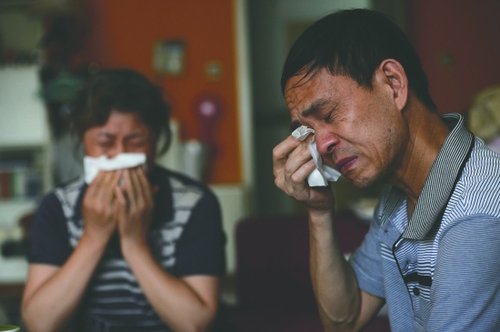
| Posted: 19 Jul 2012 09:59 PM PDT   A high-speed train speeds across the viaduct where two trains rear-ended on July 23, 2011, near Wenzhou, Zhejiang Province. Photo: Cai Xianmin/GT Imagine a rocky field filled with waist-high weeds, a hum of insects under the scorching midsummer sun. A regular view of China's rural areas, one might think, were it not for the thrumming of high-speed bullet trains speeding by. One year ago, in the suburbs of Wenzhou, Zhejiang Province, a fatal bullet train crash left 40 passengers dead and injured 172, also causing economic losses estimated at 197.3 million yuan ($30.3 million). Although boasting one of the fastest high-speed trains in the world, the way the Ministry of Railways (MOR) disposed of the wreckage and delayed the results of an investigation into the crash sparked public fury and widespread doubt as to the wisdom of the massive investment in high-speed railways. One year after that horrible night, as new weeds have covered up the scene's desolation, how are the injured and the bereaved families coping? One year on On July 23, bullet train D301 heading from Beijing to Fuzhou, Fujian Province rear-ended D3115 from Hangzhou to Fuzhou, which had stopped on a viaduct due to losing power after being struck by lightning. Seven carriages careened off the tracks, with four of them plunging 17 meters off the viaduct. Without this fatal day, 3-year-old Xiang Weiyi would be a healthy girl, growing under the protection and care of her parents. Now, everything has changed. Dubbed the "miracle girl," Xiang Weiyi was the last survivor of the tragedy to be pulled from the wreckage after being trapped inside a carriage for 21 hours. Both her parents died in the collision. "Yiyi is aware that there's something wrong with papa and mama since they no longer stay with her, but she avoids talking about them," said Xiang Yuyu, the little girl's uncle, who takes care of her now. Every day, Yiyi goes to Shanghai Xinhua Hospital for rehabilitation. Although doctors managed to save her left leg from amputation, it will be hard to get back full mobility and motor function. "Two-thirds of her left leg muscles were cut. There's still an obvious difference with normal kids when she walks," he added. After the crash, thousands of strangers donated to help her, but the family declined to accept any more money after the amount reached over 500,000 yuan. Xiang even turned away a 1 million yuan donation. "We saved the accident compensation money and donations into Yiyi's bank account, so that she can choose how to use it after she turns 18." Although he appreciates the outpouring of help and support, Xiang still feels upset. "Yiyi is not a perfect girl, but her whole family treats her like a normal kid. However, she was still rejected to get into kindergarten," he said. Concerned that staying with her grandparents all day long is not good for his niece, Xiang commutes between Shanghai and Wenzhou every two weeks to take care of Yiyi and his own son in turn. "We planned to let Yiyi have more time to get along with other kids in kindergarten, but she was rejected due to her disability," Xiang told the Global Times. Xiang understands the dilemma of kindergartens, who are worried about being liable if Yiyi injures herself further. "But Yiyi is so eager to go to a school that won't allow her past its front door. When she's not willing to eat, we tell her that only good children who eat their meals can go to school, and she finishes her meal quickly," said Xiang. Compared with Yiyi, Wang Hui's two-year-old daughter seems slightly more fortunate, as she still has her mother. Her family of three was ripped apart that night, when 35-year-old Zheng Hangzheng passed away in the crash, leaving his wife and baby girl behind. "My daughter almost collapsed mentally last year. She kept crying and clutching his picture," Wang Jian, Wang Hui's father, told the Global Times. After the accident, Wang Hui and her baby girl moved to live with her parents. "We try our best to avoid mentioning the crash at home; we don't even hang his picture on the wall. I hope the whole family will be able to stop grieving and move on," Wang Jian said. As a housewife, Wang Hui is struggling financially since her husband died. She only has 300,000 yuan in compensation left after Zheng's parents bought three tombs at 210,000 yuan for their son and themselves using part of the compensation money. They also spent nearly 70,000 yuan on monks who prayed for the dead. "Only a small amount of money is left to Wang Hui. She is considering working again after her daughter goes to kindergarten," said Wang Jian. Though unwilling to discuss the past, Wang Jian still complained about the MOR. "After the memorial service, the MOR officials fled and have never contacted us ever since. The investigation result was delayed, and the complete name list of all the passengers on the trains has still never been released," he said. "The MOR did punish someone, but nobody was even jailed," Wang complained.
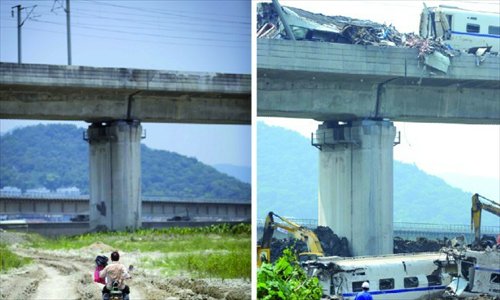 A photo montage contrasts the train crash scene then (R) and now. Photos: Cai Xianmin/GT |
| INAUGURATION DAY FOLLOW-UP: President Hu’s Message for Hong Kong Posted: 20 Jul 2012 12:24 AM PDT Clashes and controversies surrounding the July First inauguration of Hong Kong's new chief executive on the 15th anniversary of its return to Chinese rule have continued non-stop ever since. Pro-democracy protestors remain on the offensive and their opponents have resigned themselves to a seamless transition from one campaign to another. Chief Executive Leung Chun-ying, who planned to hit the ground running, now accepts that he will not be able to begin work in earnest until after the Legislative Council election on September 9 … probably many months after. THE FIRST 20 DAYS The police are still under fire for their heavy-handed security arrangements during President Hu Jintao's visit and mis-managed crowd control arrangements afterward (July 5 post). Secondary school students are increasingly agitated at the prospect of new compulsory political studies courses. And Chief Executive Leung immediately discovered that so many people were so angry over so many issues that after three weekends of intermittent chaos, his promised community outreach town hall meetings have been suspended until further notice. But that was only the beginning. One of Leung's new top-level appointees had to resign within two weeks of being sworn in on July First. An incomplete vetting process failed to uncover his unorthodox use in the 1980s of a civil servants' rent subsidy allowance and ex-Secretary for Development Mak Chai-kwong is now under arrest byHong Kong's Independent Commission against Corruption. At midnight on July 17, the four-year term of the current Legislative Council ended without lawmakers voting up or down on the Chief Executive's plans for more government offices and officers to implement his ambitious agenda. Even worse, Democratic Party chairman and erstwhile Chief Executive election candidate Albert Ho has applied for a judicial review. He wants to ascertain whether Leung violatedHong Kong's strict election rules by lying about the "unauthorized building works" on his property. If so, his election could (theoretically) be declared invalid fueling rumors (all unsubstantiated) thatBeijinghas given him 100 days to shape up or ship out. Much ado about nothing … perhaps … but pan-democrats are now in election campaign mode and every protest might mean more votes won on September 9. Any response from Beijing will also come after September 9 for fear of doing harm to loyalist candidates who are quietly laying the groundwork for anticipated major gains. But in the meantime, pro-Beijing commentators are also laying the groundwork for Beijing's anticipated determination to hold its forward lines of advance and push ahead as planned. Toward this end they are focusing on President Hu Jintao's speech to Hong Kong delivered at CY Leung's swearing-in ceremony. WHAT PRESIDENT HU SAID ON JULY FIRST With so much else going on that day, Pres. Hu's speech was largely ignored as just another exercise in Beijing-style hype about the unique "one-country, two-systems" experiment, brilliantly conceived, successfully executed, and so on. One writer said something more, however, and for once Lau Nai-keung [Liu Naiqiang 劉迺強] set himself apart from the others with a rare admission of the experiment's transitory nature. Lau began his political life in the 1980s at the other end of the spectrum soon after the British dropped their restrictions on open politicking here. But before long he moved across the dividing line, accepted appointment to the Chinese People's Political Consultative Conference in 1987, and has never looked back. With a convert's zeal, he frequently outdoes other loyalist writers in the vitriol he heaps upon his one-time friends and their successors. The one-country, two-systems formula as understood and practiced today is "not tenable," he wrote in a China Daily op-ed on July 12. That was why "signs of breakdown" were occurring daily. In other words, the formula is not a static solution to be maintained as is for an uncertain period of indefinite duration. It is an "evolving" relationship that can only be understood "dynamically" as an interaction between contradictoryHong Kong and mainland interests. Lau hailed Hu's speech as a "new paradigm" for finally acknowledging that tensions and problems must be confronted and worked through. Lau's jibe at Hong Kong people who "commonly choose to ignore" such matters could also be read as a backhanded swipe at mainland leaders for having failed to acknowledge until now that Hong Kong's 1997 one-country, two-systems reunification formula was never meant to be static or permanent. The Chinese version of Lau's article accentuated the "dialectical" relationship with a title illustrating if nothing else why tensions are rising among students, teachers, and parents ahead of the new compulsory "national education" curriculum's introduction. "It Is Necessary to Earnestly Study the Important Speech of Chairman Hu Jintao," read the headline (Wen Wei Po, July 11), reminding everyone that the old catechism routines remain a fundamental feature of mainland political life. In this version, Lau began by admonishing the Hong Kong media for its custom of not printing the full text of important speeches, selecting instead only a few key easy-to-read points, and reinforcing the public's erroneous assumptions about one-country, two-systems.* What had been ignored was what was different, namely, what Pres. Hu made a point of emphasizing before the four familiar points about prosperity, stability, and so on. He had begun by stressing that the "fundamental goal" of the central government's policies for Hong Kong is to "safeguard state sovereignty, security and development interests and to ensure long-term prosperity and stability in Hong Kong. This is the core requirement and basic objective of practicing 'one country, two systems' in Hong Kong." We also need to be mindful of the "deep-seated problems and challenges in society," he continued, saying he hoped Hong Kongers would "work harder in the following four areas." These were the four familiar themes. But what was also new and ignored by Hong Kong's media were the growing "dialectical tensions" that Hu wove into his narrative: (1) Harmony and stability must be achieved for all the diverse sectors of society but predicated on patriotism. (2) The rule of law was one of Hong Kong's "core values," but the Basic Law has "supreme status" in Hong Kong's legal system so "it is essential to put into practice each and every provision of the Basic Law." (3)Hong Kong must enhance its economic competitiveness internationally and an important way to do this is to promote even closer economic ties with the mainland. (4) Human resources must be strengthened with priority given to patriotism and "outstanding young potential political leaders in particular." There is of course a good reason why Hong Kong's mainstream media glossed lightly over Hu's message. The public is not in the habit of reading such political texts, which is one reason why the pro-Beijing press has the lowest circulation in town. But it doesn't really matter whether they read a text verbatim or not because people see the reality every day in growing mainland pressures on all the four counts, which are contributing to the new upsurge of protest registered on June Fourth and July First (June 20 and July 5 posts). There could be no sharper contrast than the one drawn between Hu's message and the young activist who concluded his mild-mannered Synergynet forum on June 30 with a declaration that Beijing should back off and let Hong Kong manage its own affairs, as promised before 1997, minus mainland interference (July 5 post). Lau Nai-keung was nevertheless right to admit that the current situation is untenable and that the "two systems" relationship is evolving — even if he didn't go on to draw the obvious conclusion, namely, that the two systems are incompatible and current pressures to force a merger are making Hong Kong ungovernable. If everyone had been honest enough to admit at the start that one-country, two-systems was only a transitional design-of-convenience preparatory to full-scale mainland-ization, the transition to Chinese sovereignty would probably not have gone so smoothly. But at least the public would have been forewarned and could have begun building its defenses more realistically against the pressures currently bearing down. Now there is little they can do except try to maintain their demo-a-day routines and hope the number of feet-on-the-ground is occasionally enough to induce concessions fromBeijing. Real solutions are difficult to foresee given Beijing's determination to proceed toward full integration and on one point at least Lau Nai-keung is far off the mark. Diligent political study habits are not going to reduce tensions any time soon. * President Hu Jintao's July 1, 2012 Hong Kong speech, full text, Chinese — Wen Wei Po,Hong Kong, July 2, 2012; English — http://news.xinhuanet.com/english/china/2012-07/01/c_131687721.htm
|
| Houston Hoping Linsanity Channels Yao Posted: 19 Jul 2012 11:49 PM PDT The Wall Street Journal reports that New York Knicks fans aren't alone in their disappointment over the news that Jeremy Lin will play for the Houston Rockets next year:
The Rockets hope that Lin's arrival will boost the team's relevance in China and fill the void left by the 2011 retirement of Yao Ming, according to The New York Times. TIME's Sean Gregory cuts through the hype and examines the likely commercial impact of Lin's move:
© Scott Greene for China Digital Times (CDT), 2012. | Permalink | No comment | Add to del.icio.us |


| You are subscribed to email updates from Update » Blogs » Politics To stop receiving these emails, you may unsubscribe now. | Email delivery powered by Google |
| Google Inc., 20 West Kinzie, Chicago IL USA 60610 | |

Comments