Links » Crème » Mid-Week Diaoyu Links: Tuesday’s Beijing “protest,” the risk of boycotting goods, and those poor innocent cars
Links » Crème » Mid-Week Diaoyu Links: Tuesday’s Beijing “protest,” the risk of boycotting goods, and those poor innocent cars
|

- Mid-Week Diaoyu Links: Tuesday’s Beijing “protest,” the risk of boycotting goods, and those poor innocent cars
- Mid-Week Links: Xi Jinping’s challenges, Mitt Romney’s China shortcomings, and Chris Devonshire-Ellis’s interview with the Beijinger
- The Sinocism China Newsletter For 09.19.12
|
Posted: 19 Sep 2012 07:39 AM PDT
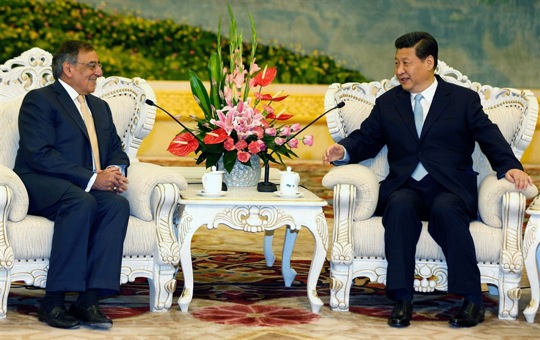 U.S. Defense Secretary Leon Panetta meets Xi Jinping at the Great Hall of the People, via NBC News (picture by Larry Downing / Reuters) As nationalistic fervor cools across the country, here's one last compilation of Diaoyu-, Mukden-, and Japan-related links. Tuesday's protest in Beijing: "Police equaled or outnumbered protesters, and they had been issued megaphones to whisk people along when they lingered. About halfway down the protest route, I heard the recorded voice of a woman, and initially thought it was a recording from the protesters. It took me a second to realize it was coming from the police station, and the message was not directed to the Japanese at all. In Chinese, it said: // 'Since Japan has violated our national sovereignty, it is natural that we express our feelings. We share the same feeling with you. The government's stance is clear: the government will not tolerate the violation of our national sovereignty. We should support our government, express our patriotic sentiments in a legal, orderly, and rational fashion. We should obey the laws and regulations, and not adopt extreme behavior, or disturb the social order. Please coördinate yourselves with our work, and obey the instructions of the police. Please do not linger here after you express yourself. Thank you everyone.'" [Evan Osnos, The New Yorker] Channeling dissent, to an extent. "So now there are people who really do want to march, chant and throw plastic bottles at Japan's embassy. And the authorities—either because they are afraid of angering people by denying them the opportunity or because they like the idea—are allowing it, up to a point. Since it would be riskier to let protesters march long distances across Beijing and pick up steam as they went, it makes a good deal of sense to provide the masses with buses. And since they are loth to pass up any opportunity to guide public opinion, they are probably also handing out flags and signs with approved messages." [Analects] Boycotting goods can backfire, namely in that one is unable to obtain those goods. "Yet despite China's growing clout in international economics, the boycott/consumer action sword can cut both ways. Whilst Japan is the current target of action in the mainland and Hong Kong, companies from all nations are being made more aware of the particularities of political risk in China – and will also remember the recent experiences of Carrefour and MacDonald's. Investment decisions are affected by risk, and a company's costs are increased if insurance premiums rise. Even shutting down facilities for a week or two is damaging to a corporation." [The Diplomat] A Chinese student in Japan weighs in. "What do we make of the hundred thousand Okinawans confronting American military bases in large-scale demonstrations? // At our university, I have already come across quite a few Japanese students who have been to China. Once they know I'm from China, they all 'show off' and use Chinese to give a self-introduction, and then in stilted tones say China's food is delicious, and so spicy! They do this in a very friendly way… // Saying this, I just want to remind my comrades: Beating up ordinary Japanese back in China just closes the last door to exchange among our people." [Tea Leaf Nation] Yes, our ability to be stupid is embedded in our DNA. "What is nationalism, after all, but tribalism writ large? We human beings, despite leaving the hunter-gatherer lifestyle and congregating into political entities with millions of others, have found it quite difficult to shed our old monkey ways." [Stan Abrams, China Hearsay] Well that's one way of ensuring the safety of Japanese cars. "Cable from the Hunan Huaihua Municipal Party Committee: Japanese Cars Banned from Road September 17-19: The Huaihua Municipal Party Committee gives notice in the cable below that all brands of Japanese cars are barred from driving on the road from September 17 through 19." [China Digital Times] Shed a tear for poor tourism companies. "Travel companies say they are seeing slowing business between China and Japan as the two countries ratchet up the rhetoric in a territorial dispute over a group of East China Sea islands. That has led to occasionally violent protests in China with a definite anti-Japanese tone." [WSJ] Chinese stone flute interlude: Finally… Protest in Guangzhou. [The Nanfang] Advocating nonviolent protest. [Antiviolence.zhiliao.cc] Gary Locke's car is damaged by protesters. [AP] Half-imagining a US-China conflict. [The Diplomat] "Thousands take to the streets to express nuanced views on complex issue." [China Daily Show] Finally, finally…  Sola Aoi again: "Diaoyu Islands belong to China," via Global Times (story taken offline for whatever reason). | ||||
|
Posted: 19 Sep 2012 04:01 AM PDT
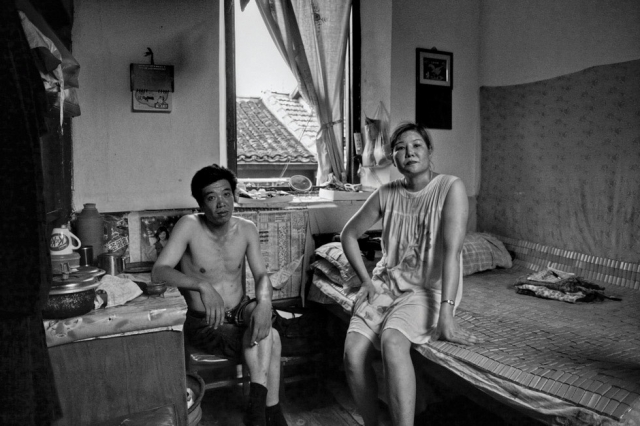 From Howard French's new book, Disappearing Shanghai, via Asia Society An extra-long edition today because we missed this on Monday. There's a special Diaoyu Islands links post forthcoming as well. Tough issues for Xi Jinping and his allies. "The last Party Congress, held in mid-October 2007, came with nearly two months' notice. Authorities have yet to announce a date for this year's meeting. It appears increasingly clear that the delay this time around is not about resolving the case against Bo Xilai or sudden health problems among leaders who have shown every sign of being fit up to now. The snag is that the political strategy that has kept the hardline center in shape is no longer sustainable. // That leaves Xi Jinping and his camp in a very tough place. They've not only got to consolidate their position more quickly than they perhaps expected — they also have to start making some hard choices about what sorts of policies will attract political support and placate the Chinese street. Surely they recognize that theirs is not only a new leadership, but that they will be leading a new China." [WSJ] Every Republican presidential candidate who speaks on China will inevitably be compared to Jon Huntsman. "On paper, Jon Huntsman and Mitt Romney have a lot in common. They are both Mormon. They are both former governors. They are both fathers to large broods of attractive children. And they both wanted to be the 2012 Republican candidate for president. But when it comes to their views on China, that's where the similarities end." [Asia Society] HA! "Chinaexpat.com founder Chris Devonshire-Ellis is many things, including a Scottish baron. He's also quite the classical music enthusiast." [The Beijinger] Corollary: Hahahahhahahahahahhahhaaha Oh, you mean it's not always useful to quote from anonymous Internet commenters? "But the elevation of the average Weibo user to the position of spokesperson for the masses isn't as straightforward as it often seems. Sure, social media trends are interesting and important, and yes, Weibo does to a certain extent determine, or at least reflect, the national conversation. But the recently implemented system of real-name registration, which requires users signing up for Weibo to submit information such as personal ID numbers and telephone numbers, is useful only to the government in identifying users. For the rest of us, there is no way to know if a person who is being quoted really is who he or she claims to be." [ChinaFile] Chen Pingfu. "With few means to make money, Chen Pingfu decided to play violin on the street. On Saturdays and Sundays he traveled 30 miles from Gaolan to downtown Lanzhou to do that. It wasn't easy for an educated Chinese man with a keen sense of 'face.' On his first trip, he chose a site but paced for an hour before taking out his violin and spreading a sheet on the floor that read: 'Employee of Victory Machinery Factory, deeply in debt due to heart surgery, have to perform on street for alms.'" [Seeing Red in China] One of the best parts about China is that one is never too to start anew. "Opportunities granted to those who used to simply show up to the party aside, we have to also admit that the social electricity that once enticed us to stay in China has tuned down. I'm not talking about being here to experience the hollow hype of the Olympics or to think how neat and trendy is it is to see Beijingers on the subway reading their Kindles. But rather I'm waxing nostalgic on those electric moments like a four-hour dinner experience, the strangely insightful conversation with a taxi driver, or the chance to go out for the night with some local government officials and survive the mayhem. Certainly the chances for this style of participation in Chinese society are dwindling. And for the less brave wallflower-laowai, fewer are the shirtless Beijing men, the canal swimmers, the annoying English language learner who approached you in the street, and the high-heeled grannies climbing the steps of the Great Wall site at Simatai." [Brian Eyler, Rectified.name] The cost of development. "Follow the spread of China's development and you'll find a shadow in its wake: Cancer villages. These are the places where the price for China's dizzying pace of development is highest, where cancer rates have skyrocketed in the last two decades and almost no family is without a victim." [Tea Leaf Nation] I would never have thought carmakers, of all people, would cut corners here… "Zhejiang Geely Holding Group Co, one of China's biggest car makers, conducted 20 to 25 crash tests when it developed its popular Panda model, engineers involved in developing the car told Reuters. Global car makers typically conduct 125 to 150 crash tests for each new model. By relying more on computer simulations, Geely saved at least 200 million yuan and two years in development time on the Panda, the engineers said." [Reuters] Suddenly I feel like eating KFC, despite hating it. "On the evening of September 4th, as a result of seeing an employee making chicken sandwiches without wearing gloves while having a meal, Mr. Yang of Beijing, who was on a business trip in Wuhan, wanted to spend 140,000 yuan to buy 2,000 Family Meal Buckets [a package that includes 5 pieces of fried chicken and 3 cups of soda] to-go in a fit of anger to put them in front of the restaurant as a warning to the city's residents. However, the restaurant refused to sell him any more after 22 orders." [NetEase via chinaSMACK] Kids will be kids. "A seven-year-old drowned after accidentally falling into a creek when playing with friends in Pinghu Municipality in Shenzhen on September 16, according to Southern Metropolis Daily. // After police searched the creek next to Pinghu Pingnan Railway, police found the body of the boy, Li Jianping. It later emerged that his three playmates had fled the scene without seeking help or even telling their parents." [The Nanfang] Teens arrested on suspicion of murdering seven. "China's official Xinhua News Agency said Friday that 17-year-old Fu Zhenli and 18-year-old Liu Qizhi were arrested after police suspected they killed three people, including a pregnant hotel owner and her 2-year-old daughter, in Yunnan province on Aug. 30." [AP] Our nipple story has made it to SourceFed interlude: Finally… The Creators Project reviewed. [China Music Radar] "Gender Relations in Chinese Comrade Literature: Redefining Heterosexual and Homosexual Identity as Essentially the Same yet Radically Different." [Paper Republic] Fashion that links China and Britain. [Jing Daily] Restaurant deals in Beijing via Dianping. [The Beijinger] Feel-good stories from Chinese Internet. [Tea Leaf Nation] Finally, finally…  "Beggars kept behind divider on temple fair in eastern China," via Free More News | ||||
The Sinocism China Newsletter For 09.19.12
This latest wave of anti-Japan protests appears have ended. Were they ever really at risk of spiraling out of control and threatening the Chinese government?
William Wan of the Washington Post writes that Beijing both encourages and reins in anti-Japan protests: China analysts say that the two-pronged approach is carefully calibrated to increase pressure on Japan, but that it is also driven by domestic politics, as officials jockey for position ahead of the approaching, once-in-a-decade leadership transition. "The party is skilled at manipulating such public opinion . . . and the signs that these demonstrations were organized by the government is very high," said Liu Junning, a former researcher at a government-related think tank and now an independent political analyst. "The protests come when the leaders need one to come, and the protests will stop when they want them to stop."On Monday, Chinese officials sent signals that they were looking to taper the protests over the disputed islands — called Senkaku by Japan and Diaoyu by China — especially in the face of their effects on China-Japan trade. Notably there have been no reports of injuries to Japanese nationals. Destruction of property is of course bad but there are a lot of Japanese in China and I am surprised none were hurt. Was there a directive to avoid physical violence against Japanese citizens? Yesterday I asked if China and Japan could return to status quo on the disputed islands, or if things have changed fundamentally. Stephanie Kleine-Ahlbrandt provides an answer in Foreign Policy's Dangerous Waters: ..a quieter move may have more serious repercussions in the end. On Sept. 10, China's Ministry of Foreign Affairs announced baselines to formally demarcate its territorial waters in the area. In Beijing's eyes, this move legally places the disputed islands under Chinese administration in a direct challenge to Japan's administration of the islands over the last four decades. Since the islands reverted to Japanese government control in 1972, they have been administered by Japan. This move is a departure from China's previous policy of seeking joint exploitation of resources with Japan through negotiation, and also differs from China's approach to the South China Sea, where it has maintained calculated ambiguity with regard to its claims by not fully clarifying how much of the area China actually claims as its own. Such an unprecedented move to formalize its claim of the contested territories obliges China under its own laws — and in the court of domestic public opinion — to assert jurisdiction over the waters surrounding Diaoyu. So there is no clear resolution to the island issue and domestic politics are messy in both countries. The US needs to play a constructive role in finding an acceptable compromise, but as the Wall Street notes the island spat has put Washington in a bind: Analysts cautioned the U.S. must be careful in how it handles the crisis. If it forces, or appears to force, Japan to retreat it could weaken its major ally in the region and inadvertently strengthen China's position. "If we forced Tokyo to take an unfavorable deal with Beijing in order to prevent conflict — even as the Chinese forces are dramatically increasing their operations and firepower around Japan — it would send a message of weakness to entire the region," said Michael Green, a scholar at the Center for Strategic and International Studies [One of America's top Japan experts, a former NSC official under George W. Bush, took a great class he taught at SAIS]. U.S. defense officials reject that notion — and believe that a peaceful resolution can be found that leaves neither China nor Japan weaker. "No one should draw any conclusions about relative power gains among countries in the region based on these disputes," said a defense official. Japanese are justifiably shaken at the violent outpourings of jingoistic hatred, even expressed in briefs and body art, as this lunatic displays. That enmity will not abate even if the islands issue is resolved to China's satisfaction. Wang Lijun's trial has ended, and the New York Times writes that because he aided prosecutors he should expect lenient treatment. On to today's links: BUSINESS AND ECONOMY 风暴眼中的中日贸易:稀土等资源出口可能有变化 - Reports that China may once again restrict rare earths sales to Japan// 数家稀土出口商9月18日告诉本报记者,钓鱼岛风波可能使得中国稀土对日的出口再度面临停滞。2010年9月的中日钓鱼岛撞船事件后两个月时间,中国未再对日本出口稀土,日本舆论当时就称这是中日邦交恢复以来,中国首次对日本实施的经济制裁。 Japanese Automakers Bracing for Bashing in China Protests – Bloomberg - Wang illustrates why Japanese carmakers such as Toyota Motor Corp. (7203), Nissan Motor Co. (7201), and Honda Motor Co. are bracing for what may become a bigger crisis in China than last year's tsunami in Japan. As violent protests over control of islands claimed by both nations flare up, China's Passenger Car Association predicts Japanese brands will lose their lead over German nameplates in the country for the first time since 2005. Economist Lin Yifu on State-Sustained Growth – Caixin Online - Lin Yifu, who recently retired as a senior vice president and chief economist at the World Bank, is holding his ground with a prediction that China's gross domestic product will grow by 8 percent in 2012. Underpinning Lin's sometimes controversial position is what he calls "new structural economics" – a theoretical framework that emphasizes the importance of a state role in shaping and directing an economy. Retreat of China's credit tide leaves a stench – FT.com - Chinese banks are facing a step-change in their competitive environment and, at the same time, long-term constraints on lending. If bank interest rate deregulation continues – forcing banks to compete for deposits among themselves, and with other sectors – the banks will have to make sharper, more informed choices about who they lend to and at what price. The incoming Basel III rules will also subject bank capital to different, likely higher costs, that will also effect the pricing of their loans. Chinese Machinery Makers Make Sales on Credit to Keep Growing – WSJ.com - End of Construction Boom Sparks Frenzy of Sales Aided by Credit—And Worries of Customer Defaults
Iron-Ore Ships Rebounding as China Spends $158 Billion: Freight – Bloomberg China, accounting for 65 percent of seaborne demand, bought the most ore in three months in August and stockpiles at ports fell for the first time since March, government and Shanghai Steelhome Information data show. Ore prices that neared a three- year low on Sept. 5 have since rallied 21 percent as the state announced spending on everything from subways to roads to warehouses. Increasing demand for the commodity, the second- biggest cargo after oil, will help diminish a glut in shipping.
China Home Prices Rise in Fewer Cities Easing Policy Woes – Bloomberg Prices climbed in 35 of the 70 cities the government tracks from a month earlier, according to data released by the statistics bureau today. That compared with 49 cities in July, the most in 14 months. The eastern city of Wuxi and the central city of Zunyi led the month-on-month gains, while among major cities prices advanced in Beijing.
China's CIC Makes Investing Shift – WSJ.com - Now, as its overseas holdings grow and the fund faces greater pressure to generate returns, CIC is ratcheting up its direct-investment efforts by teaming up with, rather than investing through, third-party managers, according to fund managers who have done business with CIC and others familiar with the fund.关于垄断行业改革的几个问题_2012/18_求是理论网 - if this qiushi essay is an indication, don't expect privatization or wholesale reform of monopoly SOEs any time soon. in part due to western plots against SOEs...// 我国的国有企业特别是大企业是有自己的优势的。它们大都有完善的内部管理制度,人员素质、技术水平、创新能力总体上远远好于私企。在很多行业,包括那些竞争性较强的行业,技术最先进、管理最规范、人才最集中的,都是具有较大规模的国企。国企在带动多种所有制经济共同发展、共同提高国际竞争力上,发挥了突出的作用。即使一些垄断行业的国企,效率也很高。例如,中石油的骨干企业大庆油田有限责任公司,其管理水平、勘探能力、采油技术在世界上都是比较先进的,职工的劳动积极性很高、科技创新能力很强,不仅在国内创出了很好的经济效益,而且在国际招标中也屡屡击败国外同行。 正因为如此,西方国家要刻意打压我国的国企。近年来屡屡发生的国企海外投资受挫,背后都有西方政治势力和利益集团的干预。对此,我们应该有清醒的认识。改革是为了兴利除弊,推进垄断行业改革绝不是要改掉我们的固有优势。 鄂尔多斯楼市仍处冰封期_公司频道_财新网 - Caixin on Ordos real estate, says still in "ice age", prices fallen back to 3000 rmb/m 解构保障房信贷"上海模式"_财经频道_一财网 - First Financial looks at the "Shanghai Model" for financing subsidized housing projects. // Burberry stops handbag production in Chinese factory in ethics row | Business | The Guardian - another luxury firm overcharging rich chinese when its products are made in china by poor chinese. just like the iphone and ipad// Workers at factory in Guangdong Province have complained about low pay and aggressive and verbally abusive behaviour Audi responds to its cameo in China's anti-Japanese protests | FP Passport - at least he did not say they were temps 临时工// Stertz also said that "it's my understanding that they're not Audi China employees;" whoever they are, the lack of loud domestic condemnation of their message does not bode well for the future of Sino-Japanese relations. Marketing: In the Name of Patriotism-Illuminant - pics// Therefore it's not strange at all if you take a stroll in Beijing streets these days, and see all sort of seemingly irrelevant places having anti-Japanese banners put up high. Like a massage shop shouting "Diaoyu Islands belong to China!", or a corner store, where Japanese expats seldom pass by, claiming "Japanese not welcome here". I don't think any Japanese person will ever pay attention to these. Expats in Beijing, maybe. The real decision makers in Tokyo? Not in a trillion years. Thus I can only assume such are statements out of the business owners' true feelings, or a gimmick to make the business stand out by winning favorable attention among local Chinese. POLITICS AND LAW Wang Lijun stands trial for four charges – Xinhua | English.news.cn - CHENGDU, Sept. 18 (Xinhua) — Wang Lijun, Chongqing's former vice mayor and former police chief, stood an open trial on Tuesday in a court in Chengdu, southwest China's Sichuan Province, for bribe-taking and bending the law for selfish ends… He had produced important clues for exposing serious offences committed by others and played a key part in the investigation of these cases. This can be considered as performing major meritorious services, prosecutors said in the indictment paper. The ballad of the Chinese middle class | FT- Along with condemning the violence, these people recoil at the prospect of being manipulated by a government that forbids them from demonstrating for their own rights but encourages them to throw bottles at the Japanese embassy over a territorial dispute that has nothing to do with their daily lives. Many also see more sinister forces at work. They link the state-sanctioned protests with the political jockeying that is going behind the scenes at the very highest level of the Communist Party as it prepares to hand power onto a new generation of leaders. Protests, real and fake: Of useful idiots and true believers | The Economist In short, officials are allowing the demonstrators to do their thing, and at the same time doing their best to channel them. To credit the object of their manipulations as the real passion of real people is not to deny that there is some manipulating going on. Likewise to acknowledge that protesters may have been bused in, handed a sign to wave and a bottle of water (either to drink or to hurl over an embassy wall) is not to say that their passions are fake. 推动中国特色社会主义社会管理之路越走越宽广_2012/18_求是理论网 - Zhou Yongkang in latest issue of Qiushi on social management with Chinese characteristics. It is a summarized version of the speech he gave at July 20 meeting on social management// 坚定不移走科学发展道路_2012/18_求是理论网 - Qiushi 秋石 has the lead essay, on how great scientific development is, in latest Qiushi。 // 全党同志必须牢记,我国过去30多年的快速发展靠的是改革开放,推动未来科学发展也必须坚定不移依靠改革开放。我们一定要坚持党的十一届三中全会以来的路线方针政策,坚持把改革创新精神贯彻到治国理政各个环节,更加自觉、更加坚定地推进改革开放,着力构建充满活力、富有效率、更加开放、有利于科学发展的体制机制,奋力开创科学发展新局面。 CHINASCOPE – Qiushi: Improve How Mainstream Media Guide Public Opinion - The September 11 issue of Qiushi Journal, a bi-weekly magazine published by the Central Committee of the Chinese Communist Party, included an article that discussed how state-controlled mainstream media can enhance their ability to manipulate public opinion. The background of the discussion is that unexpected social emergency situations are popping up more frequently across the country. The author offered his ideas on three areas for improvement: (1) The media need to improve their ability to predict upcoming potential problems. (2) The media need to improve coordination among news agencies and coordination with the involved government branches. (3) In an emergency, the media should not only communicate the government's opinion to the general public; whenever the people express opinions that can help ease the situation, they should reflect those opinions as well. The author expressed the belief that state-owned mainstream media should play a better role in guiding public opinion 提高主流媒体突发经济事件舆论引导能力_传媒要文_求是理论网 - Romney vs. Renminbi – National Review Online - "gulag state". "cabal of decrepit tyrants". wow, who writes this stuff? ruins an editorial that otherwise makes some good points// During our current period of competitive devaluation, it would be difficult to find a country of any economic significance that is not a currency manipulator. The Federal Reserve might as well be called the "Department of Currency Manipulation." The ironic fact is that the Fed and the Chinese manipulate currency in part by doing precisely the same thing: buying up U.S. Treasury bonds….Few if any substantive U.S. interests would be served by provoking an unnecessary trade war with China, while many substantive U.S. interests — economic and otherwise — could be harmed. Romney is running as the candidate of economic competence and prudence, neither of which counsels a potentially destabilizing confrontation with China. FOREIGN AND DEFENSE AFFAIRS Commentary: There should be no further provocation over Diaoyu Islands – Xinhua | English.news.cn - The Japanese side should take China's position seriously, listen to the just appeal of the Chinese public, stop any acts that may intensify tensions over the islands and return to the track of negotiations for the settlement of controversial issues. Chinese defense chief wants peaceful resolution over Diaoyu Islands but warns of "further actions" – Xinhua | English.news.cn - Liang said Japan is to be blamed for "heating up" the Diaoyu Islands issue as the Japanese government decided to "purchase" the islands. U.S. invites China to participate in military exercise – Xinhua | English.news.cn - "The U.S. Navy will invite China to send a ship to participate in the RIMPAC 2014 exercise," Panetta said, emphasizing that the exercise hosted by the U.S. Navy's Pacific Command is the world's largest international maritime exercise. "We note that the U.S. and China just this week participated in a very successful counter-piracy exercise in the Gulf of Aden. These exercises enhance the ability of our navies to work together to 'combat' the common threat of piracy," Panetta said. 人民日报海外版-美中加强合作对美更有利(望海楼) - page 1 people's daily overseas edition on Panetta's visit…pushing the line that Japan caused this mess and it hurts US too..quotes a Chinese song 中国有首歌唱得好:"朋友来了有好酒,若是那豺狼来了,迎接它的有猎枪"。 "when a friend visits there is fine liquor, if a jackal comes we will greet it with a hunting rifle" Panetta urges China to increase military contacts to avoid missteps | Reuters - "Our goal is to have the United States and China establish the most important bilateral relationship in the world, and the key to that is to establish a strong military-to-military relationship," Panetta said in opening remarks that reporters were allowed to observe.
U.S.-Japan Missile Defense Accord Is Criticized in China – NYTimes.com several leading Chinese reacted strongly, saying the system was also aimed at China, where officials fear that their relatively small nuclear deterrent could be greatly diminished by even a modest missile defense program. Two senior figures in Chinese international relations said the American missile shield was also emboldening Japan to resist China's territorial claims on the Diaoyu Islands, known as the Senkaku Islands in Japan. "The joint missile defense system objectively encourages Japan to keep an aggressive position in the Diaoyu Islands dispute, which sends China a very negative message," said Shi Yinhong, a professor of international studies at Renmin University in Beijing. "Japan would not have been so aggressive without the support and actions of the U.S."
The Case for a Politically Correct Pentagon – By Michael O'Hanlon | Foreign Policy - Rather than Air-Sea Battle, Air-Sea Operations would be a much better, more strategically sound, and more diplomatically fruitful name for the doctrine. That would encompass planning for war, to be sure, but would also include normal peacetime presence missions, posturing for deterrence, exercising with allies, positioning for crisis response, and indeed even cooperating with China in some activities. Put differently, our central paradigm for future force planning for Asia needs to have a name that we can expect China to accept, even welcome. Air-Sea Operations accomplishes this in a way that Air-Sea Battle cannot. Such a shift in terminology will also allow U.S. military officials and diplomats to acknowledge what is already obvious to the Chinese, yet often denied by Americans — that in fact Air-Sea Operations is largely designed to deal with the PRC's rise, but in a way designed less to prepare for conflict than to reinforce regional stability.Troubled Seas: Japan's Pacific and East China Sea Domains (and Claims) 荒れる海−−太平洋・東シナ海の日本海域(および権利主張) :: JapanFocus - In a major examination of the Senkaku controversy, Gavan McCormack locates the issues within the broader terrain of the 1982 UNCLOS transformation of the Law of the Seas which has transformed a world of open seas into one in which the major colonial powers, notably the United States, Great Britain, France and Japan, receive huge bonanzas in terms of 200 nautical mile exclusive economic rights that flow from their colonial legacies, while China comes up short. The result is to raise fundamental questions about the premises of the UNCLOS order. Asia-Pacific Journal coordinator. Double Vision: Making Sense of China's Second 'Stealth' Fighter Prototype – China Real Time Report – WSJ- This is part of a larger pattern in which China's defense industry shows itself to be increasingly capable of developing its own sophisticated systems. Future visits of U.S. officials may well coincide with new Chinese development and testing. Some unveilings are likely to constitute "selective transparency"—targeted signals from an increasingly confident Beijing eager to deter foreign pressure and rally domestic support. But some revelations will simply be byproducts of the profusion of programs and political currents that propel China's sprawling technocracy. Even the J-31's unveiling just prior to Secretary Panetta's visit this time may be driven by such internal dynamics as programmatic timelines and the positioning of SAC, the PLA and bureaucrats prior to the upcoming 18th Party Congress and final working-out of succession issues. Not everything Beijing does, even militarily, revolves around Washington or its representatives. Engine Woes Could Ground China's Stealth Armada | Danger Room | Wired.com - we'll see, I think world will be surprised on this// So no matter how much the PLA tests its J-20 and J-21 stealth prototypes — and no matter how many copies of the new jets Shenyang and Chengdu's factories churn out over roughly the next decade — these impressive-looking warplanes could be hobbled by inadequate engines. CPC to enhance cooperation with Arab parties – Xinhua | English.news.cn - While meeting with an Arab delegation, Wang Gang, a member of the Political Bureau of the CPC Central Committee, said that promoting China-Arab relations through cross-party cooperation is the common aspiration and responsibility of the two sides. Arctic Resources, Exposed by Warming, Set Off Competition – NYTimes.com - While the United States, Russia and several nations of the European Union have Arctic territory, China has none, and as a result, has been deploying its wealth and diplomatic clout to secure toeholds in the region. "The Arctic has risen rapidly on China's foreign policy agenda in the past two years," said Linda Jakobson, East Asia program director at the Lowy Institute for International Policy in Sydney, Australia. So, she said, the Chinese are exploring "how they could get involved." TECH AND MEDIA CPC publicity chief vows more exchanges, cooperation on Internet development – Xinhua | English.news.cn - this is worth an entire post, and more// BEIJING, Sept. 18 (Xinhua) — Liu Yunshan, publicity chief of the Communist Party of China (CPC), said China is ready to join other countries in conducting exchanges and cooperation in various forms and on various levels on Internet development. Liu made the remarks on Tuesday when meeting with foreign delegates for a round-table conference on emerging countries' Internet development, which is running under a theme of Internet security and international cooperation, held in Beijing from Tuesday to Wednesday. 王晨在新兴国家互联网圆桌会议发表主旨演讲_新闻_腾讯网 - Wang Chen's speech at the meeting of emerging countries Internet leaders. // Yahoo Closes $7.6 Billion Alibaba Deal – John Paczkowski – News – AllThingsD - sad day for yahoo shareholders, yours truly included// Yahoo has closed the multibillion-dollar sale of half its assets in China's Alibaba Group. Alibaba CTO: Google Has Strayed from Its 'Don't Be Evil' Motto - TheNextWeb on Aliaba CTO's open letter to Google over its accusations about Aliyun. So far Alibaba has not used the nationalism card in this dispute with Google, but if the do it will be a clear tell they are dissembling about Aliyun and its alleged Android origins// "As former fans of Google's technology and spirit, reading Andy Rubin's article filled me and my colleagues with deep regret and sadness. Here, we see a different Google. The Google that used to fight for "Don't be evil", openness and free competition has changed," Wang wrote. Google-China: don't let a 1,000 Androids bloom | beyondbrics - But if so-called fragmented Android versions like Aliyun take off, it could "contribute to chaos in the Android ecosystem," hurt the development of the app market and make the user experience uneven, says Wong Teck-Zhung, an analyst with IDC. It remains unclear why Google decided to crack down on Acer's Aliyun phone and not the phone by Haier, which is also a member of the OHA. Wong says one likely reason is that Google got worried that Aliyun was starting to catch on and wanted to "nip it in the bud". 打压阿里云 谷歌强化Android控制权|阿里云|谷歌|Android_21世纪网 21 century business herald on why google upset about aliyun. mobile os folks reporter talks to all think alibaba borrowed heavily from android Chinese Writers 'Win' in Lawsuit Against Baidu – China Real Time Report – WSJ - Despite the suit's high profile, the vagueness of the ruling and the lack of concrete steps to address online copyright infringement seems unlikely to change the way China's courts currently deal with the issue, according to Stan Abrams, an attorney with GoldenGate, a Beijing-based law firm. Youku Exec and Investor Dump Stock Holdings, Causing Share Price Dive – Tech in Asia - Brookside is a Bain Capital. Romney have a piece? And see this from earlier this year In A WSJ Op-Ed Mitt Romney Confronts The China Fantasy, Ignores His Own Hypocrisy? //Brookside Capital also dumped nearly 170,000 shares. In total, Mr. Liu and Brookside likely cashed out at more than $3 million each, but the abrupt sales of company stock by two inside parties sent Youku's stock price plummeting by more than ten percent Net Neutrality? Baidu Plants its Flag on Disputed Islands. – China Real Time Report – WSJ - not what a firm with aspirations to be a global Internet player does// "The vast majority of Baidu's users, as well as our employees, are of a mind on this issue," said Baidu spokesman Kaiser Kuo. "But the real purpose of this is to encourage people to be rational in their expressions of patriotism, to renounce violence, and other forms of extremism. The way we see it, planting a digital flag to express your feelings on the Diaoyu Islands is a far better alternative than throwing rocks or smashing cars." With some Chinese protesters burning Japanese cars and destroying the property of Japanese companies, Baidu's move is indeed a relatively tame one. But anyone searching for neutrality in this corner of the net is sure to be disappointed. SOCIETY AND CULTURE Last Call to Prayer | ChinaFile Beta - China's Hui Mulsims are unique in many respects. The country's second-largest ethnic minority share linguistic and cultural ties with the majority in China that have allowed them to practice their religion with less interference and fewer restrictions than others, like Uighur Muslims and Tibetans. Outside of China, the Hui practice of installing women as the head of female-only mosques has been viewed with criticism and admiration. In this video, we look inside the lives of Hui women and what the practice, and the religion, means to them. China's Gender Imbalances: Ready, Able, Squeeze | The China Story - our ayi very upset as the "price" for a bride back home in Hubei has doubled in 3 years to 100k rmb, and her son keeps saying no to the women she finds// Chicago University economist Gary Becker, not surprisingly, places his trust in the market, arguing that: 'As children become adults in cohorts with a high ratio of boys, the advantage of girls and women increases since they are scarcer' so it is men and not women at a disadvantage as the value of women rises and value of men falls. Becker goes on to defend sex selection of births (or, to put it bluntly, aborting unwanted girls) because the market will correct for it in the long run. Be assured that not all economists share this view! Out-of-control SUV kills boy, 8, at Beijing school gates – People's Daily Online - near traffic chaos at the dropoff and pickup at Fangcaodi every morning// An 8-year-old primary school student was killed and seven other people were hurt when an out-of-control SUV slammed into a crowd outside a school gate on Monday afternoon. The driver, a woman surnamed Zhang, 34, was picking her child up from Changqiao Primary School, Xicheng district at about 3 pm. 拐点-中国青年报 - Li Zhao, the man who held up a sign on a street in Xian warning drivers with Japanese cars to turn around because protesters were burning cars ahead. He became a star on Weibo. FOOD AND TRAVEL 300kg moon cake appears at Chongqing food expo |Center |chinadaily.com.cn - yes, it is that time of year again Bright Dairy recalls cheese with banned additive — Shanghai Daily | A cheese product made by Bright Dairy for babies was pulled from shelves nationwide after it was tested to contain a banned additive, Beijing Times reported today. | ||||


Comments