| This Restaurant Wants To Give You A Steep Discount, Assuming You’re Not Japanese Posted: 20 Sep 2012 09:12 PM PDT 
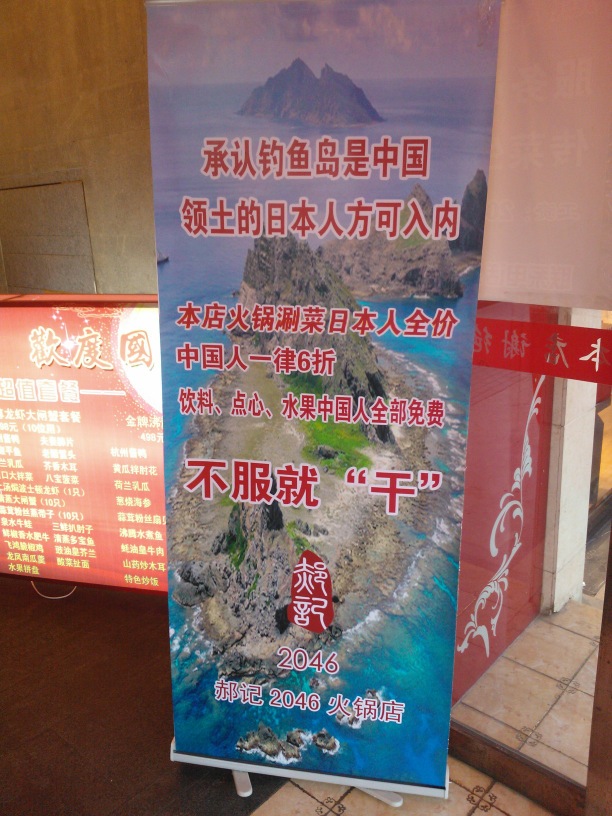
Sent in by an anonymous tipster, a restaurant on Jintai Street near Chaoyangmen offered this sweet deal on Saturday: Japanese customers who recognize the Diaoyu Islands are Chinese territory may enter Japanese customers must pay full price on hotpot, rinsed vegetables at this location Chinese people without exception receive 40% discount Drinks, desserts, and fruit for Chinese customers are complimentary If you refuse, fuck off [Ed's note: the character isn't literally "fuck," but that's the idea.] Hmm. I think I'll be getting my hotpot elsewhere. Wait… 40 percent, you say? What kind of desserts do you offer? Keep 'em coming: we're looking for Diaoyu-related ads around the city. Previously: Century 21. |
| This Week in Shanghai Sports Posted: 20 Sep 2012 09:08 PM PDT |
| Bookstore Buy: A Thriller from Travel Writer and Author Simon Lewis Posted: 20 Sep 2012 07:45 PM PDT Date: Sep 21st 2012 9:45a.m. Contributed by: laurafitch |
| ‘The Next Leader Of China Was Under Heavy Pressure From Communist Party Elders’: Malcolm Moore Posted: 20 Sep 2012 07:15 PM PDT  Tibor Baranski Jr. Good friend and China/Japan lawyer extraordinaire, Tibor Baranski Jr., posted on LinkedIn the most insightful report I've seen about current factional politics and Mr. Xi's unexplained absence: 'The Next Leader Of China Was Under Heavy Pressure From Communist Party Elders' by Malcolm Moore. Especially interesting: As China begins to count down the weeks to the 18th party congress, factions are again vying for power in process is still clad in Soviet-era secrecy. "At the Beidaihe meeting, no decisions were made but the old gang criticised Xi harshly, especially Qiao Shi and Song Ping,"…. Both Mr Qiao, 87, and Mr Song, 95, are strong supporters of Hu Jintao, the outgoing president. … "They called him [Mr. Xi] unreliable and even brought up the idea of significantly delaying the party congress," said the source. "The fight was so harsh that Jiang Zemin [the former president] had to mediate." With Hu Jintao preparing to step down from power, and hand over to Mr Xi, he faces the uncertainty of whether his successor will continue his legacy, or turn against him, a perennial fear for a Chinese politician. A new rift appears to have emerged between the two main factions in the Communist Party: the "red" princelings, the up-and-coming children of Communist Party heroes, and the technocrats. Mr Xi is a princeling, while Mr Hu is a technocrat, although Mr Xi has been successful at bridging the divide. "Song Ping and the other elders are suspicious of Mr Xi and the other princelings because they are not obedient. They saw these princelings grow up and know the difference between them and Mr Hu and Wen Jiabao [China's premier], who are more polite and less personally ambitious". The pressure on Mr Xi, who is the focus of the world's attention as he tries to grasp his chance to be president, may explain his mysterious absence. As well as a mild heart attack, certainly understandable under the circumstances. |
| Green & Safe: Small Portions of Tasty Organic Fare Posted: 20 Sep 2012 06:50 PM PDT Date: Sep 21st 2012 9:20a.m. Contributed by: dan |
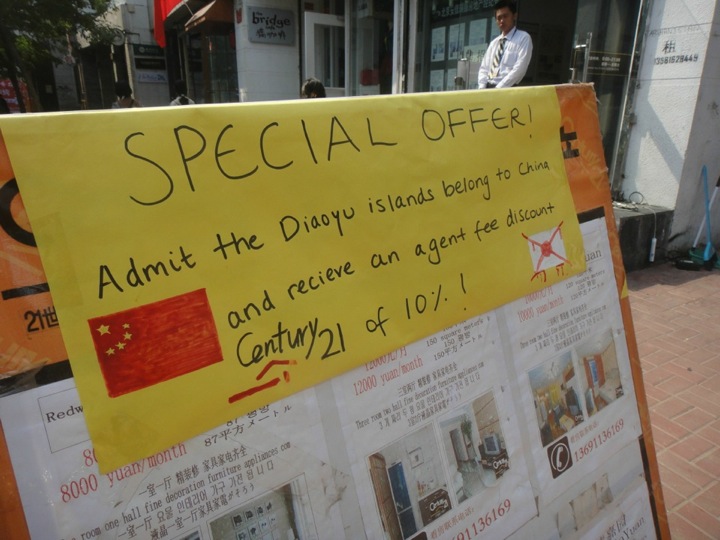
| Special Offer! Tell Us What We Want To Hear And Your Death Will Be Merciful Posted: 20 Sep 2012 06:00 PM PDT 
Our Wudaokou correspondent Jacob, who runs the site Beijing Wiki, spotted this advertisement in front of a Century 21 office yesterday. We'd like to bring your attention to two things: the blood dripping from the Japanese flag (someone has an overactive imagination), and the Japanese on the ads. But interestingly, the special offer is only written in English. Hmm. Just a bit of silly entertainment, surely — but it seems inevitable that there are more such ads out there. Let's collect them. If you see any businesses offering Diaoyu-related discounts, let us know and we'll post em here. |
| Weekendist: Sep 21-23 - Volleyball Wars, Hostages, Casino Royale! Posted: 20 Sep 2012 02:13 PM PDT  It's weekend! Time to put on your dancing shoes and head over to Rico Rico to pefect your Latino moves, or jeopardize your money at The Spot's casino night. On Saturday, you can marvel at the works of young creatives at DAFF, and hit new club Virgo for the after party or enjoy a long night of dance at Lune. Or watch the premiere show of the Irish drama Someone Who'll Watch Over Me. Whatever you do, let's just hope you save some energy for Sunday, as we have bloody and unforgiving beach volleyball matches on the schedule. Uh well, if you don't actually feel like moving your butt, you can also just go there, watch the balls bounce, drink beer, eat burgers and enjoy the music. Not bad either for a lazy Sunday. And if that's still not enough, head over to our calendar for more. It's weekend! Time to put on your dancing shoes and head over to Rico Rico to pefect your Latino moves, or jeopardize your money at The Spot's casino night. On Saturday, you can marvel at the works of young creatives at DAFF, and hit new club Virgo for the after party or enjoy a long night of dance at Lune. Or watch the premiere show of the Irish drama Someone Who'll Watch Over Me. Whatever you do, let's just hope you save some energy for Sunday, as we have bloody and unforgiving beach volleyball matches on the schedule. Uh well, if you don't actually feel like moving your butt, you can also just go there, watch the balls bounce, drink beer, eat burgers and enjoy the music. Not bad either for a lazy Sunday. And if that's still not enough, head over to our calendar for more. [ more › ]        |
| Corn Batman Posted: 18 Sep 2012 06:00 PM PDT 
Bruce Wayne surveyed the hospital room where Gordon lay in babbling incoherence. The police commissioner had been delusional since being pulled from the Gotham sewers two days ago. And while the fallen officer could offer no words to explain his predicament, the keen eyes of his guest nonetheless understood. For lying on the table beside him were the remnants of a dinner too much for any man to bear: an untouched slab of beefsteak, a spoonful of mashed potatoes. And then the corn. Two pieces of corn on the cob, gnawed clean to the bone. Learning Chinese? We are working with industry contacts in Hollywood to bring a greater and better vision of The Dark Knight to Chinese cinemas, one with more corn and less Dickens. Shooting a film is a pretty big endeavor, but while we get it off the ground we are pleased to bring a double-header podcast to help share our vision of the film, and drum up support for what we think will be a much more ambitious and literary take on the Batman mythos. This posting includes an audio/video/photo media file: Download Now |
| South Park On How Chinese People View The Japanese Posted: 20 Sep 2012 01:00 PM PDT This episode's old, but it's still relevant, isn't it? "Lu Kim, the owner of City Sushi invited City sushi owner, Junichi Takayama to a school meeting claiming it to be about the diversity of Asian people," reads the YouTube description. "Little does Takayama know is that the meeting would be a trap to embarrass him." (H/T Reddit user Amathev) |
| Newspaper editor defends publication of topless Xi Jinping pictures Posted: 20 Sep 2012 12:59 PM PDT By GOU ZAIDUI
Media Correspondent  The rugged pictures covered pages 1-42 of the normally staid People's Daily BEIJING (China Daily Show) – A top Chinese editor has defended his newspaper's controversial decision to publish topless photos of Xi Jinping, arguing, "I was ordered to." The crystal-clear images, showing a bare-breasted Xi in a number of poses – including sitting astride a black stallion, clutching an ivory hunting horn –were taken earlier this morning from an digital SLR camera five feet away, and leaked to the People's Daily. After a five-minute telephone conversation with Xi, the newspaper agreed to publish them immediately. "We considered the news value," said Ho Ximin, editor of the People's Daily gossip section, "and received the urgent directive to print them at once." The pap snaps, reproduced in startlingly pinprick-detail across all 42 pages of the party mouthpiece, depict 59-year-old Xi – who is expected to replace Hu Jintao as China's President in October – as "very much the high-resolution picture of strident, masculine health," complete with "gleaming pectorals, strong teeth and a glossy head of hair," the newspaper reported. The flattering pictures appear following a long, unexplained absence from public appearances by Xi in September, during which he was dogged by rumors of ill health. Explaining his tough decision to publish the images, Ho said, "It was in the guidance of public interest," adding, "I had absolutely no choice." Follow 18th Party Congress news updates with @chinadailyshow on Twitter |
| Watch: Angry Hong Kong protestors "liberate" subway station by shouting "Locusts!" at mainlanders Posted: 20 Sep 2012 10:41 AM PDT  While the Chinese have been busy protesting against the Japanese this week, Hong Kongers have been busy protesting the Chinese. Hong Kong blogger Bad Canto points us to a massive protest that took place over the weekend at Sheung Shui MTR station, just one station away from the immigration checkpoints at Lo Wu and Lok Ma Chau leading to Shenzhen. [ more › ]  |
| Off the Beaten Palate: Pig's brain, feet, lung, and intestine Posted: 20 Sep 2012 09:56 AM PDT  Over the past year I've brought many fellow Americans along on my eating adventures around Shanghai, some more willing than others. What I've observed is that it's not the Off the Beaten Palate foods like snake, scorpion, sea anemone etc., that put them off the most, but rather many foods I enjoy on a more normal basis such as pork dishes. They'll gobble down sections of cobra like sausage links while exclaiming "it tastes just like chicken," ravage a sea worm and note it's clam-like flavor, and yet various pig parts and even my favorite food, fatty pork belly, get exiled to the side of their plates. When I ask them how they could commit such culinary treason why, they reply "it's just...just....strange." After some thinking I finally realized what was turning them off about the pork. Unlike many of the more exotic foods, which my American friends can actually compare to flavors from their childhood, Chinese pork dishes are nothing like the pork they grew up with. [ more › ]  |
| “Automatic Sperm Extractor” Is Bizarre, Wonderful Posted: 20 Sep 2012 10:02 AM PDT Found in a Nanjing hospital, this device is very much used for what you might think. That is to say, it is not a fleshlight masquerading as a mushroom; it is an artificial vagina that serves the purpose of actual vaginas: to extract sperm from male genitalia. Hard stop. And the best part is that it comes with a screen that shows movies, and can be hooked up to surround sound. Wait, no, that's not the best part. What am I thinking? The best part is that its massage pipe – actual name — jerks you off, and is adjustable. As Key of China Hush relays, via Zhengzhou Evening News, "the 'massage pipe' in front can be adjusted according to the height of the user. Users can also adjust speed, frequency, amplitude and temperature etc. Machine is also equipped with headphones and two handles on both sides." On Sina Weibo, netizens are having a bit of fun. "Admire, such high technology," says @大力水手paopai. "This… this… this is too scientific… this weekend I'm going to Nanjing to contribute," says @大爷一辈子都是德国和拜仁的死忠. "The number of lonely women will increase again," notes @7点13. "My Nanjing, I kneel before you," says @枕边愛美麗. And, "Divine tool," says everyone. Of course, there are questions. "Will it get stuck?" asks @小知了虫. "Could it be that it doesn't extract sperm, but urine!" asks @一枕清霜1, abstrusely. (Why would it extract urine?) "Could it be that the hands are free?" wonders an incredulous @D者G建灿, raising the question — what, are hands not good enough anymore? And @文艺好青年V muses, "Does Hangzhou have one?" But don't get too far ahead of yourself thinking that sperm donators have it so good. These devices are apparently only used on the infertile. "When male infertility patients come for treatment, we must first fully inspect the sperm, which requires sperm extraction," says Zhu Guoxin, director of the urology department at Zhengzhou Zhongxin Hospital. Extraction. No word on when this machine will become commercially available. 
|
| Woman attempts suicide jump from fifth floor, gets stuck between fourth and third floors Posted: 20 Sep 2012 08:55 AM PDT by Barry van Wyk on September 20, 2012  Sometimes suicide attempts become somewhat comical. The front page of the Modern Express (现代快报) from Jiangsu province today features a graphically illustrated story of an attempted suicide jump from an apartment complex that got stuck in mid-air, literally. At around half-past ten on Tuesday evening, Mr Wei (韦先生) was getting ready for bed on his sixth floor apartment at Hainan Community (海南小区) in Lianyungang (连云港) in Jiangsu province, when he heard someone yelling outside his window. He ran to his balcony and saw a lot of people on the ground level all looking up in his direction. He followed their gaze and saw a shadowy figure standing swaying on the outside protective railing of an apartment on the fourth floor. He immediately knew that it was someone who wanted to jump, so he did what any man would do: he grabbed a torch and a video camera and ran downstairs. At this point an elderly couple living in the third floor apartment also noticed some commotion outside their window, and when the old man, a Mr Sun (孙), looked out of his window, he saw the woman on the fourth floor, where a man inside the apartment was holding both her hands. Yet as Mr Sun looked on, the woman suddenly fell down from the fourth floor, but the man holding her hands held on, so she was now dangling in between the fourth and third floors. Mr Sun saw the man straining to hold on as the woman's life hung in the balance. He didn't think much at this moment, he said afterwards, he just immediately gripped the woman's legs as hard as he could to try and help the load. He couldn't keep this up for long though, so he balanced the women's feet on his shoulders and head. Feeling himself growing tired, he shouted down to the people watching below, asking for some young people to come up and help him. Three young men answered the call, and rushed up to Mr Sun's apartment. Meanwhile the man on the fourth floor had also gotten some help, and between the people on the third and fourth floors, the woman was held in place, though not out of danger. She was only finally rescued when the firefighting service pitched up, and she was lofted to safety through Mr Sun's third floor window. The woman had hung suspended for close to half an hour between the third and fourth floors, a suicide attempt that literally got nowhere. Links and sources
Modern Express / Xiandai Kuaibao (轻生女悬在半空, 上有人拽,下有人托)
More Front Page of the Day stories on Danwei  |
| Yellow River threatened by desertification in Tibet's wetlands Posted: 20 Sep 2012 03:54 AM PDT The Tibetan plateau's Zoige wetlands, a crucial water source for the Yangtze and Yellow Rivers, continue to deteriorate despite conservation efforts.
The "kidneys" of the Tibetan plateau are failing.
The Zoige Wetland National Nature Reserve, which sits on the northeastern fringe of western China's Qinghai-Tibet plateau, contains the largest alpine peat wetlands in the world. It is also the catchment area for the Yangtze and Yellow Rivers; known as the "kidneys of the plateau", these wetlands provide at least 30% of the water flowing into the upper reaches of the Yellow River.
But they are gradually disappearing. Desertification here is increasing at a rate of more than 10% per year. "Of the county's 17 villages and towns, 10 are suffering from desertification, and more than 70,000 hectares are affected," said the deputy head of Zoige County Forestry Bureau, Zuo Lin. "The situation is quite critical."
Water increasingly scarce
Herdsmen on Zoige county's grasslands are finding it more and more difficult to find water these days, explained Sonam Dorje, a staff member at Zoige Wetland National Nature Reserve. "You used to be able to dig down two or three metres and find water; then later you had to dig seven or eight metres. Now in some places you have to go below 10 metres." He described how, after many years of studying the area, he has watched the underground water level sharply decline and plants die off, exposing thick layers of sand.
The situation in Maixi township, Xiaman township and Tangke township is especially serious, said Sonam Dorje. In the hardest hit places, the desertified area doubles in size every year. "Sometimes you have pasture still there in the summer but by winter it has already turned to sand," he said. "Herders are abandoning more and more areas because they are unsuitable for grazing."
Zoige has conducted four desertification surveys since 1995. The first found that only 16,000 hectares were desertified. The latest research, carried out in 2009, showed that in the whole of Zoige county, 72,000 hectares were desertified, or 6.76% of the county's total area. Today, the area of grassland in this county which is threatened by desertification has reached 135,000 hectares, with close to 30,000 people affected, that's about 39% of the whole county's population.
Deputy head of Zoige Wetland National Nature Reserve Li Hua said that Zoige's genuine wetlands are shrinking – that more and more land is turning to grassland. Currently, just under a third of the wetlands are in their original state; the other two thirds are degraded.
There were originally more than 300 lakes of all sizes in Zoige. Today, more than 200 of them have dried up. Those left are far smaller than they used to be, or have turned into seasonal lakes. Maixi township's Xingcuo Lake was originally 469 hectares in size; it is now less than 10.
Grazing pressure on the grassland
As one of the country's "big five" grasslands, Zoige faces a livestock overload. There were 330,000 heads of livestock in Zoige county in 1953, according to local government statistics. By 2011, that number had climbed to 1.2 million.
In the past, the pressure prompted efforts to actively expand the grassland. By digging drainage ditches to turn wetland into grassland, went the logic, locals would have space for more cattle and sheep, ensuring long-term prosperity. In 1964, the year of the "Learn from Dazhai" campaign – Mao Zedong's call to the people of China to follow the success story of a farming community in Shanxi province – more than 380 kilometres of ditches were dug across one million mu (667 square kilometres) of wetlands in order to drain water into the Yellow River. This has been one of the key drivers of Zoige's desertification plight.
Zuo Lin explained how peat wetlands form: during winter-time, many herbaceous plants die and rot. The decaying vegetation piles up over a long period of time and, via a complex process, eventually forms peat. It grows thicker and thicker and is like a sponge, which means it can store water. When a wetland degrades, Zuo continued, the first sign is that water levels begin to drop. The wetlands gradually shrink and turn to grassland, losing their ability to store water. Lacking a water source, the grasslands soon turn into desert.
To the east of Zoige is the Yangtze River and to its west is the Yellow River. The western peat wetlands have a water-storage capacity of 5.6 billion cubic metres; add to that the water storage of the lake and grassy marshland and the total water-storage capacity of Zoige's wetlands is close to 10-billion cubic metres. It is the world's largest alpine "solid reservoir" and it is known as the Yellow River's water resource. Zoige plays an irreplaceable role in regulating the climate, protecting soil and water and maintaining biodiversity. The protection of the wetlands is connected with the security of the Yellow River system and the region's ecological stability.
The piecemeal protection of Zoige's wetlands began back in the 1960s. Sichuan province, in which Zoige lies, has made efforts to conserve parts of the wetlands through the Wetland Protection Project and the Northwestern Sichuan Desertification Project. By measures including filling in drainage ditches and raising the water levels in lakes, they have restored part of the wetlands.
But overgrazing has challenged these efforts. Sonam Dorje explained that the grasslands are currently divided up between households. That means that, if you want to protect the land, you need to seek the approval of the herders who have usage rights over it. "However, as you start filling in ditches and canals, the wetlands begin to recover, and the grazing area for the herders' cattle will decrease," he said. "So it's very difficult to implement this ditch-filling policy on a large scale. On the whole, we can only fill in a couple of kilometres worth every year."
Efforts to control the spread of sand are also affected by overgrazing. When herders see grass beginning to grow on a sparse pasture after sand barriers and sand controls have been put in place, they quickly move their sheep and cattle to that area of land. If wire netting is put up to protect it, they just cut the wire, and the animals get in and graze as before.
Sonam Dorje said: "Desertified areas need about three years to recover after being treated according to our experience. But since we are dealing with a vast, but sparsely populated area, they are especially difficult to protect. People often damage the fences, undermining the effectiveness of the protection work."
The struggle for permanent protection
In Zuo Lin's opinion, years of conservation work have been unable to prevent the problem of the wetlands being "partially protected but overall deteriorating".
"Between 2004 and 2007, less than 2,000 hectares of all levels of desertified land were fully restored across the whole of Zoige county, which only accounts for 4.58% of all newly desertified land during this period," he said. Insufficient investment in late-stage protection means some of the restored land ends up facing degradation for the second time, he added.
Gu Haijun, deputy chief of Sichuan Forestry Department's wetland-protection centre has repeatedly said that wetland conservation still lacks long-term, sustainable project support. The other major problem, Gu told China National Radio, is a lack of funds. They need more than one billion yuan (US$158 million) to fill in just 800 kilometres of ditches, he said. But the whole county's annual fiscal revenue is only 20 million yuan (US$3.2 million). Even just to maintain basic government operations, Zoige looks strapped for cash.
In July, the State Forestry Administration's Wetland Conservation and Management Centre sent a research group to Zoige's wetlands. The group concluded that the key to a sustainable future on Zoige's wetlands is to implement the "West Sichuan and Tibet ecological conservation and construction plan" as soon as possible, adopt comprehensive measures and carry out wetland conservation and desertification control on many different levels and fronts.
Deng Hai, is a journalist at "New Century Weekly", where this article was first published.
Homepage image by funfunny 可颂
|
| Yellow River threatened by desertification in Tibet's wetlands Posted: 20 Sep 2012 02:44 AM PDT The Tibetan plateau's Zoige wetlands, a crucial water source for the Yangtze and Yellow rivers, continue to deteriorate despite conservation efforts.
The "kidneys" of the Tibetan plateau are failing.
The Zoige Wetland National Nature Reserve, which sits on the northeastern fringe of western China's Qinghai-Tibet plateau, contains the largest alpine peat wetlands in the world. It is also the catchment area for the Yangtze and Yellow Rivers; known as the "kidneys of the plateau", these wetlands provide at least 30% of the water flowing into the upper reaches of the Yellow River.
But they are gradually disappearing. Desertification here is increasing at a rate of more than 10% per year. "Of the county's 17 villages and towns, 10 are suffering from desertification, and more than 70,000 hectares are affected," said the deputy head of Zoige County Forestry Bureau, Zuo Lin. "The situation is quite critical."
Water increasingly scarce
Herdsmen on Zoige county's grasslands are finding it more and more difficult to find water these days, explained Sonam Dorje, a staff member at Zoige Wetland National Nature Reserve. "You used to be able to dig down two or three metres and find water; then later you had to dig seven or eight metres. Now in some places you have to go below 10 metres." He described how, after many years of studying the area, he has watched the underground water level sharply decline and plants die off, exposing thick layers of sand.
The situation in Maixi township, Xiaman township and Tangke township is especially serious, said Sonam Dorje. In the hardest hit places, the desertified area doubles in size every year. "Sometimes you have pasture still there in the summer but by winter it has already turned to sand," he said. "Herders are abandoning more and more areas because they are unsuitable for grazing."
Zoige has conducted four desertification surveys since 1995. The first found that only 16,000 hectares were desertified. The latest research, carried out in 2009, showed that in the whole of Zoige county, 72,000 hectares were desertified, or 6.76% of the county's total area. Today, the area of grassland in this county which is threatened by desertification has reached 135,000 hectares, with close to 30,000 people affected, that's about 39% of the whole county's population.
Deputy head of Zoige Wetland National Nature Reserve Li Hua said that Zoige's genuine wetlands are shrinking – that more and more land is turning to grassland. Currently, just under a third of the wetlands are in their original state; the other two thirds are degraded.
There were originally more than 300 lakes of all sizes in Zoige. Today, more than 200 of them have dried up. Those left are far smaller than they used to be, or have turned into seasonal lakes. Maixi township's Xingcuo Lake was originally 469 hectares in size; it is now less than 10.
Grazing pressure on the grassland
As one of the country's "big five" grasslands, Zoige faces a livestock overload. There were 330,000 heads of livestock in Zoige county in 1953, according to local government statistics. By 2011, that number had climbed to 1.2 million.
In the past, the pressure prompted efforts to actively expand the grassland. By digging drainage ditches to turn wetland into grassland, went the logic, locals would have space for more cattle and sheep, ensuring long-term prosperity. In 1964, the year of the "Learn from Dazhai" campaign – Mao Zedong's call to the people of China to follow the success story of a farming community in Shanxi province – more than 380 kilometres of ditches were dug across one million mu (667 square kilometres) of wetlands in order to drain water into the Yellow River. This has been one of the key drivers of Zoige's desertification plight.
Zuo Lin explained how peat wetlands form: during winter-time, many herbaceous plants die and rot. The decaying vegetation piles up over a long period of time and, via a complex process, eventually forms peat. It grows thicker and thicker and is like a sponge, which means it can store water. When a wetland degrades, Zuo continued, the first sign is that water levels begin to drop. The wetlands gradually shrink and turn to grassland, losing their ability to store water. Lacking a water source, the grasslands soon turn into desert.
To the east of Zoige is the Yangtze River and to its west is the Yellow River. The western peat wetlands have a water-storage capacity of 5.6 billion cubic metres; add to that the water storage of the lake and grassy marshland and the total water-storage capacity of Zoige's wetlands is close to 10-billion cubic metres. It is the world's largest alpine "solid reservoir" and it is known as the Yellow River's water resource. Zoige plays an irreplaceable role in regulating the climate, protecting soil and water and maintaining biodiversity. The protection of the wetlands is connected with the security of the Yellow River system and the region's ecological stability.
The piecemeal protection of Zoige's wetlands began back in the 1960s. Sichuan province, in which Zoige lies, has made efforts to conserve parts of the wetlands through the Wetland Protection Project and the Northwestern Sichuan Desertification Project. By measures including filling in drainage ditches and raising the water levels in lakes, they have restored part of the wetlands.
But overgrazing has challenged these efforts. Sonam Dorje explained that the grasslands are currently divided up between households. That means that, if you want to protect the land, you need to seek the approval of the herders who have usage rights over it. "However, as you start filling in ditches and canals, the wetlands begin to recover, and the grazing area for the herders' cattle will decrease," he said. "So it's very difficult to implement this ditch-filling policy on a large scale. On the whole, we can only fill in a couple of kilometres worth every year."
Efforts to control the spread of sand are also affected by overgrazing. When herders see grass beginning to grow on a sparse pasture after sand barriers and sand controls have been put in place, they quickly move their sheep and cattle to that area of land. If wire netting is put up to protect it, they just cut the wire, and the animals get in and graze as before.
Sonam Dorje said: "Desertified areas need about three years to recover after being treated according to our experience. But since we are dealing with a vast, but sparsely populated area, they are especially difficult to protect. People often damage the fences, undermining the effectiveness of the protection work."
The struggle for permanent protection
In Zuo Lin's opinion, years of conservation work have been unable to prevent the problem of the wetlands being "partially protected but overall deteriorating".
"Between 2004 and 2007, less than 2,000 hectares of all levels of desertified land were fully restored across the whole of Zoige county, which only accounts for 4.58% of all newly desertified land during this period," he said. Insufficient investment in late-stage protection means some of the restored land ends up facing degradation for the second time, he added.
Gu Haijun, deputy chief of Sichuan Forestry Department's wetland-protection centre has repeatedly said that wetland conservation still lacks long-term, sustainable project support. The other major problem, Gu told China National Radio, is a lack of funds. They need more than one billion yuan (US$158 million) to fill in just 800 kilometres of ditches, he said. But the whole county's annual fiscal revenue is only 20 million yuan (US$3.2 million). Even just to maintain basic government operations, Zoige looks strapped for cash.
In July, the State Forestry Administration's Wetland Conservation and Management Centre sent a research group to Zoige's wetlands. The group concluded that the key to a sustainable future on Zoige's wetlands is to implement the "West Sichuan and Tibet ecological conservation and construction plan" – part of a wider government-led programme to increase investment in environmental protection of the plateau by 2030 – as soon as possible, adopt comprehensive measures and carry out wetland conservation and desertification control on many different levels and fronts.
Deng Hai, is a journalist at "New Century Weekly", where this article was first published.
Homepage image by funfunny 可颂
|
| Japan’s no-nuclear policy could prove “hollow promise” Posted: 19 Sep 2012 05:21 AM PDT The decision to scrap all Japanese nuclear plants over the next 30 years is a short-term political move that leaves plenty of room for u-turns.
After months of turmoil, on September 14 the Democratic Party of Japan (DPJ) announced a new energy policy. As Japan's Asahi newspaper correctly argues, the policy is chock full of contradictions and escape clauses. Even so, the policy will almost certainly – perhaps in the course of this month – be adopted as is by the cabinet and frame the new "energy basic plan" put out by the Ministry of Economy, Trade and Industry (METI).
The energy policy's main components, so far as much of the domestic and international debate are concerned, are a commitment to withdraw from nuclear energy by the 2030s and emphasise renewable energy. An example of international reaction is the September 14 declaration by the Financial Times that Japan's "decision to phase out nuclear power has sent shockwaves through the energy industry, and could affect everything from global gas prices to the business of making and selling solar panels."
Certainly the policy is different from the June 2010 plan that committed Japan to getting over half its power from nuclear plants by 2030 and included a reluctant nod to renewables (20% of power by 2030). That policy announcement was followed by Fukushima, of course, and Japanese energy politics and policymaking continue to be profoundly shaken by it.
In particular, energy policy is no longer the technocratic exercise it was before Fukushima, when it was dominated by METI and the "nuclear village" of pro-nuclear monopoly utilities, big business, reactor-dependent communities and legions of politicians, bureaucrats and academics. Among the actors actually and effectively at the table now are other bureaucracies, non-nuclear local governments organised into increasingly coherent regional blocs, social-media mobilised civil society, renewable-investing big capital, SMEs, farm coops and households.
Imagine the DPJ's challenge of representing all these interests. The party was never a compact vehicle to begin with, only achieving a certain brief coherence in the 2009 election campaign's imperative of clearly differentiating itself from the long-governing Liberal Democratic Party (LDP). Now it faces an election campaign in the coming months while it attracts an abysmal 10% support in recent polls. Prime minister Noda Yoshihiko knows he needs to appeal to the powerful anti-nuclear, green-growth streams within his own party as well as in the public at large.
Asahi also notes, quite correctly, that other factors may wield significant influence before the election. The September 19 inauguration of the new Nuclear Regulatory Commission (NRC) may lead to further approvals for restarts. Among other problematic outcomes, more restarts could weaken incentives for energy conservation, deployment of renewable energy and progress towards a distributed energy economy.
On the other hand, post-Fukushima Japan is increasingly incentivised to move in the renewable direction by its feed-in tariff (FIT). The FIT was installed in late August 2011 by outgoing prime minister Kan Naoto. In the first month after it came into effect on July 1, the policy attracted 33,695 renewable projects worth about US$2 billion (12.6 billion yuan), well beyond what was anticipated. Led by local banks and credit unions, Japanese finance capital is opening its faucets in this direction.
Electricity is at the core of Japan's "local production, local consumption" boom, and the FIT is the key policy accelerating it. So we need a sense of perspective: the new energy policy is interesting as a snapshot of Japan's fluid energy politics, but the FIT serves as an important institutional conduit channelling that flow.
Flimsy no-nuke promise
The government's pledge to pull the plug on nuclear power by the 2030s could prove to be a hollow promise, with few details yet given on how to achieve it, how quickly to proceed and how to reconcile contradictions along the way.
Observers see the policy as a product of compromise, and something prime minister Noda hopes will both get him re-elected in a party leadership race this month and win support from ordinary voters in the upcoming Lower House election. Noda himself is unwilling to dump nuclear power. It is instead what the public and many in his party have increasingly been demanding.
Noda himself leaned toward shrinking nuclear power by 2030 but not abolishing it. He would have preferred to keep it at 15% of the nation's total energy makeup, according to aides. But Noda could not ignore demands from the public, which overwhelmingly called for a full phase-out by 2030. The government held open forums nationwide and solicited comments on the ideal future contribution of nuclear power. It offered two alternatives to zero-nuclear: 15% and 20-25%, both of which the public rejected.
"Noda needs to win the party's presidential race first," said a lawmaker close to him. "Some DPJ members working on his re-election team back zero nuclear energy. If they turned their backs on him, it would have cast a pall on the management of a new administration even if he was re-elected." But the decision for abolition by 2039, albeit a decade later than 2030, provoked criticism, too.
The United States expressed concern over how Japan would manage plutonium generated in recycling spent fuel. And Yonekura Hiromasa, chairman of Japanese business federation Keidanren, the nation's most powerful lobby, called Noda on September 13 to voice his opposition to zero nuclear power. Under pressure from both an international ally and business leaders, the administration included a clause at the last minute which allows leeway toward scrapping the policy entirely.
"Energy sources available to the nation have been significantly affected by factors such as fuel supply and development of technology in the global market," the clause read. "It is extremely hard to predict how things may develop in the future and we should make sure that we are able to take a flexible approach."
Furukawa Motohisa, national policy minister, insisted on retaining a clause that makes it a legal requirement for central and local governments to achieve the new energy policy. But in a session on the morning of September 14, the clause was taken out. With no legal basis behind the policy, the energy industry and local governments are not bound by it.
METI is expected to flesh out the policy's details as it compiles the Basic Energy Plan this month. But that plan comes up for review every three years. There is no guarantee that an administration in power in 2015 will stick to it. "If a new administration is formed, the new energy policy could fall through," said a senior official with the industry ministry, referring to the possible outcome of dissolving the Lower House for a snap election.
What appears in conflict with public sentiment and the overall target for the 2030s is the administration's pledge to restart reactors as "important sources of electricity" if they are confirmed to be safe.
Since the 2011 nuclear disaster, officials have authorised two of Japan's 50 reactors to resume activity. The restart came amid widespread public opposition. The Noda administration plans to approve further reactor restarts if the new NRC declares they are safe. The commission is due to be formed on September 19. That, however, could pave the way for Japan to slip back to the situation before the Fukushima disaster, in which it relied on nuclear energy for close to 30% of all electricity output. Once reactors are restarted, plant operators could step up their opposition to abolishing nuclear energy. It could also slow a nationwide drive to reduce energy use and sap momentum towards a nuclear-free future.
Plutonium plans unchanged
Recycling spent fuel is another question entirely. Despite pledging to end nuclear power, the administration offered no change to the problem-laden plan to reprocess spent nuclear fuel to obtain plutonium. Plutonium can be used to generate electricity, but it can also be used to produce nuclear weapons. Critics accuse the Noda administration of planning to stockpile plutonium, even as Japan turns its back on nuclear power. "It makes no sense that rectors will use recycled fuel when they will be decommissioned just a few decades later," said Katsuta Tadahiro, an associate professor of nuclear power policy at Meiji University.
The government has envisaged bringing a fast breeder reactor on-line around 2050 to get the nuclear-fuel recycling project to take off. Meanwhile, the plutonium stockpile could raise questions about Japan's motives for the nuclear-fuel recycling programme. "The international community will cast a suspicious eye on Japan if it retains large plutonium reserves that it cannot use at nuclear power plants," said Yoshioka Hitoshi, a professor of history of science and vice president of Kyushu University.
Andrew DeWit is professor in the School of Policy Studies at Rikkyo University and an Asia-Pacific Journal coordinator.
This article was first published as Andrew DeWit, "Japan's Energy Policy at a Crossroads: A Renewable Energy Future?" The Asia-Pacific Journal, Vol 10, Issue 38 No. 4, September 17, 2012. |
| US coal exports make mockery of green policies Posted: 18 Sep 2012 02:11 AM PDT California fights moves to ramp up coal exports to Asia through new terminals planned for west-coast states.
While emerging economies of the world are hungry for inexpensive sources of energy, coal use is stable – if not slowly diminishing – in the United States, while US emission standards for fossil fuels are growing more stringent. Unfazed by new regulations, the coal industry now sees a golden future in expanding American coal mining, and exporting the coal to fast growing Asian markets.
Coal export terminals are slated for construction in the states of Washington and Oregon, on the west coast of the United States. If built, they will make America the world's third largest coal exporter. As those terminals begin operating, the coal exported will effectively cancel out the progressive benefits of new energy policies especially in adjacent states.
In an unusual expression of concern over the planned terminals, nearby California has adopted a resolution – AJR 35 – which says: "This measure urges the President of the United States and the 112th Congress to enact legislation to restrict the waterborne export transshipment of coal for electricity generation to any nation that fails to adopt rules and regulations on the emissions of greenhouse gases and airborne hazardous air pollutants that are at least as restrictive as those adopted by the United States."
California's concern is not without cause. With the exception of the young renewable-energy industry, coal is the world's fastest growing energy source. Worldwide, coal use has grown an average of 4.4% per year since 1990. In recent years, the growth rate of coal consumption has vastly increased. In 2003, the World Coal Institute projected world consumption would reach 7 billion tons by 2030. Just eight years later, in 2011, the figure was almost 7.5 billion tons.
The fastest growing markets are in Asia. In the last three years alone, South Korea's coal imports have grown by 30% and China's by a massive 313%. In less than 10 years, China has gone from being a net exporter of coal to the world's largest coal importer and consumer. With estimated imports of 190-million tons per year and its own production of 3.47 billion tons, in 2011 China accounted for 48% of the world's coal consumption. Political support for coal
Six years ago, in lieu of a comprehensive national energy policy, the State of California created its own policy, crafted in the state legislature with bipartisan support and signed into law by then governor Arnold Schwarzenegger. With the signing of the California Global Warming Solution Act of 2006, California embarked on an ambitious plan to increase the state's energy efficiency and reduce its greenhouse-gas emissions. The goal it set was to reduce greenhouse-gas emissions to 1990 levels by 2020, regardless of population growth and increased demand for energy. As a state ranked as seventh most powerful economy in the world, both the California's public and private sectors had long been aware of air pollution and the environmental threat presented by the release of greenhouse gases, particularly carbon dioxide, from its power plants, factories, cars and homes.
One component of California's plan targeted coal-fired power plants as a major cause of airborne pollutants. While California has almost no coal-fired power plants within state borders, it does buy electricity generated by coal from other states. So, California's Public Utilities Commission created a standard for coal-fired plants of a maximum of 1,100 pounds of carbon-dioxide emissions per megawatt hour. After the termination of existing contracts, electricity from power plants exceeding the standard was banned. The work of California in cooperation with the state's electric utilities set a valuable standard for the entire United States, and blazed a trail for other states to follow. But without national guidelines governing energy exports, circumventing energy policies such as California's is easy. America's major coal-producing states have small populations and the coal industry makes generous political contributions. Gaining support for coal exports is a simple matter. The coalfields of major coal-producing states such as Wyoming and Montana are on public lands already leased to the coal industry. The lease fees equal approximately one dollar per ton for extracted coal. A sufficient rail system for transport of coal to the export terminals already exists. All that is needed is to build the export terminals themselves, and then coal can be exported to countries where California, or any other US state, has no control over emission standards.
Applications for permits-to-operate four new coal export terminals are on file with the US Army Corps of Engineers. Two additional terminals are under consideration. The four terminals by themselves will export more than 150% of the coal that the entire United States exports today.
To reach the proposed capacity of the new terminals, the coal industry is prepared to increase production in the United States by at least 100 million tons a year. Actively working to increase American coal production and stimulate worldwide coal use are companies like Peabody Energy, the major player in the largest of the planned coal terminals – the Gateway Pacific Terminal – in Bellingham, Washington. Peabody is the largest private coal company in the world, with holdings in the United States, Australia and Asia. Not only does Peabody plan to export US coal to China, it is also a major player in the development of new coalfields in western China's Xinjiang autonomous region. Cancelling out emissions savings
While both the United States and China, as the world's two largest coal users, have begun to institute significant energy-efficiency standards and stringent greenhouse-gas regulations, the unspoken reality is that burning more coal in power plants and steel mills will continue to release more carbon dioxide. Simple mathematics suggests that ever increasing coal use will overwhelm even the best and most rigorous regulation. With California as an example, and taking an average of the carbon emissions projected in a staff paper produced by the California Energy Commission, the coal shipped from the proposed new terminals will add 250 millions tons of greenhouse gases a year to the earth's atmosphere. The number is five times greater than the quantity of greenhouse gases California has fought to reduce from out-of-state coal-fired power plants.
As coal is mined and burned at an accelerating pace, the conflict between demand for cheap, reliable energy and the environment grows more acute. Carbon dioxide has no respect for international borders, and when the coal shipped by the planned west-coast terminals is burned, that coal will number among the world's top 25 emitters of carbon dioxide.
Charles West is an American journalist and TV producer with a strong interest in the politics of energy. He lives in Washington state.
Homepage image by coalswam |
| China-built projects in US stir up environmental concerns Posted: 17 Sep 2012 07:13 AM PDT California's new Bay Bridge is one of several major infrastructure projects across the US in which Chinese contractors play a key role. What are the environmental consequences?
With an expected price tag over US$6 billion, California's new Bay Bridge will be one of the most expensive structures ever built when it opens next year—and a crucial component of it was built just outside Shanghai.
The Bay Bridge is only one of several major infrastructure projects across the United States in which Chinese contractors have recently played a significant role. These firms have completed a wide range of projects in multiple states, including a coliseum in South Carolina, a hotel-casino complex in Atlantic City, and bridge and subway projects in New York. They reportedly won over US$1 billion worth of US contracts in 2010 alone. With concerns focused on labour and safety issues, the environmental consequences of Chinese contractors' growing reach have received little attention. Conversations with industry and environmental experts, however, suggest they deserve a closer look.
Construction of the original Bay Bridge began in 1933 in tandem with its more famous cousin, the Golden Gate. Both quickly became vital transportation arteries linking San Francisco to the rest of California. The current project, designed to ensure the bridge's survival during a catastrophic earthquake, involves retrofitting the bridge's western span and constructing an entirely new eastern span over two miles long. Controversially, the contract to fabricate key components for this eastern span—the bridge's most vulnerable and iconic section—was awarded to a Chinese state-owned enterprise (SOE), Shanghai Zhenhua Heavy Industries.
Earlier this year, those components were brought over on barges and put in place: the bridge's massive cable, containing 137 strands of steel, the deck, and critical parts of the span's single, striking tower. (Unlike a typical suspension bridge, where cables are strung between two towers, the eastern span will be asymmetrical and "self-anchored".) With a contract value over US$350 million, the more than 45,000 tonnes of steel provided by Shanghai Zhenhua and fabricated at their plant in Shanghai represent a significant investment by the California Department of Transportation (Caltrans) in Chinese steel, which is cheaper and dirtier than its American counterpart. "I am not aware of any environmental component to the pre-award audit," said Bart Ney, a spokesman for Caltrans, of the contract. Ney did not respond to other questions about the environment impacts of the largest public works project in California's history. Carbon-intensive steel from China
China is now the world's largest producer of steel, responsible for 45% of global output (eight times that of the United States) and increasingly oriented towards export. Structural steel from China typically has three times the carbon footprint of steel produced in the United States, according to Joe Cross of the American Institute of Steel Construction, an industry association that promotes structural steel in the United States. US producers employ a method called Electric Arc Furnace (EAF) that uses up to 95% recycled steel. By contrast, around 90% of steel production in China, according to the World Steel Association, involves the Basic Oxygen Furnace (BOF) method, reliant on coke, iron ore (usually imported) and a much smaller quantity of recycled steel (25% to 30%). Indeed, some research indicates that the carbon footprint from BOF steel in China may be significantly greater than Cross indicated. Chinese efforts to convert to EAF are still in their infancy.
As for carbon emissions and environmental factors associated with Bay Bridge construction, "you would definitely see a recognisable difference" between using American and Chinese steel, said Michael Lepech, a Stanford professor who specialises in life-cycle assessments (LCA) of construction materials and undertakes projects in China.
Transporting materials from the United States to China plays a relatively small role in the project's environmental impact, as most materials are shipped by relatively low-impact barges, said Lepech. But carbon emissions from a booming shipping industry, increasingly centred on China, can start adding up: Brian Lombardozzi of the Blue Green Alliance, an umbrella organisation of labour unions and environmental groups, pointed out the estimate that they will increase between 150% and 250% by 2050, based on a finding by the International Maritime Organisation.
"The much bigger deal [about China-built infrastructure]," argued Lepech, "are the emissions and environmental impacts associated with Chinese power production and Chinese industrial processes. The downside of that is that we have relatively little good data on exactly what those emissions are. Obviously, they don't have to comply with the [US] Clean Air Act, the Clean Water Act, all these other things."
Issues of "public health equity" quickly arise when steel is produced in China for American infrastructure. "We're putting developing populations at more risk for asthma, for ingestion of heavy metals, for all of the things that come out of the stack of a steel plant," Lepech said. Lombardozzi cited a report by the Alliance for American Manufacturing showing that Chinese steelmakers emit around 3.53 kilograms of sulphur dioxide for every ton of steel to US steelmakers' 0.7 kilograms. Chinese companies also emit much more particulate matter. "The regulations that have been put in place have made the [American] industry figure out cleaner and more efficient ways of doing things," Lombardozzi said.
In the production of concrete, water and aggregate are usually sourced and mixed in locally, but the input cement may come from China (the single biggest source of US cement imports). "The production of cement is quite damaging to the local environment from the standpoint of dust emissions… and the alkalinity of water coming off of the site," said Lepech, adding that it is also a major global pollutant in terms of carbon dioxide. In connection with an even more massive project—California's planned high-speed rail system—one expert recently stated that low-CO2 concrete "could reduce the infrastructure's environmental footprint by 15%." But will California make the investment or simply source the cheapest material on the global market? Growing global clout of China's builders
In a relatively recent, momentous development, five of the world's 10 biggest contractors are now Chinese SOEs, according to the International Construction rankings compiled by the KHL Group, with large Chinese construction firms accounting for US$344 billion in revenue in 2011. Their ability to underbid the competition, often based on low-cost labour and supply chains in China, has enabled them to win an extraordinary range of projects including dams in Africa, a highway in Poland, rail projects in South America and, most recently, a football stadium in Italy.
The environmental impacts of these projects vary wildly. Chinese contractors are just beginning to push beyond their primary markets in Asia and Africa (a combined 80% of their overseas business, according to the China International Contractors Association) and into North America and Europe. It no longer comes as a surprise to see Chinese politicians lobbying for their SOEs to get a big piece of the (troubled) high-speed rail projects in the UK or California—and cash-strapped western politicians are sorely tempted. Even if they follow the letter of the law where they work, the major Chinese contractors do not have a reputation for leading on environmental issues. In contrast, said Lepech, "a US-based firm like Bechtel is coming in and adhering to pretty much United States law everywhere they work".
China Construction America (CCA), a subsidiary of China State Construction Engineering Corporation, the largest of these contractors, is based just outside New York City and was recently named one of the region's fastest growing construction companies by The New York Times. The company has worked on over 100 public works projects and private developments across the US worth hundreds of millions of dollars, including seven public schools, apartment blocks in Washington DC, and major transportation infrastructure in and around New York City. Despite repeated requests, CCA refused to comment for this story, leaving unanswered questions about the sourcing of their construction materials and the environmental impact of their projects.
Western contractors are not always models, of course, and there has generally been far too little attention given to the infrastructure-environment nexus and to life-cycle assessment for large-scale projects. China's own Environmental Impact Assessment law only came into effect in 2003, and LCA is essentially a new idea in China, even for manufactured goods, given the lack of a national emission database and a shortage of expertise. The global expansion of low-bidding Chinese construction companies—increasingly in every country, on every continent, often in connection with public works projects—is occurring at a significant environmental cost. Greenhouse gases, energy, water, land use, particulates, ecotoxicity, human health impacts and the lives of ordinary Chinese people are all at stake.
Ross Perlin is a writer and linguist. His book Intern Nation: How to Earn Nothing and Learn Little in the Brave New Economy is out in paperback and ebook this year from Verso.
Homepage image by Sha Sha Chu
|
| Wealth is poor predictor of green values Posted: 14 Sep 2012 04:50 AM PDT New analysis of public opinion in 80 countries challenges long-held theory that affluence breeds environmentalism.
Anyone who has taken even a passing interest in global climate negotiations in the past 20 years will be familiar with the strong moral argument that rich, mainly western countries should bear more of the costs of dealing with environmental change than poorer, developing nations. The richer nations developed earlier and established the foundations of their economies largely free of environmental concerns. Developing nations, with vast populations living in poverty, should be afforded a similar chance to grow their economies. The upshot of this moral argument is that rich, industrialised nations can "afford" to be more environmentally concerned.
Conveniently, an important 1971 study of western public opinion found that concern for the environment among western populations grew rapidly in the second half of the twentieth century. This period also coincided with decades of strong economic growth in these countries. US political scientist Ronald Inglehart, the study's author, argued that these two trends were connected. He argued that economic growth led populations to become more concerned about the environment, and therefore more willing to sacrifice in order to improve it.
For Inglehart, the transition to greener public opinion was due to generational change. People who were born in tough times, with war and poverty, were less likely to put environmental concerns ahead of "materialist" priorities, such as economic growth and national security. Peace and economic growth in the group of developed nations in the latter decades of the twentieth century meant that younger people, who grew up in these better times, could raise their horizons beyond the priorities of the older materialist generations. They are a new breed of "post-materialists", who prized, among other things, protection of the environment.
One result is that the politicians in countries with a large number of these post-materialists would be pressured to make the environment a high priority, perhaps sometimes even putting the greater good ahead of the national interest. For dealing with global environmental problems like climate change this is very good news indeed. The rich nations will carry much of the weight on their broader shoulders, and their populations, freed of their "materialist" instincts, will accept their responsibility to do so. Poorer countries can grow their economies and, as they become richer, they too will become more "postmaterialist" and more willing to sacrifice for the common good.
The decline of environmentalism?
Since Inglehart's pioneering work there has been a major economic slowdown in western countries. The "rich countries" are no longer quite as rich. If Inglehart is correct, this would tilt public opinion back in the direction of materialist priorities as the people in these nations struggle to deal with the immediate challenges of unemployment and a declining standard of living. For the global environment this is worrying. But if we follow Inglehart's logic, we should expect a return to the good times once economic growth comes back to the industrialised countries. Soon enough, the interruption will end and the post-materialist momentum will resume.
In a recent research exercise, we found evidence that indicates this rosy scenario may not be the likely one; that problems at the core of Inglehart's argument mean a return to economic good times may not bring with it the optimistic future he mapped out. We looked at data from the World Values Survey, which combines 135 large-scale random sample surveys from 80 countries across 15 years (1994-2008), incorporating 149,559 respondents. Because this sample is broader than those used in previous studies, it is more likely that it captures more accurately the complex reality of public opinion on environmental protection. Unlike most other studies, it includes western and non-western countries, and countries with vastly different levels of economic development. One-quarter of the countries sampled do not qualify as conventional democracies.
Our focus was on respondents' answers to two questions: the first asks whether they agree with an "increase in taxes if used to prevent environmental pollution" and the second asks them to choose between "protecting the environment" and "economic growth and creating jobs". Both items tap individuals' willingness to bear real economic costs in order to protect the environment, a better way of gauging their attitudes to the environment than merely asking them whether they think that environmental protection is an important issue.
We found that there has been no general increase in environmental concern in the countries for which we have data. Instead, the data suggest that there has been no clear trend over the time period that we examine, only idiosyncratic, country-specific fluctuations. Moreover, there has been no discernible increase in environmental concern in those countries that are rich or that had experienced rapid economic growth.
The data show that some countries such as Norway, Switzerland and Canada conform with the predictions of post-materialism theory; these are countries where pro-environment sentiment is strong. Yet in other countries that were prime examples of post-materialist sentiment, such as Germany, environmental concern is declining. Though it was one of the first publics to support a "Grün" party and elect green candidates to a national legislature, Germany has experienced a precipitous decline in environmental concern – by around 15% over the period of the survey. This has occurred despite its long experience of affluence.
Germans still score highly on other indicators of post-materialist sentiment, which means that they give more weight to matters of self-expression, such as participation in political decisions, than to the materialist priorities of fighting crime, inflation, and war. But this interest in self-expression no longer translates as consistently into concern for the environment. To a lesser degree, we also observe similar patterns in the United States, Singapore and South Korea. In these countries, which have also experienced affluence for an extended period, environmentalism ranks relatively low in citizens' rankings of priorities.
Environmental concerns rising in China
There are also surprising results in the other direction. Some populations that, based on the Inglehart theory, we would expect to prioritise materialist concerns over environmental ones do not appear to do so. These countries include Vietnam, China, Burkina Faso, Mali, the Philippines and India. In these countries, there has been an increase in concern for the environment, and a growing willingness to incur costs to protect the environment, despite the fact that the citizens in these countries remain averagely poor. No country has witnessed a more explosive growth in environmentalism than India: a hefty 17 percentage point rise between 1995 and 2006. This is a country with hardly a whiff of post-materialist sentiment where, despite recent economic growth, the average citizen continues to be burdened with crushing poverty from cradle to grave. It is striking that our unexpected "greenies" across Asia and Africa seem willing to bear costs to protect the environment even without the benefit of affluence.
China also displays surprisingly high levels of environmentalism. For the period we studied, it ranks in the top 10 countries in terms of its citizens' pro-environment sentiments, even though it is outside of the top 50 in terms of per-capita wealth. The citizens in countries such as China have strong environmental concerns but it is not because they are post-materialists. Perhaps it is due to the destruction of local ecosystems, or natural disasters or health and safety concerns. Our research does not tease out the precise sources of environmentalism in these countries, but it does strongly suggest that post-materialism is a weak explanation of environmental attitudes in developing countries.
Indeed, it suggests that the process leading to a growth in environmental concern may run in the opposite direction to that posited by Inglehart. So, while Inglehart argued that childhood prosperity led citizens to look beyond materialist concerns, our data shows instead that childhood poverty is correlated with high levels of environmental concern. This surprising finding is consistent with the idea that upbringings marred by famine or floods, or at least precariously dependent on careful management of natural resources, may help to foster a yearning for environmental protection.
Where does all of this lead in our attempts to solve collective problems like climate change? The answer is unclear. Environmentalism has stalled in the west, so it may be too optimistic to expect the solution to be one where the industrialised nations curb their carbon emissions to allow space for the increasing emissions of the developing countries.
In any case, the acceleration of economic growth in large, developing countries such as China and India makes this unlikely scenario probably insufficient to deal with the volume of global emissions. A global solution to the carbon problem, one that stabilises emissions at sustainable levels, cannot depend on the inevitable rise of post-materialism.
There may be other solutions. Maybe environmentalism will grow in countries that experience the adverse effects of global pollution. Maybe these costs will make environmental issues important enough to compel changes at the national and international level. Maybe politicians will take the lead by encouraging pro-environment attitudes in their nations.
These are a lot of maybes. The point is, we don't know what will happen. Our study shows that global opinion on environmental protection is remarkably unsystematic, which necessarily means highly unpredictable. The general pattern of results is consistent with mass opinion being determined, at least in large part, by varying interests: by a particular public's idiosyncratic calculation of the domestic costs and benefits of a specific course of action, at a particular point in time.
Hopefully governments can reach binding agreements in the collective interest. Hopefully the governments of the world's biggest polluters, the United States and China, can be leaders in this area rather than laggards. All of this may yet happen. Our research suggests, however, that economic growth will not provide an automatic answer to our environmental woes.
Zim Nwokora is post-doctoral research fellow in politics at the Centre for Governance and Public Policy at Griffith University.
Karen Stenner is senior social scientist at the Commonwealth Scientific and Industrial Research Organisation.
Homepage image by Greenpeace
|




Comments