Blogs » Society » Three of the Best Health Insurance Providers
Blogs » Society » Three of the Best Health Insurance Providers |

- Three of the Best Health Insurance Providers
- Thousands take to the streets to express nuanced views on complex issue
- Find of the Week: Hai Pai’s Croque Madame
- Watch: Financial Times On The “Ghost Of Mao”
- WIN Two Tickets to Maroon 5
- Next Media Animation’s Take On China’s Patriotic Protests
- Another Weird Pageant In China, This Time Involving Goldfish
- Did A 2009 Video Game Foresee The Current Island Conflict?
- Man in Wuhan falls off his bicycle, someone helps him
- China-built projects in US stir up environmental concerns
- Italian Kitchen 26: Exceptionally helpful staff, but a hit and miss menu
- Another Rally In Beijing, This Time To Commemorate The Mukden Incident, Or Something
- US coal exports make mockery of green policies
- WIN Tickets to the Booka Shade Party
- The Two-Day Trial Of Wang Lijun Is Over
- Interview: Bob Boyce, owner of Blue Frog and KABB
- Presented By:
- Let's Talk About Sex: Too Big in the Bedroom
- Girls Night Out Launch Party at Bar Rouge
- Video of the Week: The Five-year Old Piano Prodigy
| Three of the Best Health Insurance Providers Posted: 18 Sep 2012 08:47 PM PDT |
| Thousands take to the streets to express nuanced views on complex issue Posted: 18 Sep 2012 07:26 PM PDT By WO KOU  'Look – there's a diplomat. Let's have a rational debate!' BEIJING (China Daily Show) – Across Chinese cities, thousands poured into the streets yesterday, to express a diverse range of considered musings concerning the controversial issues raised over a quintet of uninhabited islands in the South China Seas. The Diaoyu Islands, currently claimed by Japan and China, as well as Taiwan, have become the recent subject of a heated political dispute. Today, concerned protestors around China used a sensitive anniversary to publicly call for delicate diplomacy and plead for measures to prevent the clumsily-handled dispute from escalating into a potentially devastating confrontation. Thought-provoking banners were in abundance, many proclaiming prudent slogans such as "Remember the tragic 1931-1945 war! End all violence, seek diplomatic solutions" and "We condemn the provocative actions of the right-wing Tokyo nationalists but urge the Chinese government to seek a bilateral solution," as crowds called for a tactful end to the immature stand-off. "It's about peace and free love, man," smiled one long-haired citizen, waving a sign playfully urging fellow citizens to "Fuck the Japanese." "We will not stand for any more bullying!" insisted another poster; its owner, Beijing shopkeeper Lao Ping, 52, explained he was sickened by the recent acts of cowardly violence and looting committed against foreign-owned businesses. Many placards bore the images of incumbent leaders Hu Jintao and Wen Jiabao, as well as President-in-waiting Xi Jinping, because, as one demonstrator explained, "they're the ones who are supposed to be in charge of defusing this mess." Millions of Chinese plan to march tomorrow to their local libraries, in order to research the thorny, unresolved historical issues surrounding the partially submerged outcrop, and seek more informed opinions. "But at the end of the day, they're just rocks," shrugged one. Declare support for Diaoyu! Follow us at @chinadailyshow on Twitter or use Baidu |
| Find of the Week: Hai Pai’s Croque Madame Posted: 18 Sep 2012 07:18 PM PDT |
| Watch: Financial Times On The “Ghost Of Mao” Posted: 18 Sep 2012 07:09 PM PDT Though China's modern-day Maoists may advocate larger government, wealth redistribution, and a return to a backward agrarian society, they strike me, by and large, as Bible Belt conservatives in their longing for past glories and comforts, their love for a transcendent leader, and their fondness of ideology. They also have this annoying habit of cherry-picking only the best parts from Mao's rule and forgetting that millions were purged, starved to death, and slandered/slaughtered by their coworkers, students, neighbors, friends. But hey, no cadre corruption! Yay! This Financial Times video paints these Maoists as generally convivial, song-loving people, but all the same — I'm glad they don't have a vote in this country. Video description:
(H/T Alicia) |
| Posted: 18 Sep 2012 06:31 PM PDT |
| Next Media Animation’s Take On China’s Patriotic Protests Posted: 18 Sep 2012 03:00 PM PDT Japanese ambassador Shinichi Nishimiya committing seppuku when he finds out he's been assigned to China is a nice touch, though perhaps a tad too soon:
For the record, NMA claims the Diaoyu Islands for Taiwan. Obviously this video will not be appearing on any Chinese video hosting site anytime soon. VPN time, you folks in China, if you haven't got one already. |
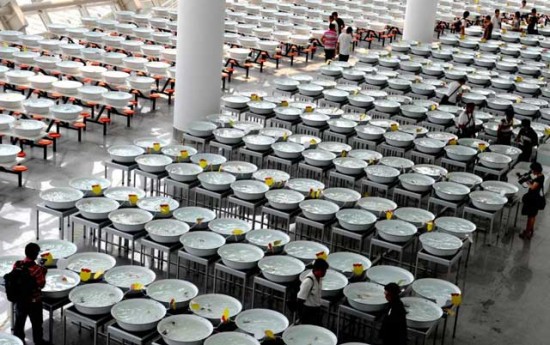
| Another Weird Pageant In China, This Time Involving Goldfish Posted: 18 Sep 2012 10:54 AM PDT We've seen beauty pageants for cows, so it would naturally follow that there would be a pageant for goldfish. In Fuzhou, Fujian province on Saturday, 3,000 fish from 14 different countries competed in the International Goldfish Championship. They were judged according to breed, body shape, swimming gesture, color, and overall impression, judge Ye Qichang told ITN News. Some fish stood out more than others, such as a 3.9-pound goldfish. That's really fat. "Many factors such as breed and breeding method may affect their size," Ye said. "A goldfish cannot grow into that size if it suffers any hardship or major illness during the breeding. So it is a very rare one." And morbidly obese. Youku video for those in China after the jump. |
| Did A 2009 Video Game Foresee The Current Island Conflict? Posted: 18 Sep 2012 09:49 AM PDT Here is the cinematic intro to Operation Flashpoint 2: Dragon Rising, a tactical shooter game released in October 2009. In it, an island originally owned by the Chinese, called Skira, is jointly colonized by Russia and Japan through military force in the 17th and early-18th centuries. After the Russo-Japanese War, Japan gains the entire island, then loses it back to Russia following World War II. Sometime during the Cold War, oil is discovered on this volcanic island but is "hard to reach." After the Cold War ends, Russia and the US become bound by certain treaty arrangements related to Skira. In 2004, a "massive Chinese economic boom" depletes the country's domestic reserves of oil, and after the global economic crisis of 2008, Chinese leadership destabilizes as the people gravitate toward hardliners. In 2011, China mobilizes its forces toward Russia, closer to Skira Island. Russia responds. And then, the PLA takes Skira, claiming "original ownership." The trailer ends with the US sending forces to the Sea of Japan. Swap out Russia for Japan, and does any of this sound familiar? The connection was made by Reddit user XADE101, and if nothing else, it makes me want to play the game. I'm sure the Bo Xilai scandal is tied into Operation Flashpoint's storyline somehow. You know what they say: reality imitates first-person shooters. Youku video for those in China after the jump. (Update, 12:53 pm: The video was up for a good hour-plus before censors removed it. I wonder which senior censor figured out the connection.) |
| Man in Wuhan falls off his bicycle, someone helps him Posted: 18 Sep 2012 09:34 AM PDT by Barry van Wyk on September 18, 2012  The front page of the Changjiang Daily (长江日报) from Wuhan in Hubei province today features an illustrated account of what should be an everyday act of kindness yet in China is by no means guaranteed: helping someone on the street. When a middle aged man crashed his bicycle on a street in Wuhan, falling on his face in the road in a spatter of blood, a journalist and photographer happened to be close by, and they recorded what happened next. A young man went to crouch next to the middle-aged man, asking if he was hit by a car and whether he was able to see the car's license plate, before proceeding to call emergency services. The middle-aged man did not reply, but the young man helped him to lie down by the side of the road. A worker at a pharmacy nearby and a sanitation worker had by now joined a small throng, and they inspected the man's bike and found no signs of a collision. When after 20 minutes the emergency services had still not arrived, another young man wearing sunglasses took the middle-aged man's phone and contacted some of his relatives. About ten minutes later, an ambulance arrived, yet all the while the middle-aged man said nothing. A doctor's initial assessment at the scene concluded that he had suffered flesh wounds to his mouth and nose. When the middle-aged man was safely taken away in the ambulance, about 30 people stayed loitering about and talking to the journalist. Some of them were saying that in other places in China if a person falls in the street, no-one will dare help them, but clearly Wuhan is different! Indeed, they concluded, Wuhan is a city that has love! Links and sources  |
| China-built projects in US stir up environmental concerns Posted: 17 Sep 2012 07:13 AM PDT California's new Bay Bridge is one of several major infrastructure projects across the US in which Chinese contractors play a key role. What are the environmental consequences? With an expected price tag over US$6 billion, California's new Bay Bridge will be one of the most expensive structures ever built when it opens next year—and a crucial component of it was built just outside Shanghai. Carbon-intensive steel from China US producers employ a method called Electric Arc Furnace (EAF) that uses up to 95% recycled steel. By contrast, around 90% of steel production in China, according to the World Steel Association, involves the Basic Oxygen Furnace (BOF) method, reliant on coke, iron ore (usually imported) and a much smaller quantity of recycled steel (25% to 30%). Indeed, some research indicates that the carbon footprint from BOF steel in China may be significantly greater than Cross indicated. Chinese efforts to convert to EAF are still in their infancy. Growing global clout of China's builders |
| Italian Kitchen 26: Exceptionally helpful staff, but a hit and miss menu Posted: 18 Sep 2012 08:45 AM PDT  Italian restaurants are arguably the most "hit and miss" of Shanghai's foreign eateries. For every Sabitini Ristorante there's that restaurant (we're not naming any names) that serves some very Hamburger Helper-esque pasta and rubbery baloney with the cold cuts plate. So when we spotted Italian Kitchen 26 during a night stroll on Anfu Lu, we had to pop in and see if it could tip the scale in the "hits'" favor. What we found was a kind've hit and miss restaurant. [ more › ] Italian restaurants are arguably the most "hit and miss" of Shanghai's foreign eateries. For every Sabitini Ristorante there's that restaurant (we're not naming any names) that serves some very Hamburger Helper-esque pasta and rubbery baloney with the cold cuts plate. So when we spotted Italian Kitchen 26 during a night stroll on Anfu Lu, we had to pop in and see if it could tip the scale in the "hits'" favor. What we found was a kind've hit and miss restaurant. [ more › ]        |
| Another Rally In Beijing, This Time To Commemorate The Mukden Incident, Or Something Posted: 18 Sep 2012 06:34 AM PDT The more I think about it, the more I want to believe these anti-Japan protests are just an excuse for people to catch some fresh air and blow off steam. The genuine anger in some parts isn't reflected in the above video, taken today by Jacob of BeijingShenghuo (who you'll remember took this video of Saturday's more volatile protests). The chants of "Little Japan, fuck your mother" are said so nonchalantly that a spectator who doesn't know Chinese could confuse this gathering for a high school prep rally. Look at all the people recording with cell phones: they're not angry; they're curious. They are, as the Chinese expression goes, cuo renao – joining the fray. There for the hell of it. And the cops are chaperones, just keeping the kids from dancing too close. Jacob says the crowd was only slightly more lively closer to the Japanese embassy. A few projectiles were thrown, but "it looked like the people throwing things from the back were just hitting the people in the front, including the armed police/soldiers." And the police, according to Jacob, "were actually pretty friendly." In other words: we've seen twice this anger at CBA games, and infinitely nastier insults at Guo'an soccer matches. And like so, another anniversary of the 1931 Mukden Incident — during which the Japanese sabotaged their own railroad in Manchuria as pretense to invade — passes. (Almost — I suppose there's time yet for real violence, but hopefully not.) Japanese stores will open again tomorrow, and all will be okay. Of course, bloggers in Changsha and Liuzhou and Chengdu et al. could well report tonight that their cities are going up in flames. But I prefer to hope that the worst of these anti-Japan protests are over. For all our sakes, let us hope. |
| US coal exports make mockery of green policies Posted: 18 Sep 2012 02:11 AM PDT California fights moves to ramp up coal exports to Asia through new terminals planned for west-coast states. While emerging economies of the world are hungry for inexpensive sources of energy, coal use is stable – if not slowly diminishing – in the United States, while US emission standards for fossil fuels are growing more stringent. Unfazed by new regulations, the coal industry now sees a golden future in expanding American coal mining, and exporting the coal to fast growing Asian markets. Political support for coal But without national guidelines governing energy exports, circumventing energy policies such as California's is easy. America's major coal-producing states have small populations and the coal industry makes generous political contributions. Gaining support for coal exports is a simple matter. The coalfields of major coal-producing states such as Wyoming and Montana are on public lands already leased to the coal industry. The lease fees equal approximately one dollar per ton for extracted coal. A sufficient rail system for transport of coal to the export terminals already exists. All that is needed is to build the export terminals themselves, and then coal can be exported to countries where California, or any other US state, has no control over emission standards. Cancelling out emissions savings |
| WIN Tickets to the Booka Shade Party Posted: 18 Sep 2012 04:04 AM PDT |
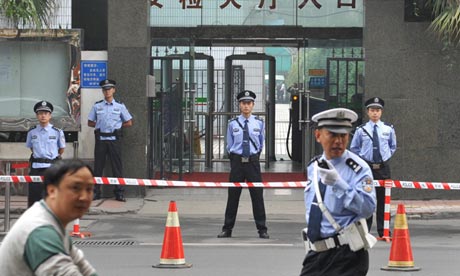
| The Two-Day Trial Of Wang Lijun Is Over Posted: 18 Sep 2012 02:10 AM PDT The "open trial" of Wang Lijun, on charges of bribe-taking and "bending the law for selfish ends," according to Xinhua, began this morning. It is now over, having taken place "under tight security before a carefully selected audience," according to the Guardian, from which the above picture is taken. "Foreign journalists were not permitted to attend." Yesterday, Wang, the former Chengdu vice mayor and police chief, stood a "closed-door trial" on the charges of defection and abuse of power. He did not contest any of the charges. As the NY Times notes, "The outcome of trials in China, especially those connected to elite politicians, is often predetermined. The flamboyant Mr. Wang, 52, is expected to be found guilty on all four charges." And with that, another trial in the Bo Xilai saga begins and ends, swiftly and efficiently. We're down to one last player, someone we haven't seen in months: Mr. Bo himself. But before we move on, let us pay homage, one last time, to the man who kicked off this preposterous, made-for-TV political saga. Words via NYT:
And image, not via NYT: Be well, Wang Lijun. |
| Interview: Bob Boyce, owner of Blue Frog and KABB Posted: 18 Sep 2012 01:08 AM PDT  When we last spoke with Bob Boyce, Montana-native and founder of Blue Frog Bar & Grill and Kabb, he had just opened a third Blue Frog on Tongren Lu, and was in the midst of expanding the Blue Frog/Kabb empire. In light of last month's closing of the original Blue Frog on Maoming Lu after 13 years of business, Boyce shares his thoughts on the journey from its opening to closing, the evolution of Shanghai's Western dining scene since his arrival, and future ventures. [ more › ] When we last spoke with Bob Boyce, Montana-native and founder of Blue Frog Bar & Grill and Kabb, he had just opened a third Blue Frog on Tongren Lu, and was in the midst of expanding the Blue Frog/Kabb empire. In light of last month's closing of the original Blue Frog on Maoming Lu after 13 years of business, Boyce shares his thoughts on the journey from its opening to closing, the evolution of Shanghai's Western dining scene since his arrival, and future ventures. [ more › ]  |
| Posted: 18 Sep 2012 01:08 AM PDT  |
| Let's Talk About Sex: Too Big in the Bedroom Posted: 17 Sep 2012 11:31 PM PDT |
| Girls Night Out Launch Party at Bar Rouge Posted: 17 Sep 2012 11:04 PM PDT |
| Video of the Week: The Five-year Old Piano Prodigy Posted: 17 Sep 2012 10:30 PM PDT |

| You are subscribed to email updates from Update » Blogs » Society To stop receiving these emails, you may unsubscribe now. | Email delivery powered by Google |
| Google Inc., 20 West Kinzie, Chicago IL USA 60610 | |

Comments