| End Of The One-Child Policy’: Aljazerra Posted: 18 Jun 2012 09:14 PM PDT Aljazerra's 'China: Unnatural Selection' puts human faces on the impact of China's one-child policy, as well as discussion of the policy issues. |
| This Is How They Rescue People From A Six-Vehicle Pileup Posted: 18 Jun 2012 08:32 PM PDT A semi-trailer traveling from Guizhou collided with a van heading the opposite direction on a dangerous stretch of State Highway 210 in Nandan County, Guangxi on Saturday, resulting in a six-car accident that killed six and injured six others, according to Guangxi Daily. The video here is of the aftermath. Particularly striking is the excavation of the girl trapped in the passenger seat of a car smushed by the tipped-over trailer; the driver next to her is never seen because that side of the vehicle is completely crushed, and she would have been as well if not for the grace of something — the grace of an orange truck next to her car, perhaps, which took the brunt of the trailer's weight. Original Youku video for those in China after the jump. |
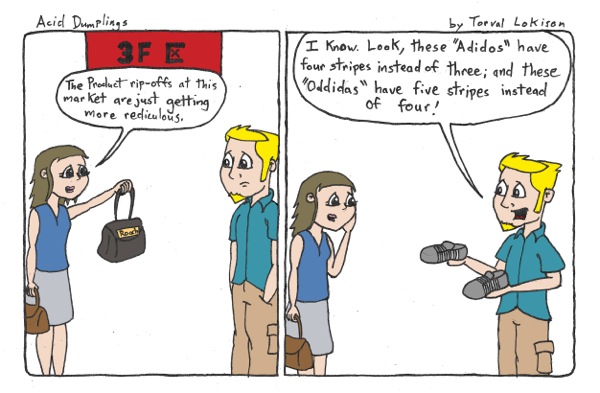
| Acid Dumplings [17] Posted: 18 Jun 2012 05:00 PM PDT |
| "Mystery mushroom" which leaves Xi'an villagers befuddled turns out to be artificial vajayjay Posted: 18 Jun 2012 04:14 PM PDT |
| Beijing-Shanghai high-speed rail prices down from next week Posted: 18 Jun 2012 03:30 PM PDT |
| Data Points and Article Links 6/18/12 Posted: 18 Jun 2012 07:14 AM PDT Here are some of the data points and article links I've been tweeting @prchovanec: - (18 Jun) Overcapacity: China aluminum supply = 1.6m tons growing at 20%/year, demand = 1.3m tons growing at 4% http://bit.ly/Pbtx3f
- (18 Jun) FP: Popular novels offer glimpse into "hidden rules" of Chinese politics http://bit.ly/LwIMCo
- (18 Jun) RT @chinahearsay Telegraph: 'Sexy Mandarin' online language school uses models to help students learn http://bit.ly/KGNh0U
- (18 Jun) Inflation: Mercer survey says cost of living in 1st/2nd tier Chinese cities now exceeds US http://bit.ly/L7euKb
- (18 Jun) Zhejiang business owner flees owing RMB 1b debt after losing money on real estate, company goes bust http://bit.ly/LfsSOs
- (17 Jun) Interesting NYT profile of Wendi Murdoch http://nyti.ms/NzUKQl
- (17 Jun) RT @WantChinaTimes Beijing forbids 'negative' news ahead of leadership transition http://bit.ly/L50sJ0
- (17 Jun) RT @niubi Caixin has long piece on Chengdu & commercial real estate bubble. 30 buildings 200m+ tall under construction.
- (17 Jun) Do RVs (Winnebago-style recreation vehicles) have a bright future in China? http://natpo.st/MULTT6 Good luck finding a parking spot
- (17 Jun) WTO strikes down China tariffs on US-made specialty steel http://onforb.es/MUE1B4
- (17 Jun) China Times: China Overseas Land reported sales up 22% in May, actually sold less than half amt claimed http://bit.ly/LwzeFW
- (15 Jun) China aircon manuf to build world's tallest bldg in 9 months … in Changsha. Changsha? http://on.wsj.com/Mbx0e5
- (15 Jun) Almost 90% of China shipyards have received no orders this year, 28% have secured none since end of 2009 http://bloom.bg/KGGL5x
- (15 Jun) China Bsn News reports long queues to buy property may be "faked" by developers to gin up sales – any thoughts?
- (15 Jun) China power consumption in May up 5.2% yoy, vs Apr +3.7% and May 2011 +11.7%
- (15 Jun) Further info from Reuters on alleged CIA mole in China's State Security Ministry http://reut.rs/K7oNaW
- (14 Jun) New stimulus measure? RT @haohaoreport Guangdong TV Trots Out Girls In Bikinis To Deliver Weather Forecast http://bit.ly/OE4iq2
- (14 Jun) Here we go again! China Daily reports CBRC set to relax limits on lending to LGFVs and property http://bit.ly/KoD9Zo
- (14 Jun) Serious EU-China trade spat over airline CO2 charges: China threatens to seize European planes http://reut.rs/KnADm6
- (14 Jun) Reuters: May surge in China oil imports likely stockpiling to hedge US pressure to stop buying from Iran http://reut.rs/M3nppp
- (14 Jun) RT @JingDaily With E-Commerce Surging In China, Who Needs Brick-And-Mortar? http://is.gd/6B4peP
- (13 Jun) RT @WSJchina Chinese Banks to See Profit Squeeze http://on.wsj.com/Nf2pTM assumes profits were real to begin with
- (13 Jun) Bloomberg: Wenzhou's financial crisis isn't over, it's still going on http://bloom.bg/L6KOvS
- (13 Jun) Watch what you Tweet: 2 arrested in Wuhan for "spreading rumors" re horrible air pollution http://bloom.bg/KsVUvR
- (13 Jun) Greentown boss: ignoring govt efforts to curb property market nearly ruined firm http://bit.ly/Ne3dZ2
- (13 Jun) Caixin: May recovery in property sales driven by price discounts, avg price down 12% yoy, set to fall further http://bit.ly/KBfth1
- (13 Jun) Caixin casts doubt on China effort to open banking and infrastructure to private investment http://bit.ly/LxJMrJ
- (13 Jun) SCMP: More on the crunch faced by China's strugging car dealers http://bit.ly/M1S0DX, http://bit.ly/MrokE0
- (13 Jun) Very alarming: China authorities have arrested/harassed researchers into fraud by Chinese companies http://bit.ly/KBcLbn
- (13 Jun) WSJ: China is Hollywood's fastest growing market for films http://on.wsj.com/KBce9g curious how will this affect content?
- (13 Jun) Caixin: loan demand remains weak despite boost in China's May lending data http://bit.ly/KToXIS
- (13 Jun) NBS says China home appliance sales flat (+0.5% yoy) in May, compared to +7.7% in April
- (13 Jun) NDRC reports China's car dealers are cutting prices due to mounting inventories, despite May rebound in sales
- (13 Jun) Beijing title transfers >600/day, due to surge in secondary property sales – investors are cashing out, to greater fools??
- (13 Jun) Chinese media reports Shanghai, Shenzhen, Hangzhou, Nanjing seeing thousands lining up to buy homes – the well of confidence is very deep
- (13 Jun) New Express (via BoA-ML) reports 30+ people killed in shadow banking dispute in Shandong, ppl borrowing at rates >20%
- (13 Jun) In Hunan, 26 of 35 power plants shut down, coal inventories at 50 days
- (13 Jun) Hunan power plant utilization at just 25%, Hubei at 62%, Jiangsu at 65% due to weak demand from steel, nonferrous, and cement prod
- (13 Jun) WSJ's Orlik: Is Chinese govt caving to property developers? http://on.wsj.com/LPKyvC it's more about credit access than buying restrictions
- (13 Jun) RT @AdamMinter air quality emergency in Wuhan. PM 2.5 at 589! Rumors of chlorine gas leak at a steel mill. Birds falling from the sky.
- (11 Jun) China regulators refusing to help SEC investigate fraud charges against US-listed Chinese companies http://bit.ly/Oh8tbj
- (11 Jun) Steady stream: head of Yantai Bank + 38 employees taken down for embezzlement http://bit.ly/MBcub7
- (11 Jun) Who's next? Caixin reports head of China's Postal Saving Bank under investigation for corruption http://bit.ly/MBbO5N
        |
| New iPhone app lets you track China's latest food scandals Posted: 18 Jun 2012 01:50 PM PDT |
| Forming a China WFOE — Getting Started Posted: 18 Jun 2012 11:52 AM PDT Cheating a bit here, but since I am on the road, I cannot help it. I'm cheating because this post is nothing more than the typical email we send to our clients at the commencement of our work for them in forming a China WFOE. But I don't feel bad because what better way to convey some of what it takes to get going with a China WFOE than by using a true to life example, freshly received today, no less. Here goes: Following please find the preliminary information and documents that we will need for the WFOE formation. Depending on the exact nature of your activities in China and the requirements of the local government, we may need additional information at a later date. The below will be sufficient to get us started. Please never hesitate to contact any of us with any questions. 1. Full legal name, legal structure (corporation, LLC, partnership), state of formation, and registered legal address of the shareholder of the WFOE. I assume that your U.S. entity will be the shareholder. If this is not correct, please explain. 2. Most recent registration document (usually called an annual report) from the state of formation showing the name, address and officers and directors of the shareholder. Our office can obtain this document after we receive your response to item 1 above. 3. Proof of existence of the shareholder. For this we will need certified copies of a) a certificate of good standing and b) the most recent annual report for the shareholder. These documents must be authenticated by the secretary of state of the state of formation and also must be authenticated by the applicable Chinese consulate or embassy. This is a complex process. Our office will handle obtaining these documents and processing with the relevant Chinese consulate/embassy. 4. Name of the WFOE in Chinese and English. We can assist in selecting the name if you wish. Chinese company names are complex. For now, what we need is the basic name that you want. We will then work with the local authorities to determine what should be the full legal name. Note that China is really only concerned with the Chinese version of the name. There is no real control on the English name that you use. 5. Lease on office space for the WFOE. The lease must be valid for at least one year beyond the eventual approval date for the WFOE. Since approval may take some time, it is best to have the initial term of the lease be at least one-and-a-half to two years. The lease must be in proper format and must be registered with the local real estate authority. We will also need proof that the landlord owns the property in question and has the authority to enter into the lease. This is usually proved by provision of a land rights certificate and proof of existence of the landlord (National ID for an individual, business license for a company). We will work with you during the leasing phase to ensure the lease is properly executed and that the landlord has proper authority. Prior to your entering into the lease, we will determine whether the proposed use is permitted for the premises and whether the proposed address is acceptable for a WFOE. Leases are often the biggest obstacle for WFOEs, so this is a matter to address right away. Note also that the specific details of the documentation requirements for a WFOE depend on the district where the WFOE will be formed. We therefore need to know the proposed address for the WFOE or at least the proposed district before we can make a final determination of the exact procedures that will be required for WFOE formation. Note also that we cannot even begin the registration process in China until we know the address of the proposed registered office for the WFOE, as well as the proposed use. This highlights the importance of the lease in the registration process. 6. We must specify the scope of business of the WFOE. Please provide a statement of what services the WFOE will perform on a daily basis. We need reasonable detail for this, but no more than one page. The scope of business should address the following questions, among others: - How many employees will be working there? Are they full-time or part-time? Will they be working in the leased space or off-site?
- Will the number of employees vary over time?
- What is the nationality of these employees?
- What will each of these employees be doing in this rented space – will they be programming? consulting? buying? selling? manufacturing? providing customer support? managing other employees? something else?
- Who are the customers of the business? That is, who will be paying for the services provided by the WFOE?
- What is the projected cash flow of the business? Where will income go (i.e., to the WFOE, to the parent, to an affiliated entity)? How will expenses be paid (i.e., directly by the WFOE, by the parent, by an affiliated entity, etc.)? Where will the WFOE get its money to operate?
The scope of business will also be used in the company name as noted in Question 4. above. 7. We must provide a feasibility study that states the basic business plan of the WFOE. Our staff will draft that document. In order to do this, in addition to the information requested in Question 6 above, we need the following information: - Statement of start up expenses in reasonable detail.
- One year and five year proforma income statement and balance sheet.
- Statement of what services/product the WFOE will provide (to the extent not addressed in Question 6).
- Statement of the expected cash flow of the WFOE: what entities will pay and what will they pay for (to the extent not addressed in Question 6)
- Initial staffing plan for the WFOE with a three year and five year projection. Of particular importance is the nationality of the staff (to the extent not addressed in Question 6).
- Statement of the business opportunity this WFOE will exploit, the expected market for the service, how you propose to meet the needs of that market and the benefit to China from the project.
8. Registered Capital. We must state the amount of the registered capital for the WFOE. This amount is the actual amount of capital that will be paid in by the shareholder as start-up capital for the WFOE. Registered capital is not a deposit: it is the actual operating capital used by the WFOE for payment of start up expenses such as rent, remodeling, equipment and salaries. There is no set number, since the amount required for each WFOE is different. As a rule of thumb, most Chinese regulatory authorities expect that registered capital will be equal to at least the first years expenses. Some districts have a minimum amount for registered capital. For example, districts in Shanghai generally require at least US $150,000 in registered capital. Note also that certain businesses will be required to have higher registered capital minimums. The rule is that all registered capital must be paid within two years after approval of formation of the WFOE. Fifteen percent of this amount, or the required minimum, whichever is greater, must be paid within 90 days after formation of the WFOE. The amount of registered capital must be considered carefully. Any amounts paid into the WFOE by the shareholder in excess of registered capital will be treated as income to the WFOE, and taxed as such. Accordingly, it is important not to set the registered capital number so low that you would encounter this problem. We will discuss this in more detail with you as we progress. 9. Management. The WFOE can be managed through a) a board of directors or b) through a single managing director. For a board of directors, the number of directors is typically three. One director is selected as the representative director who has the right to enter into agreements on behalf of the WFOE. For the managing director, a single person is appointed as the managing director. This person is also the representative director. You will need to determine which management method you will use. For single shareholder WFOEs, the managing director approach is common. You will need to designate the following directors and officers: - If you will use a board, state how many directors. Provide the full name and address of each director.
- If you will use a managing director, provide the full name and address of each director.
- The daily business of the WFOE will be managed by a general manager. This person can be a member of the board or an independent individual. The person can be a Chinese national or a foreign national. The person can be a resident of China or a non-resident. Typically, for a WFOE the general manager is a Chinese national who does not serve on the board and who is resident in China. However, there is no fixed pattern.
- The supervisor is responsible for supervising the conduct of the board in order to protect the rights of shareholders. In a one shareholder WFOE, the supervisor position is not necessary. However, Chinese law requires an appointment to this position. The person must be independent and cannot be a director or the general manager.
Documentation. For each person above, provide the following: - Name and address.
- ID: For non-Chinese citizens, we will need four color copies of their passport. For Chinese citizens, we will need four color copies of their national ID card.
- Resume: one or two page, including birth information and address, signed, four originals.
- Photos: four 2″ visa size photos.
10. Proof of financial status. Normally, this can be done through a letter from your bank stating the basics of your deposit relation with the bank. We will provide you with an approved form for this letter. In some cases, the Chinese authorities will require an audit of the investor company. We will determine as soon as possible whether such an audit will be required.  |
| A Beach In Sanya For Those With “Skin Diseases” Posted: 18 Jun 2012 11:00 AM PDT 
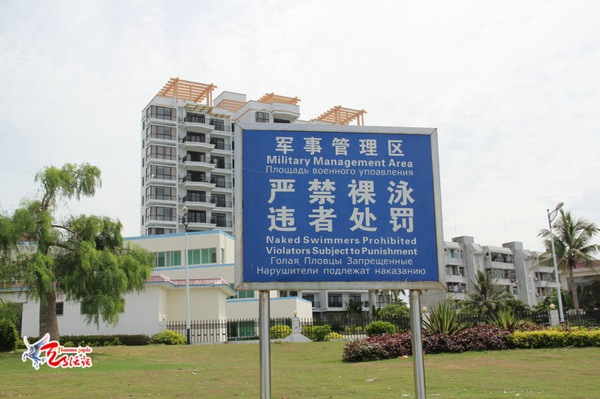
Nude beaches are pretty uncommon in China, if only for the fact that beaches here are always packed with people, most of whom, surely, have no desire to see any choads. But a tourist in Sanya, Hainan province (the "Hawaii of the East"), Tian Ma, recently found himself looking in at a nudist resort — a cleverly disguised one — and thought what anyone would think: picture time! He stealthily took the images above and after the jump and posted them on his blog, Tian Ma Topics. First, this sign explains about all you need to know about the beach: 
Military Management Area; Naked Swimmers Prohibited
How, then, do people know this is a place to dress way down? Tian Ma writes that the beach is advertised as a treatment for "skin diseases" — like clothes. (A treatment for clothes, I mean.) The day he went, 50 to 60 people were there, naked, around noon. There were at least three foreigners, probably Russian. All were unabashed. Looks like a veritable nudist resort, to say nothing of hideaway. Here, three more pictures (the sloppy censoring job is not mine). More pictures are on Tian Ma's site, if that's what you're after. (H/T Alicia) 


|
| Anyone seen Lei Feng? Posted: 18 Jun 2012 11:16 AM PDT by Allison Carroll Goldman on June 18, 2012  The front page of the Guizhou Metropolis Daily today features a large photo of Lei Feng, with the headline: "Who has seen him?" The article says the whole city of Guiyang, the capital of Guizhou province, has mobilized in search of the true "Lei Fengs" among them. Lei Feng was a Mao era soldier who was held up as a selfless and modest person and posthumously became the subject of a massive propaganda campaign: "Learn from Comrade Lei Feng" (向雷锋同志学习). He is the exemplar of old fashioned socialist morality in China, and often features in various propaganda campaigns. Now, as of June 17, the Guiyang Culture Office is recommending a series of online activities that revive the old propaganda slogans in an effort to make the people of Guiyang strive to learn from Lei Fang together, see the good in others' actions and decide to become "good people." The program will continue until December 20, 2012. It is understood by everyone that the program will help the whole society "take pleasure in helping others" (助人为乐), "have the courage to defend a just cause" (见义勇为) , "be honest and true" (城市守信), "be dedicated to their work" (敬业奉献") and "piously love their parents" (孝老爱亲). Furthermore, the program hopes to encourage more morally advanced people to do extraordinary things, and create a strong social atmosphere of striving to be better. At the end of the program, one person will be selected as the "best person in Guiyang" (贵阳好人). They will be sent on to participate in the "best person in China" public choice awards ( "中国好人榜" 评选). Also on the front page: a headline about China's most recent space launch. The Shenzhen No. 9 space shuttle is now safely on its way. The three astronauts who will carry out China's first manned space docking, Jing Haipeng, Liu Wang and Liu Yang, are all safe and in good condition. Liu Yang is now the first Chinese woman ever to go into space.  |
| China should back eco justice Posted: 17 Jun 2012 11:50 PM PDT
A proposal for an international court for the environment offers China the opportunity to seize the moral and diplomatic high ground on environmental issues, writes Philip Riches. The campaign for an international court for the environment (ICE) has the potential to transform the position of China in the environmental debate.
The approach China decides to adopt in response to the proposal for an ICE will have a profound impact on those likely to use the court – be they states; businesses; non-state actors, such as NGOs; or individuals – as well as on the environment itself. In addition, the approach adopted seems likely to affect how China sees itself and how it is seen as a player in the international community.
Why would the Chinese leadership want to consider supporting the ICE proposal? After all, if the ICE is established as an institution mandated by international treaty, it could mean potential intrusions on China's sovereignty and breach the dearly-held principle of non-interference in internal affairs. Even if the ICE is established simply as a tribunal offering services to parties consenting to its jurisdiction, having individuals, businesses and communities in China seeking redress from a body not subject to the authority of the Chinese state might be thought unacceptable to Beijing. These are serious obstacles to securing China's support for the ICE.
But there is still good reason to believe that China might support the ICE. How it plays out might be affected by who has the upper hand in Beijing: the "engagers", who seek to use international norms and structures to help China's development; or the "realpolitikers", who assert a hard-nosed view of China's increasingly important place in the world. Yet even the latter group may find the ICE useful. A snapshot of those reasons would include:
*The ICE provides significant scope for affected parties – be they the Chinese state itself, regional bodies, individuals or businesses – to seek to assert their international rights, including those deriving from the Stockholm and Rio Principles, not to be harmed by others' development. Climate change is but one example: at the global level, there is good evidence to suggest that climate change is a significant cause of the increasingly precarious water supply issues in northern China. As a possible additional benefit, the ICE could provide an outlet for frustration among Chinese citizens with corruption and lack of enforcement of environmental rules at the provincial and local level.
*Chinese business is international; it needs international protection. The expansion of Chinese businesses overseas is well documented, particularly in mineral extraction, agriculture and infrastructure development in Africa. Cross-border environmental disputes and questions already arise concerning this booming economic activity. At present there is no obvious forum to determine those disputes or questions. Recent arguments over the potential damage to the Serengeti National Park from the new railway being built from Uganda to the Tanzanian coast by the China Civil Engineering Construction Company (CCECC) illustrate this well. That dispute has been dealt with by political agreement, but this is not a sustainable approach. Businesses, with long-term investments, debt to repay, shareholders and deadlines, crave certainty – something that political negotiations, dependent on the whim of politicians, do not offer. The ICE, on the other hand, offers an expert and impartial interpretation of a clearly enunciated body of law, which it will continue to develop as required by its users. The Chinese state has a direct interest in this certainty and predictability that the ICE can bring, whether as owner of some of these overseas businesses or as the ultimate interested party in the wellbeing of the Chinese individuals involved.
*China already agrees to be bound by international legal institutions. Chinese courts regularly enforce foreign judgments and arbitration awards in China. Chinese individuals and businesses, including those owned or controlled by the state, regularly participate in foreign litigation and arbitration before international courts and tribunals – international arbitration in London is one particularly good example. The Chinese state, as a party – directly or indirectly – to these foreign proceedings in international forums, regularly agrees to be bound by foreign or international determinations and makes financial payments when unsuccessful. Equally, when successful, it is happy to seek the help of these international or foreign institutions to enforce judgments and awards in its favour. China's approach appears to be a practical one. If economic growth, and thus internal stability, is helped by participation in these international forums, as it is, China will work with them and use them. Even if the ICE court mandated by international treaty might be a step too far in the immediate future, the model of the ICE as an arbitral tribunal used by those consenting to its jurisdiction is something which China could support and use to its advantage. China could permit its businesses and citizens to use the ICE, while keeping the state itself out of reach – a tentative initial step that would allow it to test the usefulness of the ICE before committing itself to any further support.
*Supporting the ICE offers China the chance to reassert itself as the leading voice for the developing world. China's long-standing efforts to position itself as the leader of the developing world are under real threat. The UN climate-change conference in Durban in 2011 was but the latest example of a gulf opening between China and the global south, with China being portrayed as abandoning those most threatened by climate change in its hell-for-leather drive for growth. The irony of the formerly colonised poorest nations allying themselves with the former colonisers in the European Union cannot have been lost on Beijing. Support for the ICE does not have to mean wholehearted support for every radical scheme that is dreamt up to slow climate change, but it would help stem perceptions of China as having abandoned the global poor.
From wherever on the Chinese political spectrum one views the issue, there are many reasons why support for the ICE would be in China's interests. Other issues will also determine whether and, if so, how and to what extent China will support the ICE. In particular, the development of Chinese civil society will play a key role, since it is grassroots organisations, taking their lead from their membership rather than from on high, which have so often proved to be the principal drivers of initiatives such as the ICE. Although it is likely that it would be Chinese business that is the greatest cheerleader for the ICE at the outset – seeing it as providing clarity and certainty presently unavailable – in the longer term, it may well be Chinese civil society that determines the extent to which China is involved in and influences the ICE story.
Backgrounder: Why I am involved?
Over 20 years ago, I came upon a Greenpeace leaflet that, in a few lines, presented the life of 4.6 billion year-old earth as if it were 46 years old, with dinosaurs appearing last year, mammals eight months ago, modern humans about eight hours ago and the industrial revolution in the last minute. It brought home clearly how destructive man has been in such a short space of time. It began for me a lifelong fascination with the relationship between man and the environment, but also left unanswered the most important question: what could in fact be done?
I am now a lawyer. As my practice has developed, I have come to appreciate law's powerful tool kit for repairing many of the deficiencies in society and how law is one of the few things that can fundamentally alter human behaviour: both directly, by regulating our actions; and indirectly, by establishing norms and by guiding us down certain paths. It crafts the framework of informal and formal standards by which we live. I have come to realise that one of the best ways of moderating man's impact on the environment is to build legal frameworks that encourage that moderation.
Many countries have done this over the past few decades, with what are now mature environmental laws and respected environment courts. However, when environmental issues cross borders between countries, there remains a gap. There is no international environmental court to help guide human behaviour and to reconcile conflicting interests. Since so many serious environmental problems are cross-border, this is a serious gap.
This is the role the ICE seeks to play. It aims to use legal tools to build frameworks to help resolve international environmental issues and conflicts, including over: water use; sustainable development; and the rights of the unborn. Much of the ICE's work will be about building trust, but it will also be about establishing norms by which we can minimise our negative impact on the environment at the international level. Without an institution that helps in this process, it seems clear that environmental conflicts will only increase.
Philip Riches is an international dispute resolution barrister and a director of ICE Coalition. |
| Towards an international green court Posted: 17 Jun 2012 11:36 PM PDT
Twenty years after the last Rio summit, the world still lacks ajudicial body to hear and determine global environmental disputes. Stuart A Bruce sets out the case for such an institution. In the 40 years since the UN Conference on the Human Environment in 1972, regional and multilateral environmental agreements have proliferated. The subject matter and scope of such treaties has significantly evolved over time: from regional atmospheric pollution to management of the marine environment, toxic substances, nuclear energy, international watercourses, species protection, biodiversity conservation and climate change to name a few. Treaties have also broadened in geographic scope, from bilateral transboundary matters to global matters of common concern.
Progress towards achieving treaty aims is facilitated through numerous state-agreed mechanisms – including monitoring, reporting, verification and certain non-compliance procedures – with varying degrees of success (the case of the Montreal Protocol and Vienna Ozone Convention is an exemplar of success). Compliance with treaty obligations remains inconsistent and risks undermining their spirit and purpose. Greater compliance with treaty obligations requires effective enforcement, resource transfer and better judicial dispute resolution.
The current international environmental law regime presents a mismatch between global interdependence and global governance. What is lacking is a specialised international judicial body to hear and determine transboundary and global environmental matters. Such a body would also provide greater coherence to the currently fragmented international environmental governance regime. Strengthening international environmental law mechanisms are essential to, among other things, securing sustainable development and combating climate change in fair and equitable manner.
The purpose of an International Court for the Environment (ICE) would be: to build trust among the international community; to clarify legal obligations; to harmonise and complement existing legal regimes; to provide access to justice to a broader range of actors than traditional institutions provide; and to create workable solutions to modern environmental concerns.
In particular, ICE would provide the primary forum for the resolution of disputes arising from customary and treaty-based environmental law obligations owed between states or to non-state actors. It would ensure cost-sensitive and flexible dispute resolution avenues, including: non-binding negotiation; mediation and conciliation; and binding arbitration and judicial determination, as well as judicial advisory opinions. Importantly, ICE will be accessible not only to states, but to individuals, corporations and civil society – a fundamental departure from traditional international judicial bodies and a considerable step towards facilitating international environmental justice.
ICE could also subsume the role of existing environmental treaty-based enforcement bodies, including those established, for example, under the Convention on Biological Diversity, the United Nations Framework Convention on Climate Change and the Kyoto Protocol.
In practice, there are two major pathways to forming the ICE, by mutual agreement or by treaty. After formation, the operation of ICE will be governed by its constitution. The quickest, cheapest and easiest way to establish the ICE would be by mutual agreement. In practice, parties to a dispute would simply need to agree and consent to submit their dispute to the jurisdiction of an ICE tribunal and to be bound to its decisions and constitution, which includes the tribunal's jurisdiction, substantive rules and grounds for standing – the legal term for the right to sue.
This is akin to existing processes under international law for use of private arbitral institutions and establishing private ad hoc arbitral tribunals – including facilitation of domestic enforcement through the New York Convention. The court as a tribunal established without a treaty could be set up very quickly, within two years. This would then provide a working example of what the court can achieve and help to encourage adoption of a UN treaty to mandate a permanent ICE.
The more involved mechanism to establish the ICE would be through an international treaty. This process could start by a recommendation at an international conference, such as Rio+20 – from June 20 to 22 – supported by a UN General Assembly resolution authorising the commencement of negotiations. While a draft constitution has already been prepared, it is likely that negotiations would ensue informally for some time and culminate in an international conference where delegates of states formally agree to the final version of the constitution text – all of which has an effect on the timeframe for establishing the ICE.
After agreement of the text, a pre-determined number of states would need to sign and ratify the treaty before the ICE officially comes into being as a new stand-alone international tribunal. A prototype for this process is the establishment of the International Criminal Court that is founded on negotiations of the Rome Statute. Once ICE is established, the operations and daily functioning of the court or tribunal would be determined in the first instance by its constitution, which would set out, among other things, matters relating to jurisdiction, the types of evidence that can be relied upon, procedure, subject matter scope, standing provisions and relations of the ICE with international and domestic law.
If the court were to operate more akin to an arbitration tribunal, the parties to a dispute would have a certain degree of freedom to consensually choose the rules of evidence and procedure of the tribunal, akin to the International Centre for Settlement of Investment Disputes, in addition to relying on scientific evidence and arbitrators with subject-matter expertise.
Many stakeholders and groups have an interest in establishing the ICE. Historically, only states had standing to seek judicial settlement on the international plane, for example through the International Court of Justice (ICJ). As a result, a large number of the people who suffer from international environmental problems have no access to justice. The broad standing rules of ICE will ensure that those affected by environmental problems have a direct right of access – this will often be NGOs, civil society and affected communities or individuals. This will enable groups to bring attention to environmental degradation that their own national governments have been unable or unwilling to address and go some way to implementing the pillars of the Aarhus Convention.
Another vital constituency is the global business community. ICE will provide businesses with independent assessment of any obligations, thus legal certainty and predictability so that long-term investment risk may be effectively managed. ICE could also influence the world business community to improve environmental standards and practices to produce a corresponding reduction in the risk of environmental catastrophe. An example of a current international dispute well suited to ICE is that of Chevron v Ecuador, which has been plagued by allegations of judicial imprudence and award enforcement complexity. As a legitimate and globally recognised body, ICE would overcome many of these challenges.
ICE will supplement traditional international dispute resolution forums by providing a body that is able to receive technical and scientific evidence and is populated by judges educated in environmental law matters – a lingering lacuna in extant international courts and tribunals (see for, example, the ICJ's 1997 Judgment in Gabcikovo-Nagymaros (Hungary v Slovakia) where sustainable development was given all but the most cursory legal analysis). This will provide similar benefits for states as it does the business community and assist in clarifying and progressively developing international environmental law.
The need for a forum providing in-depth consideration of independent science was reaffirmed with the ICJ's Judgment in Argentina v Uruguay – the Pulp Mills dispute – in which a dissenting judgment regretted that the ICJ missed "a golden opportunity to demonstrate to the international community its ability, and preparedness, to approach scientifically complex disputes in a state-of-the-art manner". The ICJ is a valuable institution, but it is not capable of providing the adaptability, consideration of science and access to justice for non-state actors required in environmental disputes. Indeed, in 1993, the ICJ recognised the need for environmental specialism when it established a specialised chamber to hear environmental disputes, but in part because it was still only accessible to states, it was hardly used. It has since been decommissioned.
ICE will benefit the international community of states (and non-state actors) in at least four ways: harmonising the fragmented system of international environmental law; serving as the chamber for all multilateral environmental agreements that reference Article 33(1) of the UN Charter on the settlement of disputes; resolving conflicting international law obligations, such as those between WTO rules and UNFCCC obligations; and providing interpretive guidance and judicial support to any new international environmental governance body, such as a World Environment Organisation – a proposal at Rio.
To make the ICE a reality, greater international support and proactive state sponsorship is required, as is environmental leadership from the business community. How long it takes to open the doors and the method by which ICE is established depends on the abovementioned variables. Many actors have publicly acknowledged their support or interest for an ICE of some type, including the United Nations Department of Public Information, European Parliament, Northern Alliance for Sustainability, The Access Initiative and the UK Government.
The ICE is possible, and it could play a significant role in addressing modern environmental concerns. But it requires more support to bring it to life.
Stuart A Bruce is a litigation lawyer and former management consultant from Australia undertaking a Master of Laws (International Law) at University College London. He is a member of the ICE Coalition Steering Committee. |
| WTF? Chinese Man Detained For Downloading Porn? Posted: 18 Jun 2012 08:02 AM PDT  Mojo@neocha (from neocha.com) Forget the fluff. China Daily brings straight meat: A man in Qianguo county, Jilin province, was detained 15 days and fined 3,000 yuan ($471) for downloading pornographic videos to his home computer, South China Metropolis Daily reported on June 15. The man first posted his story online on June 10, saying that police found 95 porn videos in his computer and then seized it. "The police said that I copied porn films and broke the law. Who can tell me the punishment was reasonable?" the man asked in the post.
There's a little confusion over whether the police detained him for the porn (on which they performed a thorough investigation with the full breadth of their organ's power, one can only assume) or for "a picture [of] a man sitting in a police car." It doesn't matter. Stan Abrams, Esq., of China Hearsay honed in on the part of the article that discussed the relevant law in this case: According to Article 68 of the Public Security Administration Punishment Law of the People's Republic of China, those who produce, transport, copy, sell or rent obscene books, pictures, video, and audio or use computer information network, telephone and other communication tools to disseminate obscene information, will be detained for 10 to 15 days and fined 3,000 yuan.
Abrams questioned: But what does it mean to "copy"? If I had to guess, this refers to reproduction of the pornographic work for distribution, not merely downloading it for personal use. Technically yes, one makes a copy of the digital work when it is downloaded, but that's not exactly the same as "reproduction" as we see in other parts of the law, for example with copyright. Just consider what it would mean if mere downloading/possession qualified as a violation under Article 68. What percentage of males above the age of twelve have porn on their computers? I'm not familiar with all the survey data, but usually the answer is somewhere around 99%, with one percent of the respondents lying about it. If the cops can grab anyone who has digi-porn, then everyone's a criminal. Scary thought.
Scary thought indeed. On that note, Beijing Cream would like to remind everyone that we have a list of PORN SITES THAT ARE NOT BLOCKED IN CHINA (please let us know if any of those are now blocked). We'll try to update the list every time we stumble upon another. Because we love you, that's why. |
| Top-of-the-Week Links: First Chinese woman blasts into space, on corruption and censorship, and “rat tribe” Posted: 18 Jun 2012 06:14 AM PDT 
Via Foreign Policy – link after jump
Beijing has rolled back its taxi fuel surcharge from 3 to 2 yuan, effective today, the Beijinger reported earlier (People's Daily reports via Sina it's thanks to a decrease in oil prices). Enjoy that fact over these links. Here's your story of the week: "Over the past two years, photojournalist Sim Chi Yin has documented this subterranean world known in the Chinese media as home of the 'rat tribe,' recording the odd mix of quaint domesticity that has managed to flourish within the drafty, moldy cells. Beijingers from every walk of life populate these hidden spaces; they are the waiters and hairdressers, fruit-sellers and manicurists of the gilded new capital taking shape above them." [Foreign Policy] Literature in 21st-century China. "This is the confusing world of the People's Republic 2.0, with its sliding scale of dissidence, a gray zone where authors are constrained but can flout the official rules without their work necessarily being banned. They carefully calibrate what can be communicated in English but not in Chinese; in Hong Kong but not in Beijing; online but not in print; via allegory but not direct exposition. The tank-to-tractor substitution — as well as related techniques, like taking advantage of Chinese's rich store of homophones to substitute a sound-alike anodyne term for a politically charged one — illustrates how the ever-present censorship machine turns Chinese writers into verbal acrobats. Put more bluntly, it forces them to lie to get their voices heard." [NY Times] Anger over abortion that wasn't. "I learned later that the family had been expecting a healthy baby. Today that baby was born, but with a major birth defect, it was missing an arm. The family was angry because the hospital had missed this during the ultrasound (or perhaps it was something that was not obvious on the ultrasound). They were shouting, 'How can our baby live without an arm?' // I couldn't believe it. This large protest was not over a death, but over a life. They were upset because they had missed their opportunity to have an abortion (or euphemistically 'stop the pregnancy')." [Seeing Red in China] Bao Tong, Zhao Ziyang's consigliere, talks about Wen Jiabao: "He's hard-working and diligent. But he hasn't accomplished anything. I'm sure he wouldn't be satisfied with his work, though in one point he could say, 'I didn't let my own conscience down: I wasn't lazy.' // But I don't want to speak badly of him. What did I do? What did I accomplish? People say, 'well you weren't corrupt.' I say, wrong. If I were in the current system, I'd be corrupt too. Do you believe me? Believe me." [Ian Johnson, NY Review of Books] Liu Yang makes history, goes into space interlude:
Finally… Asian American Writers' Workshop launches three e-zines: The Margins, Open City and CultureStrike. [Angry Asian Man] A baijiu brand called "Bomb" is pretty awesome; its imitators… not so much. [Isidor's Fugue] Pictures of China under the title, "The bewildering face of China." [The Independent] Finally, finally… 
From that Foreign Policy piece (see first link)
|
| Crossing the Border Posted: 17 Jun 2012 06:00 PM PDT 
After months setting up shell companies everywhere from Hong Kong to the Cayman Islands, Xiao Li's plans would still hinge on his single exit interview at the Shenzhen border. The mid-level manager had amassed enough paperwork from contacts outside the country to make his trip seem innocuous to superiors at the Foreign Ministry, but there was always the potential for things to get ugly at the border crossing.... This posting includes an audio/video/photo media file: Download Now |
| If you were in Rio… Posted: 17 Jun 2012 11:09 PM PDT
As world leaders gather in Brazil for the great sustainability shindig, voices from civil-society, academia and business tell Leila Mulloy what they believe should top the agenda. This week, politicians, policymakers and civil-society figures descend on Rio de Janeiro for the 2012 Earth Summit. Twenty years on from the original United Nations Conference on Environment and Development in 1992, the conference aims to "secure renewed political commitment to sustainable development". Leila Mulloy asked a group of people from activism, academia and business for their message to policymakers.
"No more business as usual"
Gisbert Glaser, senior advisor, International Council for Science
My first message to policymakers would be about the urgency to act now; that there has only been limited progress during the last two decades in implementing sustainable development. Overall, human impacts on our natural environment and climate have become much worse, and pressures on the environment are such that they may cause fundamental changes in the Earth's system and move us beyond safe natural boundaries.
Also, major social and economic challenges persist, such as bridging the development divide between [global] north and south and alleviating poverty. We will also need to increase global food production by 50% to 70% by the year 2030 and, thereafter, even more. We need to meet this challenge and, at the same time, ensure sustainable resource management.
My second message would be that we need to act on a totally different scale. There must be renewed political commitment by government leaders to implement sustainable development, and not in the "business as usual" way of taking incremental steps that we have seen in the past 20 years. We must scale up all measures to implement sustainable development. Society needs to be "greened" in terms of its production and consumption patterns, the economy also needs to be transformed to a greener, more equitable model.
Thirdly, innovation (technological and other) and societal transformation driven by new knowledge from science are the paths to sustainable development. For new knowledge to be generated, Rio+20 and policymakers need to support research for sustainable development and international scientific cooperation. At Rio+20, policymakers should strengthen the science-policy links and acknowledge the nexus of science, technology and innovation as important drivers of sustainable development. Rio+20 should be a milestone in the development of a new participatory paradigm for scientific engagement with society.
"Declare 30% of the oceans Marine Protected Areas by 2020"
Peter Raines, chairman, Coral Cay Conservation Trust
By 2010, the Convention on Biological Diversity called for 10% of the world's Exclusive Economic Zones – seazones over which a state has special rights regarding the exploration and use of marine resources – to become Marine Protected Areas, or MPAs. Then, the World Parks Congress called for 20% by 2012, a date also agreed on for a well-managed network of MPAs by the World Summit on Sustainable Development and the OSPAR Commission. Today, just over 1% of oceans are under MPA designation and less than 6% of coral reefs are under effective protection.
Coral reefs are particularly important as they are the most biodiverse and productive ecosystem on Earth, providing direct food security and livelihoods to over 500 million people, and indirectly to millions more. However, destructive activities – overfishing, pollution, climate change – mean that something approaching half of coral reefs have been destroyed or are in critical and irreversible decline. Do nothing and, by 2055, over 90% of coral reefs could be lost forever, leading to a global humanitarian disaster.
Recently, 260 of the world's leading marine scientists made an urgent call for more and larger MPAs and a figure of 30% has emerged as the area believed necessary to avert permanent damage. Policymakers at Rio must declare that, by 2020, an ecologically coherent, well managed network of strictly "no-take" MPAs, closed to all fishing and covering at least 30% of the world's oceans will be established. And they must adopt the highly successful "mega-MPA" approach to coral-reef protection of the Indian Ocean's Chagos Islands, a biodiversity hotspot.
"Halt the unsustainable economy of nuclear energy, oil and coal"
Yong Rong, head of policy and public affairs, Greenpeace East Asia
Top leaders from around the world are meeting to discuss and agree on "the future we want".
The future we want is fair, peaceful, just and green.
A fair, green economy is achievable, but it requires urgent action. Promoting sustainable practices is essential, but governments must first make a decisive end to unsustainable practices. An economy based on nuclear energy, oil and coal, genetic engineering, toxic chemicals and the overexploitation of our forests and seas will never be sustainable or green.
In order to achieve "the future we want", governments have been negotiating and preparing for two years, since the first preparatory committee meeting in May 2010 ahead of the Rio+20 summit. We appreciate the efforts, but while negotiators are fighting for their own countries' interests, the earth cannot wait.
The outcome of the conference cannot simply be a re-wording of principles, or the penning of new terminologies. What we want is something real and practical. If we cannot get clear commitments on issues such as achieving clean and safe energy for all, or zero deforestation by 2020, we must at the very least ensure the launch of a High Seas Biodiversity Agreement and a UN Environment Agency are finally delivered at Rio.
"We can learn from past successes"
Chloe Corbin, Survival International
World leaders have to recognise tribal peoples' rights as they prepare to meet in Brazil to discuss sustainable development. The conference describes sustainability as the "guiding principle for long-term global development". However, for this to work, it is crucial tribal rights are not ignored, and that the environment within which they live is properly protected.
A lot has changed since policymakers gathered in Rio 20 years ago. Not least, Brazil's rapid rise to become one of the world's strongest economies. But with this new title comes the responsibility of developing sustainably, of developing without destroying Brazil's rare environment and its natural resources.
Twenty years ago, in an historic move, Brazil created the Yanomami Park. It secured the survival of a tribe facing genocide. Legally recognising their land was significant. It gave the Yanomami a right to self-determination, upheld their ancestral rights, and protected their environment. Two decades on, the Yanomami are largely safe. Gold mining continues in some regions and they still face health problems, but their case is known, they have set up their own organisations and their rights are vigorously defended.
At Rio+20, Survival International wants policymakers to learn from the importance of the Yanomami Park – and now turn their attention to helping Brazil's Awá tribe. Their land, like the Yanomami's, is protected, but illegal logging permeates their forest – crushing their numbers. Now, only 450 exist.
As Brazil continues to develop, and as the world's demands on resources continue to soar, it is vital policymakers do not forget the peoples and their lands from which we have so much to learn about living sustainably. "Sustainable development must respect human rights"
Lyla Mehta, research fellow, Institute of Development Studies; adjunct professor, Noragric, Norwegian University of Life Sciences
Policymakers need to be committed to sustainable development that is just, fair and improves marginalised people's lives without compromising ecological integrity. There are no signs of this happening.
The so called "green economy" remains wedded to economic growth paradigms and could even legitimise large corporations gaining control over poor people's land, water and livelihoods in the name of sustainability, and the so called food, water and energy nexus.
At the moment, negotiations appear to be failing and a series of commitments around human rights are being watered down. For example, several states in the "informal informals" are resisting an explicit reference to the human right to water and sanitation. Without a commitment to this human right, it will be difficult to improve the lot of those who currently lack access and suffer exclusion. Unless politicians overcome their national self interest, I fear that Rio+20 may be irrelevant and could well be the last global summit on sustainable development.
"Scale up successful partnerships"
Andrew Slight, head of external affairs, PepsiCo UK & Ireland
Governments should commit to working in partnership with the private sector, and others, to respect, protect and fulfil the right to water and sanitation by 2020 in a way that is compatible with climate and food-security goals.
Green growth, or indeed growth of any kind, will only be possible if we are able to tackle the growing water challenges of the twenty-first century. Nearly three billion people live with severe water scarcity. Businesses are already being impacted by water scarcity. Analysis suggests that the world will face a 40% global shortfall between forecast demand and available supply by 2030.
The vast majority of the water we consume – more than 70% globally and as high as 90% in developing countries – goes to agriculture. Already, the lack of food security and access to safe drinking water affects more than 800 million people in the world. So the catalyst for action by governments, business and other actors is clear.
Rio+20 must provide the clarity, consistency and ambition to inspire change and scale-up already successful partnerships such as the Water Resource Group 2030, a consortium of businesses and the World Bank that contribute new insights to the increasingly critical issue of water resource scarcity. It can do this by committing to working in partnership with the private sector and others to respect, protect and fulfil the right to water and sanitation by 2020 in a way that is compatible with climate and food security goals.
"We must pay the 'true' price for food"
Ann-Marie Brouder, principal sustainability advisor, Forum for the Future
Our organisation is seeking to identify the features of the food system that are driving its inherent inequality, and then devise appropriate solutions that are scalable and can shift the system on to a more sustainable path.
So what have we learnt and what would we recommend to the policymakers?
Time to work together: Policymakers at Rio need to understand the issues and interests pushing the food system down an unsustainable path, and then explore how they can work collaboratively with NGOs and businesses to develop and implement solutions.
Time to support the growers: There is a fundamental imbalance within the food system between different parts of the value chain. All too often, the dynamics of the value chain mean that producers lose out, impacting on their wellbeing and prosperity and limiting the supply of food.
Time to connect people with their food: Millions of people are disconnected with where and how food is produced. This can make people reluctant to pay the "true" price for food or to reduce food waste. Policymakers could do much more to engage citizens with food, from supporting citizens to grow food, to understanding the impacts of what they eat, to providing clear, sensible food labels.
Time to understand our ecosystems: We need policymakers to take seriously the threat posed by the loss of ecosystems and the resources and habitats they depend on. As well as their other benefits, the loss of ecosystems critically affects our ability to produce enough food now and in the future.
Leila Mulloy is an intern at chinadialogue's London office.
Homepage image by Andrew Griffith |
| Top Ten Search List (June 18) Posted: 18 Jun 2012 03:27 AM PDT 
Here is today's top ten real-time search list, recorded at 2:00PM. 1. 母女跪教育局 Mǔnǚ guì jiàoyùjú – On June 14th in Nanshan, Shenzhen, the parents of over one hundred children occupied the Nanshan District Bureau of Education, demanding places for their kids in Nanshan's public schools. One parent brought her little girl with her and kneeled in front of the education department's petition office for an hour. As a result of the "occupation," the Nanshan Department of Education promised to resolve the quota issue, assuring parents that every student would have the chance to attend public school. The protest came in the wake of a June 13th announcement for 2012 first grade enrollment in Nanshan School District public schools, when several parents noticed that their children's names had been left off the list and began to wonder if other families had paid extra to ensure their children had places. The department of education promised to partially subsidize tuition from grades one through six for children attending private schools, but parents soon realized that they could only attain the meager subsidy, upon paying tuition in full. Here's the story in Chinese. 2. 大学男生毕业裸奔 dàxué nánshēng bìyè luǒbēn – "Male College Graduates Go Streaking": More college students are getting naked to celebrate their newfound freedom from the library. Several pictures are circulating today of law students from a college in Zhejiang who recently went streaking through the night, as crowds of onlookers shouted out "Streakers! Graduated streakers!" Some netizens are berating the nudists for "disrespecting their parents, who made their education possible" while others are praising their courage and admiring the "sincerity" of their raw approach to self expression. Here's the story in Chinese. 3. 广东污臭自来水Guǎngdōng wūchòu zìláishuǐ – "Guangdong Polluted Tap Water": A recent news piece with an accompanying video showing unbelievably dirty streams of tap water flowing from the faucets of a small town in Zijin, Guangdong is now gaining national attention, as netizens learn that for close to twenty years, the people of Tanlang have been relying on well and bottled water to survive, at the same time as they have been supporting their local ("penniless," according to them) government's fruitless public water supply project. Here's the story in Chinese. 4. 出租司机举报后沦为乞丐 Chūzū sījī jǔbào hòu lúnwéi qǐgài – After exposing his taxi company for accepting bribes—code-named "tea money"—in return for granting new drivers their cabs (as there is a limited number), the now famous Guangzhou taxi driver "Lao Wang" went to the Guangzhou Municipal Traffic Commission expecting compensation for making his report. Lao Wang first came forward to the media in May, thereby bringing the Traffic Commission to encourage taxi drivers to call into a hotline to report anything they knew about the tacit rule in the taxi industry which requires drivers to pay up before they start work. The hotline soon became a "cold line," however, indicating that the commission itself may be involved in the scheme. Now cab-less and without his promised reward, Lao Wang is drawing media attention again, as he has begun begging for money and support at the Guangzhou Baiyun airport. Here's the story in Chinese. 5. 贵羊羊 Guì Yángyáng – Since this past May, the price of mutton in Beijing has grown steadily, rising to up to 52 RMB/kg: a 30% increase from last year. Because of this, netizens have dubbed mutton "The Meat of the Elite" (贵族肉 guìzú ròu). Here's the story in Chinese. *Editor's note: the most popular search term related to the topic, "Guì Yángyáng" or "Elite Lamb-lamb" is a play on the names of the characters from the immensely popular Chinese animated TV series "Pleasant Goat and Big Big Wolf (喜羊羊与灰太狼 Xǐ Yángyáng yǔ Huī Tàiláng). In the series, characters have cutesy names like "Happy Lamb-lamb" (喜羊羊 Xǐ Yáng yáng), "Lazy Lamb-lamb (懒羊羊 Lǎn Yángyáng), "Beauty Lamb-lamb" (美羊羊 Měi Yángyáng), and so on. Now a new "character," "Elite Lamb-lamb," has joined the bunch, and he is very snooty. 6. 天津地震 Tiānjīn dìzhèn – A level 4 earthquake hit the border of Baodi, Tianjin and Tangshan, Hebei at 3:18 this morning. The quake had a focal depth of nine miles, but an initial survey of the affected area has reported that no houses have been destroyed, and that everything has since gone back to business as usual. Here's the story in Chinese. 7. 神九对接直播Shén jiǔ duìjiē zhíbō – "Shenzhou Capsule Live Broadcast": Today at 2:07 PM Beijing time, China's Shenzhou-9 capsule, with a crew of three (including China's first female astronaut), docked with the Tiangong-1 space lab. Here's the story in Chinese. 8. 误播六级听力Wùbō liùjí tīnglì – "Playing the Level-6 Listening Test": On June 16th at Jingdezhen Ceramic Institute in Jiangxi during the listening section of the level-4 exam for The College English Test (CET) (the national English as a Foreign Language test in China), the exam proctor somehow accidentally played a recording intended for those testing at level-6, leaving a lot of level-4 students wondering if there was something wrong or if they were just having seriously bad mornings. Five staff members faulted with poor organization and management of the testing center have been severely penalized and removed from their positions. Here's the story in Chinese. 9. 大兴安岭火车脱轨 Dàxīng ānlǐng huǒchē tuōguǐ – A freight train was derailed as it passed through the The Greater Khingan mountain range in Northeast China this past Saturday, impacting the operations of several passenger trains. There were no casualties, according to the Harbin Railway Bureau, though concern about the kind of malfunction that could have caused the accident still has everyone talking. Here's the story in Chinese. 10. 杨树鹏 Yáng Shùpéng – Though the pair previously denied the rumors, today more proof has surfaced indicating that film director Yang Shupeng and actress Zhang Xinyi are dating. They have apparently been spotted "sweetly holding hands," walking dogs, and shopping together, and now there's talk that they have been together since last year. Here's the story in Chinese. READ MORE |
| Hu Xijin to Shenzhou 9 critics: Go get your heads checked Posted: 18 Jun 2012 02:00 AM PDT |
| Video of the Week: Crazy Chinese Military Drill Posted: 18 Jun 2012 01:54 AM PDT Date: Jun 18th 2012 4:52p.m. Contributed by: jvb Bold? Fearless? Slight penchant for playing hot potato with live explosives for no apparent reason? Then the Chinese Army's for you.
These soldiers passing a grenade around is almost as impressive as it is unnecessary- put such a mind-set into battle and Christ knows what'll happen. Personally I'm terrified! |
| Watch: Daughter of Gao Zhisheng speaks on life after China Posted: 18 Jun 2012 01:00 AM PDT Grace Geng, the daughter of imprisoned human rights lawyer Gao Zhisheng, has been living in the United States for the last three years with her mother Geng He and her brother. Here, she speaks to the Falungong-affiliated NTDTV on her dad and life after China. [ more › ] |

 Xi'an Up Close 《西安零距离》, an investigative journalism programme which airs on Xi'an TV, has become a national laughing stock after airing a report on June 17 on a "mystery mushroom" which was discovered by villagers in a rural part of the city. [ more › ]


 "After the price cut, business-class tickets will be lowered to between 1,400 yuan (US$222 dollars) and 1,575 yuan (US$248) from the current 1,750 yuan (US$276). Prices of premium seats will stand at 949 yuan (US$150), down from the current 1,055 yuan (US$166)." [ more › ]
 With thousands of food safety scandals hitting China each year, it can be easy to turn a blind eye to the food you're eating here. But if "ignorance is bliss" isn't really your thing, well... there's an app for that. The China Survival Guide (中国求生手册), an iPhone app which launched late last month, tracks food scandals across China so you don't have to! [ more › ]





 "If you're happy for the successful launch of Shenzhou 9, you're a normal Chinese person. If you have not the slightest care for it, you are also a normal Chinese person. But if it has made you unhappy, or even angry, my advice to you is to get your heads checked. Because you're probably very special, often depressed, and seldom happy. This can't be good for your health." [ more › ]







Comments