Links » Crème » Top-of-the-Week Links: Japan threatens to fire at Chinese aircraft, Southern Weekly honors censored stories, and Liao Yiwu’s book about prison
Links » Crème » Top-of-the-Week Links: Japan threatens to fire at Chinese aircraft, Southern Weekly honors censored stories, and Liao Yiwu’s book about prison |

- Top-of-the-Week Links: Japan threatens to fire at Chinese aircraft, Southern Weekly honors censored stories, and Liao Yiwu’s book about prison
- Trying to Understand Today’s Huawei News Conference
- Rotting dogs, assailed nostrils, withered roses… just a story about gutter oil here
- Nostalgic for Chinese High Culture
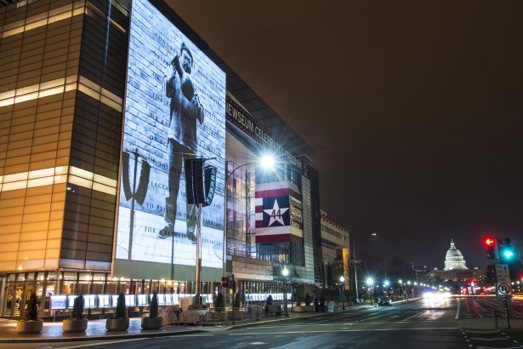
| Posted: 21 Jan 2013 04:00 AM PST President Barack Obama's public inauguration begins soon, and lookey who overlooks his parade route (above, via The Atlantic). If you're in Beijing and would like to watch, the place to go is Brussels (or so TimeOut tells us), which also showed live coverage of the US presidential election. For everyone else, links. Yi Junqing taken down by female's "fiction." "Mr. Yi, 54, an impish scholar who held the job of China's top guardian of Communist literature, is said to have provided the woman with a fellowship at his research institute in exchange for $1,600. The sex and jewelry came later. // The allegations came to light last month after the woman, Chang Yan, 34, posted online a self-indulgent and occasionally scintillating diary that recounted a yearlong affair between the two married scholars. A few days later, Ms. Chang tried to retract her sprawling tell-all, but the damage was done." (NY Times) Lovely. "Japan says it may fire warning shots and take other measures to keep foreign aircraft from violating its airspace in the latest verbal blast between Tokyo and Beijing that raises concerns that a dispute over hotly contested islands could spin out of control." (AP) There's that word again: transparency. "For years, many China observers have asserted that the party's authoritarian system endures because ordinary Chinese buy into a grand bargain: the party guarantees economic growth, and in exchange the people do not question the way the party rules. Now, many whose lives improved under the boom are reneging on their end of the deal, and in ways more vocal than ever before. Their ranks include billionaires and students, movie stars and homemakers. // Few are advocating an overthrow of the party. Many just want the system to provide a more secure life. But in doing so, they are demanding something that challenges the very nature of the party-controlled state: transparency." (Edward Wong, NY Times) Snark. "The outspoken Southern Weekly honoured the five 'best censored stories' of the past year at its annual meeting yesterday. They included a feature removed from the New Year edition which was at the centre of a rare censorship row between the newspaper's editorial staff and the provincial propaganda department." (SCMP) It's just what the kids are calling it these days. "Giving a chronic respiratory problem the name of China's capital city is an "extreme insult", the top doctor at Peking University's School of Public Health said. // Beijing has seen a recent surge in residents seeking medical help for what is being called the 'Beijing cough' – and it's not because of the flu." (SCMP) Liao Yiwu's latest book finally published in France. "Liao Yiwu clearly recalls the moment when he first stepped into a Chinese jail. He was stripped naked by inmates who then searched his anus with chopsticks — the beginning of a four-year prison ordeal. // 'I only stayed naked in front of everyone six to seven minutes, but I felt I had lost all dignity,' the author and poet said about the start of his 1990 imprisonment after the bloody crackdown on Tiananmen pro-democracy protests. // More than two decades on and despite intense police obstruction, the 650-page account of those four years — a rare depiction of life in a Chinese jail — has finally come out in France after first being published in Germany and Taiwan." (AFP) This guy doesn't seem to mind that censors snipped Skyfall. "On a basic level, the purpose of film censorship is simple: to prevent people from seeing content the government doesn't wish them to see. On another level, though, censorship perpetuates an image of the Communist Party as a benevolent organization that protects its citizens from a chaotic world. And while this doesn't mean that the Chinese population is particularly fond of censored films — most undoubtedly aren't — a large number do appreciate reminders that the government is still doing what it claims to be doing." (Matt Schiavenza, The Atlantic) All of Beijing's subways in one day? "As you're reading this there are two brave Australians trying to visit all of the stations on the Beijing Subway in a single day. Subway Saturday, the pair are calling it and it they began at International Exhibition Center station at 5.37am. The duo, Michael K. Sheridan and son Oscar, are planning to get out at each of the 202 stations on the numbered Beijing Subway lines (ie. not the Batong line), snap a picture for posterity and dash back on to a train." (the Beijinger) "Blessed" porridge. "Chaotic scenes of crowds pushing and shoving occurred for a short while on Saturday outside the largest temple in Hangzhou, Zhejiang Province, when thousands of people fought for free 'blessed' porridge handed out by the temple on the traditional Laba Festival, which falls on the eighth day of the twelfth month in the lunar calendar." (Global Times) Man U probably doesn't have 108 million Chinese fans. "I'm still waiting for confirmation from Man Utd on how it reached those numbers, but this report from Align Sport singles out Kantar Media as the culprit. They released a report last year commissioned by none other than Manchester United. Sample size: 54,000 people. Conclusion: Manchester United has 659 million fans." (The Li-Ning Tower) This might turn into a theme:
Crazy Chinese kids doing street tricks interlude (start at 1:03 mark): Finally… "iPhones given and taken away, iPads stolen in Round 25″: Jon Pastuszek weighs in on last night's Qingdao-Tianjin debacle. (NiuBBall) Sean Creamer's Hong Kong cinemagraphs, via Hong Wrong. (Hong Kong Cinemagraph) Gymnast turned beggar turned trainer… turned beggar. (Eric Fish, The Economic Observer) "Chinese professor says fake malaria drugs being sold in Africa are African, not Chinese." (The Chinafrica Project) "The Black Triangle": infographic on where Beijing's pollution comes from. (Mother Jones) Top leaders turn out for top science award ceremony. (CNTV) Finally, finally…
|
| Trying to Understand Today’s Huawei News Conference Posted: 21 Jan 2013 03:33 AM PST
However, I did read what journalists present at the news conference have said, and as a media management exercise, I think it's fair to take a look at the results. On the whole, I was slightly confused on the messaging.
On the one hand you've got the Financial Times with an upbeat, positive headline "Huawei pledges openness to woo critics" that emphasizes Meng's comments about releasing information about Huawei's shareholding structure, which has been a source of controversy due to lack of clarity.
If one of the goals of the press conference was an attempt to undo some of the damage incurred of late because of lack of transparency, then the FT article is evidence of success. On the other hand, you've got the Associated Press with "China's Huawei criticizes US security complaints as trade protectionism, promises transparency." Yes, the good news is tacked on there at the end, but the article leads with this:
and includes this:
Was this intended to push back against recent U.S. criticism, including the now infamous U.S. House intelligence committee report? Meng's comments certainly do that, but the tough guy approach doesn't exactly mesh well with the conciliatory language about transparency. To be fair, Meng's comments might make perfect sense as a whole, and obviously one can be both critical and conciliatory in a single press conference. Perhaps the FT and AP are the ones we should be looking at in terms of going with a biased view of the proceedings, although I have no way of knowing which one is more fair or accurate (perhaps neither). But ultimately, this is Huawei's show, and I'm sure it had certain goals for this event. I have a feeling that it is probably fine with the FT coverage but is somewhat disappointed with the AP account. Knowing that negative coverage might follow from any discussion of U.S. protectionism, I have to wonder why it was brought up in the first place. Who is the audience for that language and was there a better way to reach them? © Stan for China Hearsay, 2013. | Permalink | No comment | Add to del.icio.us |
| Rotting dogs, assailed nostrils, withered roses… just a story about gutter oil here Posted: 21 Jan 2013 02:26 AM PST This is a frightening lede. It is frightening indeed. More so if you knew this frightening read is about the food you eat. It's from Caixin Online.
Um.
Gross? We're immediately introduced to a man named Liu Liguo, who reveals that the process of transforming the oil found in sewers into biodiesel includes melting, stewing, hydrolysis, filtration, and distillation, all so that one comes away with a product that is "clearer and smelled less." Yes, odorless gutter oil is indeed important. Described in frightening detail, the oil then "would enter the gas-fractionation plant and separated to form the final products. Fatty acids accounted for 30 to 40 percent, and 'red oil' accounted for 60 to 70 percent." What do these things mean? We're not really sure. But the byproduct sure seemed toxic:
Are we reading about the oil that cooks our food or the gates of Beelzebub's Pandemonium? Christ! Rotting dogs. Assailed nostrils. WITHERING ROSES. The blackened bodies of fallen fruit, surely symbolic of the corruption of youth and innocence. Liu was arrested, along with more than 50 others. At its peak, his company produced 60 tons of oil per day, which we're told "can contain carcinogenic compounds and hazardous chemicals." The Shandong Oilman (Caixin) |
| Nostalgic for Chinese High Culture Posted: 21 Jan 2013 01:50 AM PST We're sliding into the Spring Festival holiday here, the year's high point, one could say, of Chinese culture around the world. In addition to all the usual holiday celebrations, it also affords us the opportunity to navel gaze about cultural traditions or, depending on who you are, bitch and moan about the sorry state of affairs here in China. You're probably familiar with this sort of grousing, since it seems to be a common human past time. For some reason, we like to fix our attention in the past, imagining that most aspects of life, including cultural traditions, were somehow of better or purer quality. In the U.S., which has practically no history at all when compared to many other nations such as China or India that have been around for thousands of years, there is a significant faction that looks back at the 1950s as a golden age. Yes, it's nonsense, but people are funny like that.
Here in China, the nostalgia goes back slightly further in time, back to the Tang Dynasty, roughly a thousand years ago. This was the high point in Chinese culture, many would say, when you couldn't swing a dead cat without hitting incomparable calligraphers, painters, sages, and so on. If you're going to complain about modern China, the Tang Dynasty always gets mentioned. And there are plenty of complaints, some of which I've written about here on this blog with respect to China's "soft power." I found a specific critique a few days ago in a Global Times Op/Ed, which hits familiar themes as the author argues that China's projection of its cultural heritage to the rest of the world has not been keeping up with its economic power:
The author, Xiao Fuxing, a former editor-in-chief of People's LIterature magazine, has a valid point here. Many of China's recent attempts at soft power projection have been ham handed and ineffective. The cited advertisement in Times's Square, essentially a series of head shots of Chinese celebrities, was groan-worthy. Not only were many of the featured celebs completely unknown to Western audiences, but the overall message of the ad was unclear. Perhaps "We have famous people too"? I don't know. Xiao goes on to further critique the current state of China television:
Cultural trash? I find it difficult to define such a concept. There are certainly poorly written, acted and otherwise executed shows out there (most of them, to be honest). Many are blatant copies of commercially successful shows, and the vast majority are based on vacuous, uninteresting subject matter. I think Xiao and I would agree to this point. One must acknowledge of course that some cultural trash is quite successful. From an American perspective, I would put all reality shows in that category. These execrable television programs make a lot of money and, one could say, remain a significant part of the projection of U.S. soft power around the world. More's the pity, but I think many would argue that these crappy shows are a net gain for the image of the U.S. abroad. Does Xiao want a commercially successful domestic industry, one that even might be able to distribute some products abroad, or is the goal to just develop higher standards? Perhaps there might be some overlap between the two categories, but then again, maybe not as much as some folks think. So what's the solution? What's that hit show that will make loads of money and be well received abroad? Xiao tells us that China's cultural products are missing traditional themes such as filial piety. Sounds like a Christian conservative in the U.S. arguing for more "wholesome" programming. We have plenty of that, it just isn't as successful as shows that feature sex and violence, which is what we hairless apes apparently treasure. I suppose the idea here is that if more Chinese sitcoms reflected relationships of which Confucius would approve, not only would these shows be successful within China but also abroad. Perhaps Xiao would like to pitch a Friends knockoff that focuses on how obedient all the 20-somethings are to their fathers? Any takers? I didn't think so. Xiao believes that if China "takes out the cultural trash," it will be left with classically-themed masterpieces over which the world will swoon. Sorry, but it ain't gonna happen. I don't recall last year's Confucius biopic garnering any Oscars, and it certainly did not do well at the box office. Nostalgia is not the solution to China's soft power problems. We all know what the real solution is, but Xiao cannot say what it is creative industries need: a lot of money and no content restrictions. The result will likely be a combination of crappy populist pablum and true artistic genius, but it's tough to have one without the other. You have to let the market sort all that out. You have to give the people what they want, and lecturing them on old traditions simply isn't entertaining. © Stan for China Hearsay, 2013. | Permalink | 2 comments | Add to del.icio.us |


| You are subscribed to email updates from Update » Links » China 精文 Crème To stop receiving these emails, you may unsubscribe now. | Email delivery powered by Google |
| Google Inc., 20 West Kinzie, Chicago IL USA 60610 | |

Comments