Blogs » Society » China's Top 25 Hotels: Garden Hotel Suzhou
Blogs » Society » China's Top 25 Hotels: Garden Hotel Suzhou |

- China's Top 25 Hotels: Garden Hotel Suzhou
- Five Street Children, Huddling For Warmth In Dumpster, Die Of Suffocation
- Tips for Dealing with Your Child's Homesickness
- Shanghai's Best Charcuterie Plates
- Company which used child models in bikinis did so to 'boost their confidence'
- Presented By:
- Unrest In Fujian As Thousands Protest Handling Of Traffic Accident, Smash And Overturn Police Vehicles
- Watch: 'New Directions from China' art exhibition in London's Southbank Centre
- ‘Gangnam Style with Chinese Characteristics’: China Media Project
- Acid Dumplings [38]
- China Trademark Basics. I Have My China Trademark, Now What Do I Do?
- That Picture Of Chinese Leaders Doing Gangnam Style Has Been Censored, Because Censors Hate Fun
- In Global Times’s Poll, “Child Bikini Modeling Is ‘Beneficial’” Is In The Early Lead
- Photos: Hainan couples compete, break records in kissing contest
- Chinese ambassador to Canada: Prove spy allegations or 'shut up'
- Auto Show Organizer Who Used Bikini-Clad Underage Girls Did So To “Boost Their Courage”
- Netizen arrested for 18th Party Congress 'Final Destination' tweet
- You’ve Been Warned: Hotpot Can Cause You To Catch On Fire
- Millions await news of test-tube panda Taotao's "return" to the wild
- The 18th Party Congress is over, let’s have some news
| China's Top 25 Hotels: Garden Hotel Suzhou Posted: 19 Nov 2012 08:38 PM PST |
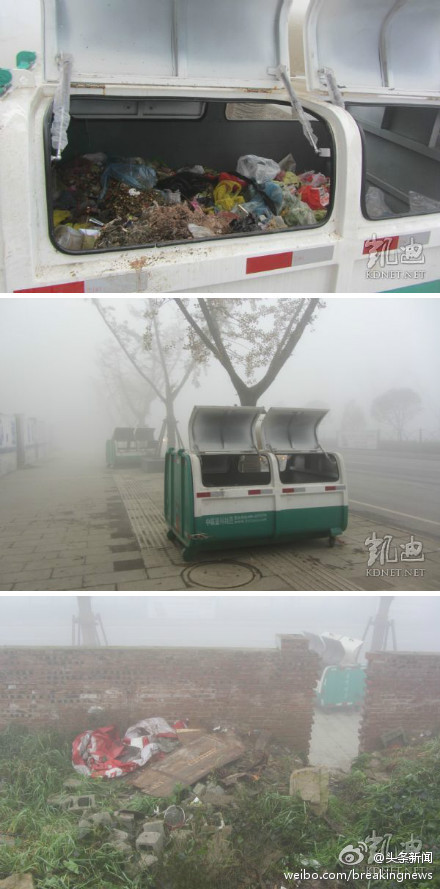
| Five Street Children, Huddling For Warmth In Dumpster, Die Of Suffocation Posted: 19 Nov 2012 09:15 PM PST A really sad story out of Bijie, Guizhou province: on Friday, five young children were found dead in a dumpster, apparently of carbon monoxide poisoning. Xinhua reports that "the boys were suspected to have suffocated as they tried to sleep in the dumpster to survive the cold night" — temperatures were around 6 degrees Celsius, with rain. Offbeat China, which has been on a heck of a roll as of late, tells us that the boys were Tao Zhongjin (12 years old), Tao Zhonghong (11 years old), Tao Zhong (12 years old), Tao Bo (9 years old) and Tao Zhonglin (13 years old), the sons of three brothers. "The five left home on November 5 and never came back since. According to their families, the boys often went out a few days without noticing family members. 4 out of the 5 boys were school drop outs. 8 local officials, including 2 school headmasters, were removed from their posts as a result." Offbeat China has also translated a Chineses story imagining the children's final moments. Excerpt:
|
| Tips for Dealing with Your Child's Homesickness Posted: 19 Nov 2012 08:26 PM PST |
| Shanghai's Best Charcuterie Plates Posted: 19 Nov 2012 06:37 PM PST |
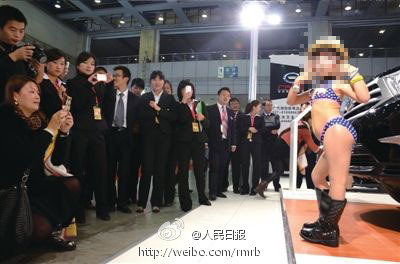
| Company which used child models in bikinis did so to 'boost their confidence' Posted: 19 Nov 2012 07:00 PM PST  In perhaps the most disturbing story to break over the weekend, the company in charge of organizing the Chutian Auto Culture Festival has been roundly criticized for using 5-year-old girls in bikinis in the show. [ more › ] In perhaps the most disturbing story to break over the weekend, the company in charge of organizing the Chutian Auto Culture Festival has been roundly criticized for using 5-year-old girls in bikinis in the show. [ more › ]        |
| Posted: 19 Nov 2012 07:00 PM PST  |
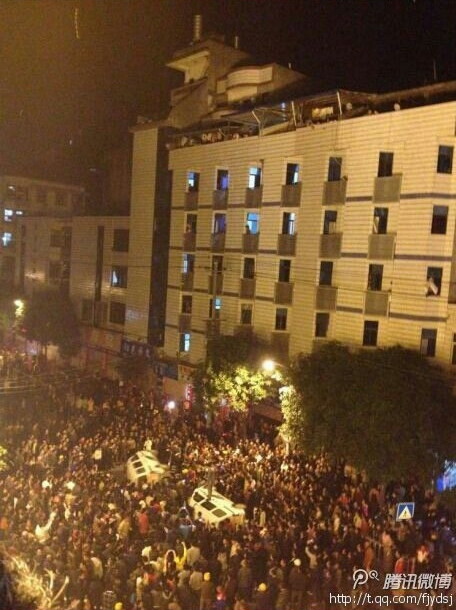
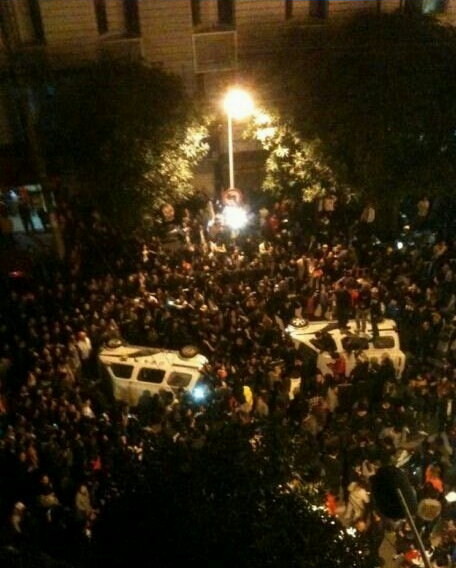
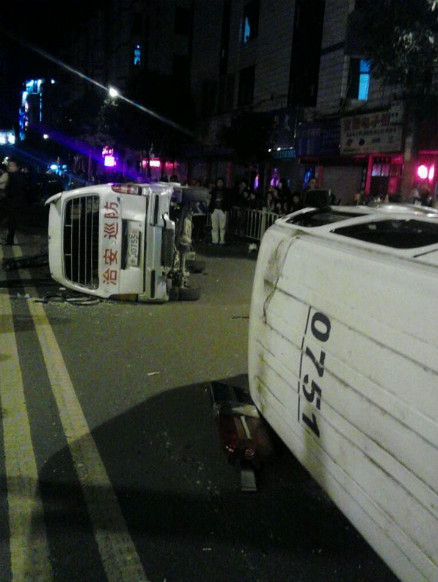
| Posted: 19 Nov 2012 07:02 PM PST We see traffic accidents every day, but in Fuan, Fujian province, one such incident on Saturday reportedly sparked a protest/riot involving "thousands" of residents. The Associated Press reports, "Police said it was instigated by 'a handful of lawless people.' One resident said people became angry because police and paramedics took nearly an hour to arrive to help the injured, while a Hong Kong-based human rights group said it was to do with corruption." Meanwhile, "The Hong Kong-based Information Center for Human Rights and Democracy said about 10,000 people clashed with police, and that 10 police vehicles had been smashed, three overturned and 20 people injured." Accounts differ. AP again:
And the official version of events:
The truth is somewhere in between, but good luck finding it. Youku has scrubbed most videos of the incident, but I was able to find one. It's unclear how long it'll stay on Chinese Internet. Photos via China Digital Times: |
| Watch: 'New Directions from China' art exhibition in London's Southbank Centre Posted: 19 Nov 2012 06:00 PM PST London's Southbank Centre is currently hosting 'Art of Change: New Directions from China', an exhibition which celebrates the work of some of China's most innovative and influential artists from the 1980s onwards. This is the first major exhibition to focus solely on contemporary Chinese installation and performance art. [ more › ]  |
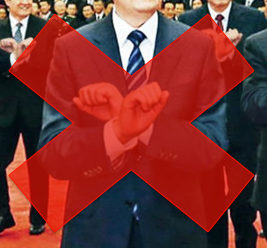
| ‘Gangnam Style with Chinese Characteristics’: China Media Project Posted: 19 Nov 2012 02:21 PM PST Hey, Evan Osnos! Who says China doesn't have Gangnam Style? As soon as I saw this, my optimism about China's next 10 years just shot up. Then, as you have no doubt guessed, this is Photoshoped. And, it was taken down from Sina Weibo. So much for optimism. Here's the short explanation from China Media Project: The following post by Gangsong Samha (港怂萨沙) was deleted from Sina Weibo sometime before 2:57 p.m. on November 17, 2012. The post shares a photoshopped image of Hu Jintao, Wen Jiabao, Xi Jinping and other top Chinese leaders dancing to "Gangnam Style," the popular dance song by South Korean pop artist PSY. The images of Chinese leaders are carefully managed by propaganda leaders, and the suggestion that they would dance in formation and shake their hips is certainly unwelcome. Gangsong Sasha currently more than 131,000 followers, according to numbers from Sina Weibo. [More on deleted posts at the WeiboScope Search, by the Journalism and Media Studies Centre]. PSY's Gangnam Style has been really hot lately! Wuppa! [Ha ha] http://t.cn/zlPmUfa In the unlikely situation that you have never seen Gangnam Style, have a look here and compare Oppan Xi's moves with PSY's:
|
| Posted: 19 Nov 2012 02:30 PM PST |
| China Trademark Basics. I Have My China Trademark, Now What Do I Do? Posted: This is Part II to all the posts we have written stressing the importance of registering your trademarks in China, including the following:
A client recently sent us an email asking us a slew of good questions on China Trademark Basics. We received this email after we had sent the client the certificate of registration from China's Trademark Office showing that it now had a registered trademark in China. Their questions and our answers were as follows: QUESTION: Is there a specific trademark symbol we should use in China, other than ® on our literature or on our equipment? ANSWER: China uses the same symbols as the United States and those symbols have essentially the same meaning in China as they do in the United States.
QUESTION: If our Agent Representatives in China generate sales/technical literature about [Company Name] equipment will it them make sense for us to "assign" our trademark? ANSWER: If someone will use your mark on a product in China AND pay you a royalty in return, you must do a formal trademark license agreement or you are at real risk of losing your China trademark. Not only must you have such a formal trademark license agreement, but you also must register that license with the PRC Trademark Office and, in many cases, with the local authorities as well. However, if you are granting a royalty free license, formal registration is not required. Nonetheless, you should still enter into an agreement with any party that will be using your trademark as such an agreement makes sense to ensure that you can control the manner and use of your trademark. QUESTION: What is the difference between an trademark assignment contract and trademark license contract? ANSWER: A trademark assignment occurs when you allow a Chinese party to make full use of your trademark in China in exchange for a payment of some type of royalty. Under a trademark assignment, you lose ownership and control of the trademark because you have assigned those over to the Chinese party. In a license agreement, you allow a third party to make use of the trademark but you retain ownership and control over it. This license arrangement can be a royalty based license or a royalty free license, as discussed above. Very roughly, think of an assignment as a sale and a license as a lease. QUESTION: I don't understand the non-use revocation possibility. What proof is needed to show that we are using our trademark? ANSWER: Chinese law requires that all marks be used in commerce and if a mark is not used in commerce, another party can demand that the trademark registration be revoked. The requirement that the mark be used in commerce means that it must be used with a product or a service in a commercial context. To date, the PRC Trademark Office has not been very strict about this standard, generally accepting virtually anything as a commercial use. China's courts tend to be considerably stricter regarding this requirement so for this reason, it is a good idea to get out there and use your trademark. Any more trademark questions, readers?         |
| That Picture Of Chinese Leaders Doing Gangnam Style Has Been Censored, Because Censors Hate Fun Posted: 19 Nov 2012 10:27 AM PST Hate it as I do, I understand why some things are censored. You can't have a perpetually restless populace in the countryside, for instance, believing that an alien overlord will descend from heaven and deliver them from misery if only they'll overthrow the current regime. You can't have top leaders exposed as hypocrites. You can't have porn. What I don't understand for the life of me, however, is why THIS is censored. The photoshopped picture of China's top leaders doing Gangnam Style — found on Facebook, posted to this website on November 13 (above link) — was shot down by the moderators of Sina Weibo. A user with more than 131,000 followers, Gangsong Samha (港怂萨沙), posted the pic to Sina Weibo on Saturday, 1:10 pm. It was removed at 2:56 pm. China Media Project explains:
But why is it "certainly unwelcome"? Are we making fun of Hu Jintao? Are we saying Wen Jiabao has a horse-face? Are we commenting on Xi Jinping's inability to move his hips laterally? Help me out here. How is 1) this picture at all political, other than the politicians? and 2) this picture at all insulting? I know the answer, of course. Because censorship. Because censorship. The accompanying text to the Sina Weibo post, by the way, reads:
Ah, there we go. Maybe the censors deleted the post because it was stupid. By the way, we still don't know, definitively, the identify of this image's creator. Please step forward if you're the genius. (H/T Alicia) |
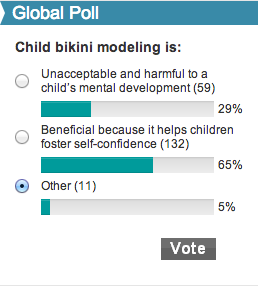
| In Global Times’s Poll, “Child Bikini Modeling Is ‘Beneficial’” Is In The Early Lead Posted: 19 Nov 2012 09:55 AM PST We're not sure how long this poll is going to be up on Global Times's English website's main page — it's not on the Chinese site – but go vote while you can. I actually am curious to see the final results. Only question: What is "Other"? Maybe something like, "Classless, but in a societal vacuum, nothing but harmless and confidence-building fun; yet in the real world, likely to be misconstrued by a segment of the population, especially as it is presented in the context of auto shows in China, and will probably become a source of embarrassment when these models come of age"? I'll vote for Other, just to be on the safe side. (This is what we're talking about.) (H/T Alicia) |
| Photos: Hainan couples compete, break records in kissing contest Posted: 19 Nov 2012 08:00 AM PST       |
| Chinese ambassador to Canada: Prove spy allegations or 'shut up' Posted: 19 Nov 2012 07:00 AM PST |
| Auto Show Organizer Who Used Bikini-Clad Underage Girls Did So To “Boost Their Courage” Posted: 19 Nov 2012 06:44 AM PST Over the weekend, pictures of preteen girls used as bikini models at the Chutian Auto Culture Festival caused controversy in and around China. Basically, everyone thought it was a bad idea, and probably felt a little uncomfortable looking at the images. But what does the Chutian Auto Culture Festival's organizer think? China Daily caught up with one Zhang Ping, general manager of the event's organizers, 7-Wind Motel Costume Company, and what she said might surprise you.
Wait, there's more.
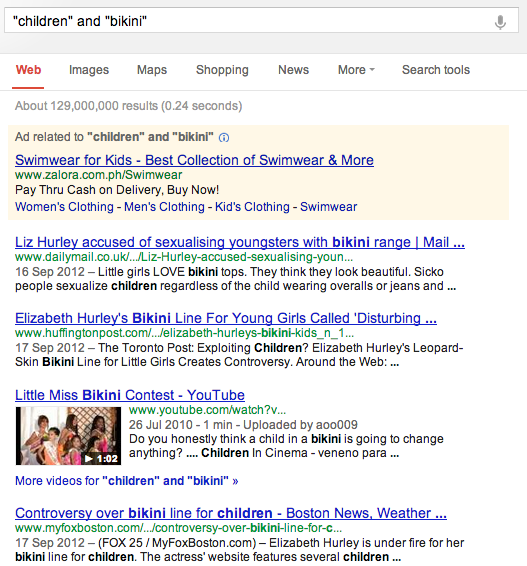
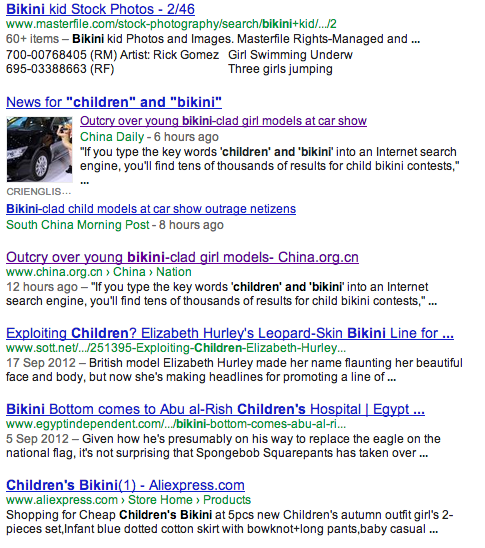
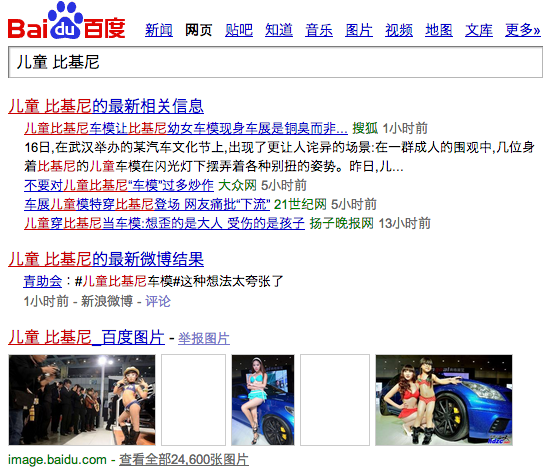
Funny thing, because I did that just now, and here are the top results: And if we just scroll down a little, here's what we find: Outcry. Exploitation. Controversy. Which Internet search engine are we talking about, Ms. Zhang? Baidu? The first page of results is mostly about Chutian Auto Culture Festival. Congratulations, your master plan to gain publicity has worked 10 times better than you imagined.
Just so we're clear on what we're talking about: car shows in China often feature scantily clad females (usually adults) who are necessarily sex objects. All car shows have cars, and usually the same ones, and there are hundreds of car shows every year. How do these events differentiate themselves? The women they hire have only one purpose, and that is to bring attention to the product they're standing next to. Somewhere down the line, organizers realized that having them read Tang poetry wasn't going to do it. Li Yingzhi, one such adult model, once became famous for wearing a risque diamond dress at a car show, then went on a Web show and had a hostess feel up her breasts to prove they were real. This is the context in which Zhang Ping inserted five-year-olds, and she didn't even try to distance them from the context of bikini-wearing adults — they pose side by side.
Okay you crazy shrew. Just let it all out.
Yeah, it's our fucking fault. Not just the media, but social media. Because it's not like we live in the digital age. Look at the photo above. Look past the adults in suits, all those corporate types. Instead, look at the cameras and camera phones. How many pictures are going to stay on those cameras, or used solely for desktop wallpapers? And how many are ending up on Sina Weibo? Zhang, who merely wanted to sell some cars (in a country in which this happens), wants to say to you: for shame. In her beautifully twisted and alien mind, it is us who have exploited those children, viewing them in the wrong context, and drawing attention to the purely commercial cause of selling cars. For fucking shame, you guys. |
| Netizen arrested for 18th Party Congress 'Final Destination' tweet Posted: 19 Nov 2012 05:00 AM PST  Chinese netizens have started an online petition calling for the release of a blogger detained since November 7th. [ more › ] Chinese netizens have started an online petition calling for the release of a blogger detained since November 7th. [ more › ]  |
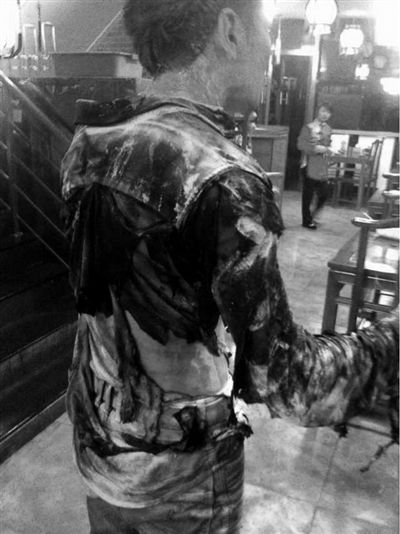
| You’ve Been Warned: Hotpot Can Cause You To Catch On Fire Posted: 19 Nov 2012 05:15 AM PST "Man ignited in hot pot inferno," reads Global Times headline. The story:
Ouch. GT again:
Of course, the restaurant denied responsibility, but it reportedly paid 50,000 yuan in compensation, mostly for Wang's surgery. The restaurant has also suspended services. What does any of this have to do with you, you ask?
So as we enter the heart of hotpot season, i.e. winter, just keep in mind one of mom's first rules: don't play with fire. Or when you do, at least remember that alcohol, unlike water, is flammable. Be careful. (Photo via People's Daily via Sina Weibo) |
| Millions await news of test-tube panda Taotao's "return" to the wild Posted: 19 Nov 2012 01:31 AM PST After a failed experiment in 2007, which led to the infamous death of the panda Xiang Xiang, China is once again attempting to introduce captive-bred giant pandas to the wild. On October 11, at the age of two years and two months, giant panda Taotao went home. Despite criticism and setbacks, the centre has stuck to its plans to train pandas for release to the wild – because its experts believe it is now both feasible and necessary. |
| The 18th Party Congress is over, let’s have some news Posted: 19 Nov 2012 07:57 AM PST by Barry van Wyk on November 19, 2012  Now that the 18th Party Congress is over, newspapers all over China are free again to report on whatever they think can make their front pages as interesting and as inviting as possible. So here's a selection of four front pages that caught our eye today with some everyday stories from around China: The Straits Times (海峡导报) from Fujian province has a Like (喜) and Dislike (惊) contrast on its front page today, where the Like is a picture of a massive pumpkin that was on display at an agricultural fair in Fujian last weekend (appropriately timed for Thanksgiving), and the Dislike is a picture of a child wearing a bikini and acting as car model at a car show in Wuhan last week (see more on this at Offbeat China). The Jinan Times from Shandong province today gleefully reveals the female members of the Liaoning, China's new aircraft carrier, who are shown posing on the deck. The front page of the Wuhan Evening News (武汉晚报) from Hubei province today features some pictures of a competition called "Wuhan Subway Experts" in which contestants had to pick out instances of uncivilized behaviour from a group of people on the subway. Finally, the front page of the Modern Express from Jiangsu province today features the story of Guo Hongzhen (郭红珍), a 69-old retired lady from Nanjing. Every time that a younger person has given up their seat for her on public transport, Ms Guo gave them a little bead ornament. She has so far given away more than 200 of these. Links and sources  |



 China's ambassador to Canada took a break from traditional diplomatic language in an


| You are subscribed to email updates from Update » Blogs » Society To stop receiving these emails, you may unsubscribe now. | Email delivery powered by Google |
| Google Inc., 20 West Kinzie, Chicago IL USA 60610 | |

Comments