| Photo: Wukan June 2012, by Remko Tanis Posted: 20 Dec 2012 11:26 PM PST |
| China Irked by “Hawkish” Abe Posted: 20 Dec 2012 11:13 PM PST A Xinhua News editorial laments the victory of the Liberal Democratic Party in last weekend's election and the imminent elevation of Shinzo Abe as Japan's new prime minister: LDP leader Shinzo Abe was hawkish on the campaign trail, which forecasts more assertive foreign and defense policies by the government he will head. And one of the major things on his to-do list is bolstering Japan's military and coastal defenses. … Though Abe paid lip service to improving China-Japan relations after the election, no specific proposals have been made by Japanese political parties to mend relations with Japan's neighbors. And his words so far on the islands dispute with China run counter to better relations. The LDP's manifested foreign and defense policies won't win Japan friends. Instead, they may destabilize East Asia.
Abe adds another dimension to the standoff in the East China Sea, according to Mark McDonald of The New York Times. He wasted little time in warning China over the disputed Diaoyu/Senkaku Islands, telling a reporter that Japan would not concede "one millimetre" of territory and encouraging China to "think anew" about a mutually beneficial approach to the issue. The LDP's return to power shows that Japan has grown increasingly nationalistic, says Ian Bremmer, who tells Reuters that Japan was "Godzilla" in a year filled with big elections: The next logical step for Japan is to engage with other countries that are concerned about China's rise. That, of course, means strengthening ties with the United States just as much of the country wants to move beyond the legacy of U.S. influence in the country. But reducing its reliance on China could be wise in the long term for a country trying to fend off a neighbor whose growth isn't going to stall anytime soon. What Japan wants to avoid is a situation similar to the one that played out between Russia and Georgia in 2008. Japan has to resist China's provocations, or else risk getting drawn into a deadly confrontation with a larger country that has something to prove. That would hurt the Japanese economy far more than tacking away from China to strengthen its relationship with alternatives like the U.S. The last time Abe was elected prime minister, in 2006, his first foreign trip was to China. Don't count on it this time around.
For The Diplomat, Michael Auslin of the American Enterprise Institute writes that the Abe's policies may enhance regional stability for the same reasons that make China nervous: Clearly, Beijing would not be amused by a stronger, less-constrained, more confident Japan. But much of the rest of Asia wouldn't mind. There might be grumbling over Japan's failure to fully account for its wartime atrocities (and Abe has been on the wrong side of this in the past), but most smaller nations are eager for Tokyo to become a counterweight to China. They may make this case quietly (or in the case of the Philippines, not so quietly), but a stronger Japan that remained closely wedded to the United States would likely be welcomed by states that have territorial disputes with China or worry about the growing presence of the PLA Navy in the region's common waters. Where Abe could make a real difference would be in proposing some significant public goods provisions by Japan, in addition to merely building up Japan's military strength. Working more closely with regional coast guards on training or further revising the arms export law to allow for sales to Southeast Asian nations could help them build up their own capabilities. A greater maritime presence in the East China Sea and perhaps more partnering on training patrols in the South China Sea would answer many of the calls by Hanoi and Manila for a bigger Japanese presence. Beijing would only see this as an attempt by Tokyo to contain China, which is fantasy, given the disparity in size between the two militaries. Yet it speaks volumes about Beijing's assessment of its own isolation, and Japan's potential strength, that it takes so seriously such modest attempts at reform. It would be refreshing if China welcomed Japan's larger role as one that can contribute to regional stability, in part by reducing the chance of miscalculation by countries that believe they can intimidate smaller nations into surrendering their national claims. Of course, since that currently seems to apply mainly to China, there's little chance Asia's two giants will grope their way to a more productive relationship, even by accident.
© Scott Greene for China Digital Times (CDT), 2012. | Permalink | No comment | Add to del.icio.us
Post tags: diaoyu islands, east china sea, Liberal Democratic Party, nationalism, Shinzo Abe, Sino-Japanese relations, XInhua News
Download Tools to Circumvent the Great Firewall
 |
| Weibo Enacts New “7 Day Delay” Function Posted: 20 Dec 2012 07:53 PM PST Weeks after the 18th Party Congress, Sina weibo censors seem to have settled on a new censorship approach to delay in showing sensitive searches . From Feichangdao: The screenshots below show that, two weeks after the announcement of the new Politburo, Sina Weibo administrators had yet to settle on a consistent approach to censoring information about the Communist Party's new leaders. At first glance, it initially appeared that Sina administrators had decided to not censor searches at all. For example, in the left-hand screenshots below, searches for "Xi Jinping" and "Li Keqiang" apparently returned thousands of results and there is no censorship notice anywhere on the page. A closer look reveals, however, that all of the "Hot Posts" were several days old, and the posts following the "Hot Posts" were actually delayed by almost exactly 48 hours. [...] One month after the announcement of the new members of the Politburo Standing Committee, Sina Weibo appears to have settled on a "new normal" – it will impose a one week delay for search results for all PBSC member's names in Chinese, except for "Hot Posts". The screenshots below show that the most recent results for searches for "Xi Jinping" on December 13 and 14 are from December 6 and 7, respectively. [...] The new rule is not only being applied to leaders and their families. These screenshots show that, whereas a search for "Xu Zhiyong" on November 27 returned results from as recently as November 25, the same search on December 18 did not return any results from the preceding seven days (with the exception of "hot posts"). 
See more on internet censorship via CDT.
© Mengyu Dong for China Digital Times (CDT), 2012. | Permalink | No comment | Add to del.icio.us
Post tags: 18th party congress, censorship, Internet censorship, online censorship, sensitive words, sina weibo, weibo
Download Tools to Circumvent the Great Firewall
 |
| China Cautioned: “The Internet is Not Outside the Law” Posted: 20 Dec 2012 07:19 PM PST On December 18, 2012 China's government backed People's Daily published an article on the front page titled "The Internet is Not Outside the Law". The article said: the internet is as much a tool of rumor and misinformation as a platform for information sharing, and everyone must be as responsible and law-abiding online as they are offline.
This piece was soon broadcast on China's state broadcaster CCTV. On the next day, People's Daily reinforced its opinion with another piece [zh]: "Internet Supervision in Accordance with the International Practice."  Screen grab from CCTV news broadcast. Both pieces are being seen as a warning to Chinese web users. Most netizens feel disappointed by the cautious note and are worried that there will be more censorship online in the future. Many netizens critized the articles with retorts aimed at the government. Below are some comments from well-known commentators and bloggers on Weibo, China's Twitter. Vanishing hope 韩志国:蜜月期已经结束《人民日报》连续发表评论,矛头直指微博反腐。在一片期待和欢呼声中,我们又听到了磨刀霍霍。对微博上的各种声音,本可根据文责自负原则通过法律途径解决,而不必采取传统思维和传统方式。尽管社科院报告认为微博的可信度高于新闻联播,但微博的发展空间十分有限,不必过度意淫。
韩志国: The honeymoon period has ended, People's Daily pieces directly point at anti-corruption on Weibo. Among the expectation and cheers, we've heard the sabre-rattling. Various voices on the microblogging can be dealt with through the law instead of having to adopt the traditional way. Despite the Chinese Academy of Social Sciences report that microblogging is more credible than CCTV news, the development and space on microblogging is very limited, so do not place high expectations on it.
大兵看世界:改革只是开始,还是即将结束!当我们寄托希望的时候,我们就要想到失望,只是希望失望不要来的那么快,微博不是法外之地,但希望不要将微博也变成只能歌功 颂德的平台!网络是新生的社会力量,它寄托了太多太多的希望,如果有一天,所有的希望都破灭了,那么还有什么希望呢?
大兵看世界:Is this the beginning of reform, or has it already come to an end? When we gather our hopes, we have to think of the disappointment and just hope the disappointment doesn't come too soon. Weibo is not outside the law, but I hope it won't become a platform to sing praise! The Internet is a new social force that has had too much hope placed upon it. One day, all hopes are crushed. What else can we hope for?
李庆松:这是要释放什么信号,监管,控制,还是封杀。难道这最后一条普通社会公民参与社会监督的阵线也要被政府无情抹杀。民主,这社会何谈民主,悲哀。
李庆松:What message does it deliver? Supervision, control, or censorship. [The Internet] is the last platform for an ordinary citizen to participate in social supervision. Will this be ruthlessly banned by the government? Democracy? How can we talk about democracy in this society? It's sad.
Aurora-trying_to_balance: 还如何言论自由?!刚有几个反腐案例 就有网络不是法外之地的声音!有几个人出来实话实说 新浪就立刻和谐!如此紧闭森严的新闻媒介和环境 中国人很难真正意义上的言论自由。
Aurora-trying_to_balance: How can we talk about freedom of speech? ! The piece came out right after a few anti-corruption cases online. A few people come out to speak the truth, then Sina immediately tries to harmonize! Under such tight control of news and media, it's hard for Chinese people to gain freedom of speech in a real sense.
Retorts at the Government 许小年: Facebook和Twitter在各国是什么惯例?
许小年:[If you follow international practice], what about the practice of Facebook and Twitter?[Facebook and Twitter are blocked in China]
赵楚 :不错,按照普世的现代法治原则,没有任何地方应该成为法外之地,但是,我想在 这里告诉央视和《人民日报》:各级党政的办公楼以及各种戒备森严的官家秘密场所,连同你们两家以公帑运营的媒体,更不应该成为法外之地。
赵楚 :Yes, in accordance with the rule of law, there is no area that is outside the law. But I'm here to tell CCTV and People's Daily: the government office buildings, as well as a variety of the heavily guarded secret places belonging to government officials, together with you two, state-run media, shouldn't be outside of the law.
贺江兵:对人民管治与国际接轨;对官员财产和非法行为讲中国特色;官媒这样如何取信于民?日报之后是不是会发表:《官员财产公开是各国惯例》《官场不是法外之地》。
贺江兵:When it comes to the control of people, they practice international standards; but when speaking of Chinese officials' property and unlawful conduct, they talk about Chinese characteristics. With the double standards, how can a state run media gain the trust of the public? Will you publish another two pieces: "The Public Disclosure of an Official's Wealth is Accordance with International Practice" and "The Land of Officialdom is Not Outside the Law"?
Another interpretation: 琢磨先生:最近新闻联播和人民日报都强调:网络不是法外之地。意思就是告诫微博小秘书,公民有言论自由,不要轻易删帖,否则必将被追究法律责任。
琢磨先生:Recent CCTV news and People's Daily stressed that the internet is not outside the law, which is a warning to the microblogging watchers and censors: citizens have freedom of speech, please do not delete posts, or you will be held liable.
Although netizens are fully aware that censoring microbloggs is a government initiative, they show support for the satirical interpreation, one netizen wrote: 火星人草帽仔:这个理解真是乐翻天!苦中作乐
火星人草帽仔:Its understanding is so funny. Find happiness in adversity.
Written by Abby · comments (0)
Share: Donate · facebook · twitter · reddit · StumbleUpon · delicious · Instapaper |
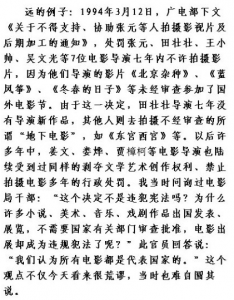
| Veteran Director Raises Curtain on China's Arbitrary Film Censorship Policy Posted: 20 Dec 2012 07:16 PM PST The screening of the previously banned film V for Vendetta on the state broadcaster China Central Television has stirred up hope for censorship reform in China. On December 15, 2012, 70-year-old film director Xie Fei, a heavyweight in China's film industry and professor at the Beijing Film Academy, published an open letter [zh] on his micro-blog, advocating for replacement of China's film censorship with a rating system. Outrageous film censorship practices Fei worries China's development of cultural and creative industries will meet a dead end if the censorship system remains arbitrary and secretive. Similar reform proposal was raised in 2004 but was rejected by the State Administration of Radio Film and Television (SARFT) in 2010.  Cartoon on SARFT's role published in china.cn.org, a Chinese government portal site. Public domain. Fei's letter, addressed to the SARFT, points out that the current censorship system is against China's constitution which protects citizens' freedom of expression and freedom of press. He also discloses [zh] many outrageous censorship practices: 遠的例子:1994年3月12日,廣電部下文《關於不得支持、協助張元等人拍攝影視片及後期加工通知》,處罰張元、田壯壯、王小帥、吳文光等7位電影導演七年內不許拍攝影片,因為他們導演的影片《北京雜種》、《藍風箏》、《冬春的日子》等未經審查參加了國外電影節。由於這一決定,田壯壯導演七年沒有導演新作品,其他人則去拍攝不經審查的所謂「地下電影」,如《東宮西宮》等。以後許多年中,姜文、婁樺,賈梓柯等電影導演也陸續受到過同樣的剝奪文學藝術創作權利、禁止拍攝電影多年的行政處罰。我當時問詢過電影局幹部:「這個決定不是違犯憲法嗎?為什麼許多小說、美術、音樂、戲劇作品出國發表、展覧、不需要國家有關部門審查批准,電影出展卻成為違規犯法了呢?」此官員回答說:「我們認為所有電影都是代表國家的。」這個觀點不僅今天看來很荒謬,當時也難自圓其說。
Past example is: On 12 March 1994, SARFT issued a notice "Do not support Zhang Yuan and others in filming and post-production" to punish Zhang Yuan, Tian Zhuangzhuang, Wang Xiaoshuai, Wu Wenguang, and four other directors; they were banned from making films for 7 years because their productions - "Beijing Bastards", "The Blue Kite", "The Days" - were listed in overseas film festivals without going through domestic censorship. Because of this Tien Zhuangzhaung did not produce any movie for 7 years, others were forced to produce "underground movies" such as "East Palace, West Palace". For many years, directors such as Jiang Wen, Lou Ye and Jia Zhangke have also been deprived of their rights in creative works and banned from making movies because of administrative punishment. I questioned the authorities: "Aren't such decisions against the nation's constitution? While novels, artworks, music and theatre performance is released outside the country without censorship, such practice has become illegal in the film sector?" The official replied: "We regard all movies to represent the state." Such perspectives are unreasonable and ridiculous in today's time.
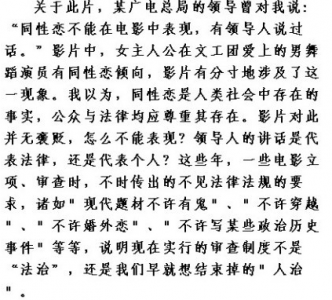
Quoting a more recent censorship case Xie wrote [zh]: 關於此片,某廣電總局的領導曾對我說,「同性戀不能在電影中表現,有領導人說過話。」影片中,女主人公在文工團愛上的男舞蹈員有同性戀傾向,影片有分寸地涉及了這一現象,我以為,同性戀是人類社會中存在的事實,公眾與法律均應尊重其存在。影片對此並無褒貶,怎麼不能表現?領導人的講話是代表法律,還是代表個人?這些年,一些電影立項、審查時,不時傳出的不見法律法規的要求,諸如「現代題材不許有鬼」、「不許穿越」、「不許婚外戀」、「不許寫某些政治歴史事件」等等,說明現在實行的審查制度不是「法治」,還是我們早就想結束掉的「人治」。
A SARFT official told me: "Homosexuality cannot be shown in a movie - a leader's instruction." In the movie, the main female character falls in love with a male dancer who has homosexual tendencies but the film handles the subject delicately. Homosexuality is a social phenomena, the law and the public should acknowledge its existence. The movie does not make any judgement on the practice, why should it be banned? Is a leader's instruction, personal opinion or law? In the past few years, there are so many unwritten laws when censoring movies, such as "ghosts are not allowed in contemporary settings", "extramarital affairs are not allowed", "certain political incidents are not allowed" etc. The censorship system is not based according to [defined] "law" but according to [arbitrary] "individuals".
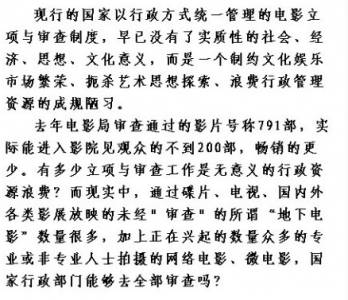
Film censorship kills artistic exploration Xie proposed [zh] replacing the current censorship system with a ratings system: 現行的國家以行政方式統一管理的電影立項與審查制度,早已沒有了實質性的社會、經濟、思想、文化意義,而是一個制約文化娛樂市場繁榮、扼殺藝術思想探索、浪費行政管理資源的成規陋習。 去年電影局審查通過的影片號稱791部,實際能進入影院見觀眾的不到200部, Written by Oiwan Lam · comments (0)
Share: Donate · facebook · twitter · reddit · StumbleUpon · delicious · Instapaper
|
| Doomsday Cult Crackdown Underlies Broader Unease Posted: 20 Dec 2012 06:55 PM PST With the government cracking down on apocalypse rumors this week, rounding up members of an outlawed cult known as the Church of Almighty God, The New Yorker's Evan Osnos explores the Communist Party's uneasy relationship with spiritual movements and its attempts to discredit them: China has a long history of religion-infused political rebellions, dating at least to the nineteenth century, when a group called the Taiping Heavenly Kingdom attempted to overthrow the emperor. But these days the Party is especially uncomfortable with obscure religious beliefs because, in the post-Socialist era, many in China have begun to hunt for something to believe. At times, it can feel like half the people at a dinner table are trying out a new guru. In my neighborhood the other day, I was walking down a hutong that hugs the eastern wall of the Confucius Temple, when I came upon a new set of official posters on the bulletin board. They were cartoons with big-headed smiling figures and puffy comic-book writing, beneath the title, "Be On The Lookout for Cults, Build Harmony." This was the latest offering from the government body known as the Beijing Counter-Cult Association. The association seems to be especially busy in our neighborhood because it's ground zero for spiritual activity of one kind or another in the capital. In addition to the Confucius Temple, it is home to the Lama Temple (Beijing's largest Tibetan monastery) and it has several blocks of fortune tellers. The new posters contained a set of instructions: "Countermeasures for the Falun Gong's Everyday Tricks of Trouble-Making and Destruction." It's been thirteen years since China cracked down on the Falun Gong spiritual movement, arresting practitioners and pressuring them to renounce their beliefs. (The group's status was the subject of a hearing this week before the Congressional-Executive Commission on China.) But China maintains a fierce opposition to the group, and the posters provided a sense of how the government perceives that kind of threat.
In response to Osnos' piece, historian Jeffrey Wasserstrom of the University of California-Irvine commented that China's history of doomsday cults stretches back far before the Taiping Rebellion. Meanwhile, The New York Times' Andrew Jacobs has more on the Church of Almighty God: Critics, including clerics from established Christian congregations, accuse Almighty God evangelists of strong-arm conversion tactics that include kidnapping and study sessions lasting days that they describe as brainwashing. Among the group's central tenets is a belief that the messiah has arrived and that she is in hiding somewhere in China.
To protect themselves from near-constant persecution, congregants do not know one another's names and instead call one another by nicknames like "Doggy" and "Little White Rabbit," according to a report last week in China Business View. The church seems to have especially alarmed Chinese leaders by prophesizing the coming demise of the Great Red Dragon, its evocative code name for the ruling Communist Party.
© Scott Greene for China Digital Times (CDT), 2012. | Permalink | No comment | Add to del.icio.us
Post tags: apocalypse, church of almighty god, cults, religion, Taiping Rebellion
Download Tools to Circumvent the Great Firewall
 |
| The Government’s Solution to the Bijie Boys Posted: 20 Dec 2012 11:24 AM PST I rarely if ever do posts like this, but if you haven't come across this news already, you should read this post from Offbeat China. For the lazy, here's the short version: dumpsters painted with this message are now appearing around Bijie: Humans and animals are strictly prohibited to enter. Violators are at their own risk. 
Normally, I would write a long, angry post about this, but this time I am literally dumbstruck. Even in the deepest depths of my cynicism, I couldn't have imagined this would even occur to anyone as a serious idea, let alone that it could get approved and would actually be carried out. VN:F [1.9.10_1130] Rating: 0.0/10 (0 votes cast) Tags: Bijie boys  |
| All Eyes on New Guangdong Party Chief, Hu Chunhua Posted: 20 Dec 2012 04:29 PM PST Among a slew of other new appointments this week, Xinhua reported that Hu Jintao protégé "Little Hu" Chunhua is to be the new Party chief of Guangdong province. His time at the helm of the economic powerhouse is likely to pave the way for national leadership in the future. Hu Chunhua has been appointed secretary of the Guangdong Provincial Committee of the Communist Party of China (CPC), replacing Wang Yang, the CPC Central Committee announced Tuesday. Wang Jun will replace Hu as secretary of the Inner Mongolia Autonomous Regional Committee of the CPC, according to the announcement. Hu, born in April 1963, is currently a member of the Political Bureau of the CPC Central Committee. Wang Yang is also a Political Bureau member. Hu previously served as deputy secretary of the Tibet Autonomous Regional Committee of the CPC, first secretary of the Secretariat of the Communist Youth League of China Central Committee and governor of north China's Hebei Province.
At the South China Morning Post, Mimi Lau described a range of views on Hu's appointment and prospects: Liu Kaiming, director of the Institute of Contemporary Observation, a labour rights NGO in Shenzhen, said Hu lacked the track record of outstanding political achievements necessary to impress Guangdong officials. "After spending extensive time in remote inland areas, Hu might find it hard to fit in at first in Guangdong, especially when dealing with vested interests," Liu said. "I'm not very sure about officials from remote regions because they often appear very conservative and arrogant, but Hu might be different because he's young." […] Dr Peng Peng, a researcher with the Guangzhou Academy of Social Sciences, said Hu would have to hunker down after arriving in Guangdong because it was unlike any other mainland region. "The press here is outspoken and the public can often complain directly to leaders," Peng said. "In order to do a good job in Guangdong, Hu needs to be even more open-minded than Wang Yang. "Wang Yang laid a solid foundation. Hu is much younger than Wang. I'm guessing Hu is more likely to flow with the open atmosphere in Guangdong."
But at The Diplomat, David Cohen sounded a cautious note on the prospects for bold reform: A Guangdong posting will give "Little Hu" a chance to burnish his reformist credentials, like Wang Yang before him. If Xi follows through on his talk of reform, that may prove to be a valuable skill. Guangdong is China's most liberal province and frequently given to experimentation — if Xi is looking for models for national reform the leader of Guangdong may get some chances to influence the direction of national policy with some inventive provincial initiatives, such as Wang Yang's much-ballyhooed "Wukan model." This trend should also give us some pause before rooting for Wang or Hu as reformers — neither of their records shows particularly bold action before traveling to Guangdong, so to some extent Wang's liberal policies in the southern province may simply reflect institutional momentum. In fact, besides his time in Tibet, Little Hu initiated a harsh crackdown at the first signs of protests in Inner Mongolia in the spring of 2011. Some felt Hu had overreacted but he did not shirk from his decision, recently telling the Financial Times, "When we deal with mass incidents, there is no question we will take compulsory measures . . . We will be tough when we need to be tough, and we will be soft when we need to be soft."
Reuters' Sui-Lee Wee outlined Hu's earlier career: In Inner Mongolia, Hu Chunhua, also known as "Little Hu", has been referred to as a future president. While there, Hu Chunhua oversaw rapid economic growth and dealt successfully with protests last year by ethnic Mongols. Hu Chunhua came to Inner Mongolia following a brief stint in Hebei, the arid province which surrounds Beijing, where he was rapidly moved after a scandal over tainted milk in which at least six children died and thousands became ill. Hu Chunhua remains something of an enigma, even in China. He has given few clues about his deeper policy beliefs. One of the best known things about him is that he does not appear to dye his hair jet black like many politicians. In meetings with the public, Hu Chunhua comes across as low key and self effacing, in line with an image of a loyal, humble Communist Party member. People who have met him describe him as relaxed, easy-going and spontaneous, unlike stiffer party leaders.
Hu and newly appointed Chongqing Party chief Sun Zhengcai were both elevated to the Politburo last month, and are likely to rise further to the Politburo Standing Committee in 2017 and the presidency and premiership in 2022. (See Cheng Li's profiles of the two men at the Brookings Institution.) None of this can be taken for granted, however: neither of their predecessors, Wang Yang and Bo Xilai, has followed the trajectory widely anticipated even at the start of this year. The Associated Press' Didi Tang focused on Wang Yang, Guangdong's previous Party chief, whose next assignment has not yet been revealed: Xinhua gave no indication of Wang's next job, but China watchers said he is likely to be named a vice premier when China's legislature meets in the spring. Wang, 57, is seen as a politically liberal figure. He failed to win a seat on the party's ruling seven-member Standing Committee when new leaders were installed last month but was named to the lower-ranking Politburo. […] Wang was seen at Xi's side when the general secretary visited Guangdong in early December. Li Cheng, an expert on China's elite politics at Washington-based think tank Brookings Institute, said the appearance of the two together was to show the solidarity of the party leadership, because Wang is not considered to be in Xi's camp in China's factional politics. "It's a symbol of unity," Li said.
Hu's replacement in Inner Mongolia, Wang Jun, has extensive experience related to the autonomous region's heavy mining industry. Wang was appointed governor of coal-rich Shanxi province following an accident which claimed more than 270 lives at an iron mine in 2008, and had previously headed the national work safety agency. His acting replacement in Shanxi is Li Xiaopeng, son of former premier Li Peng. New Party chiefs for Zhejiang, Shaanxi and Jilin were also announced on Tuesday, with appointments for Fujian and Guangxi following the next day. The blizzard of new posts sent a "subtle message", according to a Global Times editorial, which hailed the new provincial leaders as offering the public a fresh start. The Party secretary is the very top leader in a province. The prominence of this position differs from Western systems and is the key to ensuring that the Party rules the country's political system. […] The population and economic scale of many provinces exceed those of middle-sized countries. As China is undergoing rapid development and social conflicts, the difficulties in managing a province can be much greater than managing a global power. […] Party secretaries should make efforts to improve communication with the public. We are looking forward to those who are outspoken and can interact with the public. A new political style has been showcased by the Party's top leadership. These new provincial leaders are expected to emulate it in solving local problems.
© Samuel Wade for China Digital Times (CDT), 2012. | Permalink | No comment | Add to del.icio.us
Post tags: Bo Xilai, Chongqing, Communist Youth League, Fujian, Guangdong, Guangxi, hebei, Hu Chunhua, Hu Jintao, Inner Mongolia, jilin, Politburo, Politburo Standing Committee, Shaanxi, Shanxi, tainted food, Tibet, Wang Yang, Wukan, Xi Jinping, Zhejiang
Download Tools to Circumvent the Great Firewall
 |
| Chinese Responses to the North Korea Missile Launch Posted: 20 Dec 2012 03:43 PM PST |
| Ambassador Locke: US ‘Not Trying to Contain China’ Posted: 20 Dec 2012 03:50 PM PST At a recent event at the Asia Society in New York, Ambassador Gary Locke spoke with Asia Society's Orville Schell and George Stephanopolous of ABC News about the current status of U.S.-China relations and the new leadership in Beijing. From Asia Society's website: "There will be continuity in the U.S.-China relationship," Locke told a standing-room-only crowd at Asia Society in New York on Monday evening. "So much of the world's economy is in the Asia-Pacific arena. Almost 60 percent of the world's GDP is in the Asia-Pacific region. And we are so economically intertwined as two countries. … So many of the problems facing the world today will only be solved with the United States and China cooperating and collaborating together." Locke was joined on stage by moderator George Stephanopoulos, of ABC News, and Asia Society's own Orville Schell, who heads up the Center on U.S.-China Relations. Locke and Schell both had positive things to say about new Chinese leader Xi Jinping, who was named Hu Jintao's successor at the highly secretive 18th Party Congress of the Communist Party of China in Beijing last month. "He's very much more casual, more at ease in public and with people," Locke said. But he later added, "We don't really have a great sense of the policies of Xi Jinping, because China is ruled by a committee of seven. … We really won't know for a while exactly how fast, how far he's going to move, and what areas he'll emphasize."
See a video of the event:
© Sophie Beach for China Digital Times (CDT), 2012. | Permalink | No comment | Add to del.icio.us
Post tags: Gary Locke, U.S. relations, Xi Jinping
Download Tools to Circumvent the Great Firewall
 |
| Ministry of Truth: Watches and Wives Posted: 20 Dec 2012 03:51 PM PST Central Propaganda Department: Li Junwen, the people's representative of a certain district in Shanxi, has been forced to take mandatory measures. Except for printing and broadcasting Xinhua wire copy, do not play up the news, and do not employ other sources of information. (December 6, 2012) 中宣部:山西某区人大代表李俊文被采取强制措施,除按新华社通稿刊播外,不炒作,不采用其他来源信息。 Central Propaganda Department: There is an online rumor that the mayor of Lanzhou wears a name brand watch. Except for printing and broadcasting Xinhua wire copy, do not play up the news, and do not employ other sources of information. (December 6, 2012) 中宣部:网传甘肃兰州市长戴名表,除按新华社通稿刊播外,不炒作,不采用其他来源信息。
These censorship instructions, issued to the media and/or Internet companies by various central (and sometimes local) government authorities, have been leaked and distributed online. Chinese journalists and bloggers often refer to those instructions as "Directives from the Ministry of Truth." CDT has collected the selections we translate here from a variety of sources and has checked them against official Chinese media reports to confirm their implementation. Since directives are sometimes communicated orally to journalists and editors, who then leak them online, the wording published here may not be exact. The original publication date is noted after the directives; the date given may indicate when the directive was leaked, rather than when it was issued. CDT does its utmost to verify dates and wording, but also takes precautions to protect the source.
© Anne.Henochowicz for China Digital Times (CDT), 2012. | Permalink | No comment | Add to del.icio.us
Post tags: censorship, Directives from the Ministry of Truth, Internet censorship, Li Junwen, media censorship, Ministry of Truth, official corruption, propaganda, sex scandals
Download Tools to Circumvent the Great Firewall
 |
| Ministry of Truth: Dispatch from Guangdong Posted: 20 Dec 2012 03:40 PM PST  Elton John dedicated his Beijing concert to Ai Weiwei. News of a repeat performance in Guangdong was quashed. Guangdong Propaganda Department: On November 30, the Public Security Bureau of Xiangqiao District, Chaozhou City investigated and prosecuted, according to the law, the case of an assembled crowd stirring up trouble and distorting social order. For the time being, do not report on related issues. (December 4, 2012) 广东省委宣传部:潮州市湘桥区公安分局11月30日依法查处一起聚众滋事扰乱社会秩序案件,对相关问题暂不报道。
Guangdong Propaganda Department: Regarding follow-up reporting on the protests of universities near the Baiyun Mountain Tunnel, carry the information issued by authoritative bureaus of the Guangzhou government. Do not play up the story. (December 4, 2012) 广东省委宣传部:有关白云山隧道遭周边大学反对的后续报道,以广州市权威部门发布的消息刊播,不炒作。
Students protested the planned construction of the tunnel, which would cut underneath the campus of the Guangdong University of Foreign Studies [zh]. Guangdong Propaganda Department: Do not report or comment on the questions asked by a journalist directed at Internet monitoring issues at the December 4 Shenzhen Internet Association news conference. (December 4, 2012) 广东省委宣传部: 4日深圳网络协会发布会上,有记者针对互联网监管问题提问的相关内容不报不评。
Guangdong Propaganda Department: Do not independently investigate, report, or comment on the series of corruption cases in Maoming, with the exception of those which are arranged unified manner. (December 5, 2012) 广东省委宣传部:关于茂名系列腐败案,除统一部署外,一律不自行采访报道评论。
Guangdong Propaganda Department: Without exception, do not report on anything related to British singer Elton John's concert in Guangzhou tonight. (December 6, 2012) 广东省委宣传部:对英国歌手艾尔顿.约翰今晚在广州开演唱会一事一律不报。
Elton John dedicated his November 25 concert in Beijing to Ai Weiwei. Guangdong Propaganda Department: In reporting on the handover of work among important provincial Party Committee leaders, follow strictly and without exception Xinhua and provincial committee office wire copy (do not change titles or content). Do not produce any other reports or commentary except for the wire copy. (December 19, 2012) 广东省委宣传部:对省委主要领导工作交接相关报道,一律严格按新华社和省委办公厅通稿刊播(不改标题和内文),除通稿外不作其他任何报道评论。
These censorship instructions, issued to the media and/or Internet companies by various central (and sometimes local) government authorities, have been leaked and distributed online. Chinese journalists and bloggers often refer to those instructions as "Directives from the Ministry of Truth." CDT has collected the selections we translate here from a variety of sources and has checked them against official Chinese media reports to confirm their implementation. Since directives are sometimes communicated orally to journalists and editors, who then leak them online, the wording published here may not be exact. The original publication date is noted after the directives; the date given may indicate when the directive was leaked, rather than when it was issued. CDT does its utmost to verify dates and wording, but also takes precautions to protect the source.
© Anne.Henochowicz for China Digital Times (CDT), 2012. | Permalink | No comment | Add to del.icio.us
Post tags: censorship, Directives from the Ministry of Truth, Guangdong, media censorship, Ministry of Truth, propaganda
Download Tools to Circumvent the Great Firewall
 |
| Why is it in China’s Interest to Promote Health Security in Southeast Asia? Posted: 20 Dec 2012 02:38 PM PST If there is a buzzword one needs to know to understand U.S. foreign policy toward Asia in 2013, it is "rebalancing," or in the words of President Obama "pivoting." Rebalancing is of course not solely about military redeployment. Indeed, a critical element of the U.S. rebalancing strategy in the region is to nurture partnerships with countries and international institutions to address common threats in areas such as regional health security. Being the epicenter of major endemic and epidemic diseases, Southeast Asia has often been perceived as a major threat to global health security. Last week, Indonesia identified a more virulent strain of bird flu that has killed more than 300,000 ducks on the island of Java since November. That said, China and Southeast Asia share a range of health challenges, from SARS to HIV/AIDS and H5N1. Altogether, China and Southeast Asia account for approximately 90 percent of SARS cases and two thirds of the human cases of avian influenza. Since the wake of the SARS debacle in 2003, Beijing has been actively engaging Southeast Asian countries in health-related cooperative efforts. Today, China's partnership with countries in this region and other stakeholders (e.g. the United States) around health security has never been so important. There are at least three reasons that make China's engagement in regional health security imperative. The first reason why this commitment is vital is tied to regional trade and economic concerns. Economic and trade links are perceived by Beijing as the foundation for cooperation between China and Southeast Asia. While the United States remains the most powerful military power in this region, China is the most robust economic power on the block. U.S. rebalancing efforts in Asia highlight the importance for China to continue sending clear and positive message that China's rise is more of an economic opportunity than a security threat for Southeast Asia. Thanks to the launch of the China-ASEAN Free Trade Area (FTA), bilateral trade surged to 362.8 billion dollars in 2011. China is now the largest trading partner of the Association of Southeast Asian Nations (ASEAN), with ASEAN being China's third-largest trading partner. Last year, personnel exchanges reached 13.6 million. Beijing certainly does not want the flow of trade and people ruined by a SARS-like disease outbreak. Another reason for greater engagement in regional health security is geostrategic. Beijing initially engaged Southeast Asian nations on health issues as part of efforts to allay fears about rapidly rising Chinese power. Today, the need for such strategic reassurance becomes all the more important given the growing concerns about China's assertiveness in the South China Sea and the U.S. strategic pivot to Asia. Every country in this region wants to develop better relations with China. However, with the changing strategic landscape Beijing may find additional reasons to conduct active health diplomacy as a tool to project "smart power." A growing consensus among foreign policy makers is that expanded cooperation around addressing common challenges helps nations build trust and reduce tensions around more contentious policy issues. By scaling up its health-related cooperative efforts, China will also benefit from an improved image in its "not-so-beautiful neighborhood." In addition, given the tremendous health challenges China is facing, it is in Beijing's interest to avoid being seen as a source of health problems in Southeast Asia. More than one third of the anti-malaria drugs today are either fake or substandard in Southeast Asia (which is associated with the rapid rise of drug-resistant malaria in the region), and much of the counterfeiting is believed to take place in China. China also needs to be more actively involved in efforts for ensuring region health security because of domestic social-political considerations. Increasing trade links within Southeast Asia can serve as conduits spreading infectious disease. The 2002-2003 SARS epidemic resulted in one of the most serious social-political crises in China. The domestic social-political repercussions of major health problems coupled with the growing sense of insecurity among the Chinese leadership render health challenges in Southeast Asia a political stability concern for China. At the subnational level, two Chinese border provinces – Yunnan and Guangxi – would be critical stakeholders in China-ASEAN cooperation on health issues. Bordering Vietnam, Laos, and Myanmar, the two provinces should be seriously concerned about resurging vector-borne diseases such as dengue and Japanese encephalitis, and drug-resistant infections such as arteminsinin-resistant malaria and MDR/XDR-TB in the region. The spillover from a disease outbreak in the region may become more likely due to a lack of core capacities in many ASEAN countries to detect, assess, notify, and effectively respond to public health emergencies. |
| Ministry of Truth: Net Safety and the Safety Net Posted: 20 Dec 2012 03:03 PM PST  Unmasking an "Internet criminal" with the real-name registration system. (Guangming Daily) Central Propaganda Department: In the near future, Xinhua News Agency, People's Daily, and other central media outlets will successively report typical cases of threats to Internet safety and infringement on citizens' personal information. All media and websites are kindly asked to republish these documents in their entirety. Do not modify titles or content. Do not voluntarily collect reports and commentary related to Internet safety management, especially those voices which challenge Internet safety management. (December 19, 2012)中宣部:近期新华社、人民日报等中央媒体陆续刊播危害网络安全侵犯公民个人信息的典型案例,请各级媒体和网站全文转载,不改动标题内容,不自行组织有关涉网络安全管理的报道评论,尤其是刊播质疑网络管理的声音。 Central Propaganda Department: Do not sensationalize the issue of insufficient funds for pensions in urban areas reported in the Academy of Social Sciences China Pension Report 2012. (December 19, 2012) 中宣部:不炒作中国社科院《中国养老金发展报告2012》中有关城镇职工养老金收不抵支的问题。
Central Propaganda Department: All media outlets are asked to prominently carry "Internet a Major Disaster Zone for Leakage of Private Information" from the People's Daily and "Punish Internet Criminals, Strengthen Online Information Protection and Management" from Xinhua's "Letter from a Journalist" series. (December 19, 2012) 中宣部:请各媒体20日在重要版面转载人民日报《个人信息泄露,网络是重灾区》和新华社"记者来信"的《惩治网络违法犯罪,依法加强网络信息保护和管理》两篇稿件。
These censorship instructions, issued to the media and/or Internet companies by various central (and sometimes local) government authorities, have been leaked and distributed online. Chinese journalists and bloggers often refer to those instructions as "Directives from the Ministry of Truth." CDT has collected the selections we translate here from a variety of sources and has checked them against official Chinese media reports to confirm their implementation. Since directives are sometimes communicated orally to journalists and editors, who then leak them online, the wording published here may not be exact. The original publication date is noted after the directives; the date given may indicate when the directive was leaked, rather than when it was issued. CDT does its utmost to verify dates and wording, but also takes precautions to protect the source.
© Anne.Henochowicz for China Digital Times (CDT), 2012. | Permalink | No comment | Add to del.icio.us
Post tags: censorship, Directives from the Ministry of Truth, Internet safety, media censorship, Ministry of Truth, pensions, people's daily, propaganda, Xinhua
Download Tools to Circumvent the Great Firewall
 |
| Chinese State Television’s Helpful Online Announcement: World There Ends at 3:14:35 p.m. Posted: 20 Dec 2012 02:29 PM PST  Let the countdown begin. (Via Weibo) Chinese authorities may be busy cracking down on a "doomsday cult," but end-of-days chatter is still dominating Sina Weibo, China's Twitter. A recent search early in the morning on December 21, 2012, Beijing time shows that five of the ten "hottest" posts on the micro-blogging platform all relate to the forthcoming end of the world. Clocking in at #1, with over 100,000 re-posts and 20,000 comments, is this announcement from state-run China Central Television's social media account: "December 21st is the final day of the Mayan calendar, and the so-called 'doomsday.' Due to the time difference, it will be 3:14:35 in the afternoon before China enters 'doomsday.' Some netizens have said, 'The timing is good, at least the markets will have closed so I can tell whether I've earned made money or lost money.' Tomorrow at 3:14:35, what will you do?"
Many Web users' answers were honest, if prosaic–they'd be eating ("definitely eating dumplings!"), sleeping, at work, or in the library. @木牙步 from Xi'an wrote, "December 22 is my birthday, so first I will wish myself [an early] happy birthday." Others took the opportunity to reflect. @美库原创黎冬 from Beijing hoped for "a chance to be reborn and to forget our grudges." @忠义慎言 from Nanjing city wrote, "For people living in war, hunger, poverty, or under a dictator, every day is doomsday." @蒜苗欲放香, who claims to live abroad, wrote, "As a normal Chinese person, I first want to say that today is the winter solstice before it is doomsday. Every year at winter solstice, I always constantly think about my hometown…it's been so many years since I've spent the solstice in my home town!" Well-known online personality Zuoye Ben (@作业本)'s reflection clocked in among the top ten "hottest" tweets of the day. He wrote: "Regardless of whether there is a doomsday, after December 21, everything will begin anew. You once watched helplessly and powerlessly as time slipped away, the nation ignored individuals, strangers were impolite to you, your love dumped you, and you couldn't avoid saying farewell to friends…you've waited for a day that's already been [talked about] too much, and afterwards, everything will be as you wish. Hello, doomsday. [May you be] a new beginning."
 Doomsday tweets–both humorous and reflective–dominated the Weibo top 10. New beginning indeed. The fact that China has recently sought to tamp down some doomsday chatter was not lost on some commenters. A number of users joked that police should arrest CCTV–or even confine them to re-education through labor–for "spreading rumors" about doomsday. Others wrote that they could not believe CCTV's official account had posted this (faux) announcement. But this is not the first time that CCTV has pleasantly surprised netizens. As Oiwan Lam of Global Voices reported, just days ago, CCTV Channel 6 shocked observers by broadcasting for the first time "V for Vendetta," a film that depicts the overthrow of a tyrannical government in dystopian London. In any case, casual doomsday chatter may be a bit less seditious than vigilante justice, and CCTV was in thick company here. Ashin (@阿信), lead vocalist for the beloved Taiwanese band Mayday, posted a hilarious image of Micky and Minnie Mouse covering their eyes as a purple mushroom cloud exploded in the background. User @angelababy, an actress in Hong Kong, also made the top ten by posting a reverse horoscope, one instructing–not predicting–what members of each astrological sign should do in their final moments: Aries: Rob a bank Gemini: Have a crazy amount of fun Leo: Give everything you have to charity Libra: Get all made up Sagittarius: Go streaking Aquarius: Travel the world Taurus: Enjoy life Cancer: Be with your family Virgo: Bravely confess everything Scorpio: Escape the earth Capricorn: Get lost in memories Pisces: Hold hands with your lover
Time will–very shortly–tell whether any of the above is useful or prescient. For now, readers are advised to be with the loved ones; or to have fun; or to enjoy life. Perhaps such advice is sage no matter the date.  |
| Pupil slapped by 50 classmates in turn as teacher goes mad over him Posted: 20 Dec 2012 05:17 AM PST 
A photo showing a pupil's swollen and bruised face has aroused public anger again online. This is another case of child abuse that occurred recently in Ankang city, Shaanxi province. Because the child failed to complete his homework in time, his angry teacher, surnamed Luo, beat him. And later, the teacher again ordered a class of 50 other students to slap in his face in turn. The poor pupil, 12 years old, told the reporters that he was laughed by classmates when his face turned red and swollen after the beat. And he did not realize that before seeing himself in the mirror. The 22-year-old teacher, who had worked in this primary school for two years, has confessed his wrongdoing, and now been suspended from his job. The child abuse is not rare in schools in China. Several days ago, a middle school in Zhejiang province saw a teacher dumping a garage can over a student's head too because the teacher believed the student was eating snack in his class. Source: HugChina |
| Netizen Voices: No Place Is Outside the Law Posted: 20 Dec 2012 01:14 PM PST  CCTV reported on the People's Daily article "The Internet is Not Outside the Law" on its prime-time news show. When CCTV aired V for Vendetta, uncut, last Friday, netizens thought it was a sign that reform is truly on its way. They were a bit crushed, then, to read a signed article in Tuesday's People's Daily entitled "The Internet is Not Outside the Law." The official media should at least hold itself to the same standards as netizens are now being asked to, savvy commenters complain. Some worry the article marks an official response to a series of "Internet anti-corruption" efforts in which human flesh searches and vocal complaint about abuses of power have forced the government's hand. Everything from luxury watch collections to bedroom antics have been exposed online, costing a number of officials their jobs. Will the censors now crack down on Internet justice? From Weibo: author-blessing: The Internet is not outside the law? In that case, please respect the constitution; do not delete comments as you please, do not detain people as you please, and do not wield labor re-education as you please. 作家-天佑:网络不是法外之地?那请你们尊重宪法,不要随便删帖,不要随便抓人,不要随便劳教。 JinningMantouMonster: On the one hand, you people take in an astronomical amount of advertising money, and on the other, you enjoy lucrative government funding. On top of all that, you retain exclusive privileges to the Spring Festival Gala and special rights to broadcast your news show over every local satellite channel every day from 7-7:30 p.m. You're half government and half business, and yet you have the audacity to talk to me about the rule of law? Piss off! 馒头妖在金宁:你们,一边收着天价的广告费,一边享受着财政拨款,还占着除夕晚会的特权、每天19:00-19:30强制地方卫视性转播你家新闻的特权,半官半商,居然还有脸给我说法制?死滚! ZhaoChu: CCTV's News Simulcast publicized a People's Daily article about how "the Internet is not outside of the law." Not bad. According to the universal, modern principles of the rule of law, nothing should fall outside the boundaries of the law. However, I wish to inform CCTV and People's Daily of the following: every office of every level of the Party and the government, all heavily guarded secret government locations, and even the two of you, which are government-funded and operated, should even more so not exist outside the boundaries of the law. 赵 楚 : CCTV新闻联播高调转发《人民日报》文章,说什么"网络不是法外之地",不错,按照普世的现代法治原则,没有任何地方应该成为法外之地,但是,我想在这 里告诉央视和《人民日报》:各级党政的办公楼以及各种戒备森严的官家秘密场所,连同你们两家以公帑运营的媒体,更不应该成为法外之地。 HeBin: So CCTV is the only one outside of the law? 何兵: 央视才是法外之地? Evan_Chen: Government officials should not do their work outside of the law, yet your corruption is impossible to ignore. News Simulcast should not speak outside the law, yet you continue to spew nothing but lies. No offense, but my level of acceptance for this government and this TV station is zero. Evan_Chen的微博:国家公务人员也不是法外职务,但你照贪不误;新闻联播不是法外之言,但你依旧谎话连篇。不客气的说,我对这个政府和这个电视台的认可度是零。 PoliteYoungMaster: Totally, man! It's only the government that is outside the effing boundaries of the law! 和气大少爷:那是,那是!官场才是尼玛法外之地! chuyoo: What the crap… I'm a law-abiding citizen! But are you sure you're in accordance with the law? chuyoo:卧槽,我可是遵纪守法滴。。你们有没有按照法律来呢? NanQianZhu: In today's China, justice is found mostly online. Democracy is found mostly online. Law-abiding citizens, for the most part, I'm afraid, are found mostly online. The Internet is virtually the only channel through which Chinese can freely access information. The Internet and the country's citizens aren't outside the law–that's the domain of the government and corporations. 南千住:现在的中国,最多的正义在网上,最多的民主在网上,最守法的公民怕也多在网上。网络几乎是唯一可以自由得到信息的途径。法外之地不在网络不在民众,在官在商。 HeartwoodLife: For the most part, signed People's Daily articles don't actually represent the work or views of an individual. Even though an author's name is given, it name obviously represents the combined views of a given organization. For example, take Zhong Xuanli. That's obviously the Central Propaganda Ministry's Indoctrination Bureau. And Zhong Zuwen is the Central Organization Department. Actually, precedent for this kind of tactic dates back to ancient times. 心木生活:人民日报的署名文章一般都不是代表个人,尽管都有署名,其实这个署名一看就知道是某个机构的谐音。比如仲轩理,就是中共中央宣传部理论局,仲祖文就是中共中央组织部。其实这种传统古而有之。
China Media Project all points out that the name of the article's author, Mo Jinjin, is likely a fictional commentator representing an entire government department. WenZhige: These fucking mouthpieces… First they say the law is not a shield, and then they say the Internet is not outside the law. What kind of ass-backwards logic is this? 文止戈:这些狗日的喉舌,一会儿说法律不是挡箭牌,一会儿说网络不是法外之地,这是什么狗屁逻辑? Accener: Those watch brothers and house uncles must be scared now. Accener:表哥房叔们害怕了 LiZhiyongLawyer: Can't take it anymore? 李志勇律师:受不了了? ToriWine: Of course they've come out with an article like this. All those watch brothers are really taking a hit from Weibo. 东篱把酒V:这是必然的,微博已经严重影响各种表哥的发展。 LeisurelyFuton: In that case, I want to say something too: the Communist Party should not retain the special right to override the constitution. 悠闲居士的蒲团:那我也想说一句。共产党不是凌驾宪法的特权政党。
Read more untranslated comments at CDT Chinese. Translation by Little Bluegill.
© Anne.Henochowicz for China Digital Times (CDT), 2012. | Permalink | No comment | Add to del.icio.us
Post tags: CCTV, censorship, freedom of speech, Internet freedom, Internet stars, Netizen Voices, people's daily, propaganda, propaganda department, rule of law
Download Tools to Circumvent the Great Firewall
 |
| Xi Jinping: a hardline nationalist in control of China? Posted: 20 Dec 2012 12:33 PM PST South Sea Conversations looks into the new Chinese Communist Party leader Xi Jinping's political speech, in particular his talk about "the great revival of the Chinese nation"'s implication to foreign policy. To me it seems equally possible that Xi Jinping's "nationalist" rhetoric, backed up by already-conspicuous action against corruption, will give him breathing space to lead China to pursue more cooperative relations with the US and/or lower the temperature in its territorial disputes, if and when he decides it is in the PRC's interests.
Written by Oiwan Lam · comments (0)
Share: Donate · facebook · twitter · reddit · StumbleUpon · delicious · Instapaper |
| Censorship Vault: Hammer Down Chongqing Nail House Posted: 20 Dec 2012 08:26 AM PST In partnership with the China Copyright and Media blog, CDT is adding the "Beijing Internet Instructions" series to the Censorship Vault. These directives were originally published on Canyu.org (Participate) and date from 2005 to 2007. According to Canyu, the directives were issued by the Beijing Municipal Network Propaganda Management Office and the State Council Internet management departments and provided to to Canyu by insiders. China Copyright and Media has not verified the source. The translations are by Rogier Creemers of China Copyright and Media. 20 March 2007, 16:19 All websites: do not play up the incident of two Chinese persons being kidnapped in Nigeria, relevant information must be dealt with in a low-key manner, do not make lead stories, do not set up special subjects, do not link it to the previous kidnapping incidents, do not set up news trackers. 20 March 2007, 17:30 Please notify the persons in charge of all website search engines to come to our office for a meeting tomorrow at 2 in the afternoon, and to bring an electronic copy of all keywords set up for the 17th Party Congress. 23 March 2007, 18:22 Set up four new keywords: (1) Shanxi meeting; (2) new Eight Honors and Eight Disgraces; (3) the Four Heavenly Kings among the news stars on the Chinese political altar; (4) the diary of Deng Yingchao. Requirements: No search results, no more posts or blog texts containing this sort of information may also appear on forums and blogs, please clean up and delete existing content yourself. 24 March 2007, 12:00 Concerning the matter of the Chongqing nail house, commercial websites may no longer play this up, special subjects must be deleted, do not transmit this sort of information and comments anymore, forums and blogs cannot recommend this, trackers must be closed without exception for forum posts. It is stressed again: special subjects must be thoroughly deleted. 24 March 2007, 14:01 (1) Concerning the matter of the Chongqing nail house, this may no longer be played up, delete special subjects, new articles, comments or blog texts may not be issued anymore, forums and blogs cannot recommend this, close trackers for posts without exception, remove it to the back stage, do not do VIP interview. (2) Websites must remove "Jilin University Reveals Itself to Owe Huge Debts, Collects Resolution Plans from Teachers and Students in the Whole School," this matter must not be played up, do not open trackers, forums and blogs are not to discuss this. 24 March 2007, 18:06 Concerning Renmin University International Relations Institute Director Zhang Ming being dismissed and the Chinese Academy of Social Science Finance Office's Yi Xianrong resigning, this must not be played up online, do not reprint posts or issue new reports, articles and posts, existing special subjects must be removed, reports, articles, etc., on front pages must be removed, forums, and blogs may not recommend this, lock trackers for existing posts. Please implement this. 24 March 2007, 15:15:43 It is stressed again: Reporting requirements for the selection on the 15th of the Hong Kong Chief Executive: On the 25th, the Hong Kong SAR's chief executive is selected, for reporting before and after this selection, only reprint from Xinhua and People's Daily without exception, give prominence to reporting that this selection is a selection passed with high popular will and high votes. At the same time, forums, blogs, and other interactive segments must be managed well, strictly block discussions seizing the opportunity to attack our political system and "one country, two systems." The title "SAR Head" may not be used in reporting, use "Hong Kong Special Administrative Region Chief Executive" without exception. 22 March 2007, 12:01:00 Propaganda instructions concerning the incident in Guixi City, Jiangxi, where some masses blocked the railway: Concerning the incident in Guixi City, Jiangxi, where some masses blocked the railway, all websites are only to reprint corresponding information from People's Daily, Xinhua Net and China Jiangxi Net, do not set up special subjects, do not open news trackers, do the natural trundle of everyday news, forums and blogs are not to discuss this. 23 March 2007, 16:36 All websites: Please immediately delete the article "Beijing Floating People's Information Registration Form's Inclusion of Nickname Column Called Discriminatory." 26 March 2007 Network Management Office, Lin Lingsi: If there are very new positive propaganda columns, content, or activities organized by websites, etc., please recommend them to us through RTX, the Network Propaganda Office will timely grant added points and awards according to the evaluation structure. All websites: Please remove the article "Japanese Vice-Cabinet Secretary States Comfort Women Did Not Exist in Army" to the back stage. 29 March 2007, 17:49 All portals: Please reprint http://culture.people.com.cn/GB/70806/70982/5534795.html on the main page of websites and in the important news section with "Network Disputes Need Standards" as title. 2007年3月北京网管办发出的禁令(三)
2007年3月20日16时19分 各网:不要炒作两名中国人在尼日利亚遭绑架事件,有关消息要低调处理,不作头条,不建专题,不要链接前几起绑架事件,不开设新闻跟帖。
2007年3月20日17时30分 请通知各网搜索引擎负责人明天下午2点来我办开会,带着本网对17大所设的所有关键词的电子版。
2007年3月23日18时22分 增设4个新的关键词 1、西山会议2、新八荣八耻3、中国政坛新星中的四大天王4、邓颖超日记。 要求:搜索无结果,论坛、博客中也不要再发含有此类信息的贴文、博文,已有的请自己清查删除。
2007年3月24日12时00分 关于重庆钉子户一事,商业网站不得再炒,专题要撤,不要再转发此类消息评论,论坛博客都不能推荐,论坛帖文一律锁跟贴。再次强调一下,专题要彻底删除。
2007年3月24日14时01分 1.关于重庆钉子户一事,不要再炒作,删除专题,新稿子评论博文都不要再发了,论坛博客都不能推荐,帖文一律锁跟贴,撤后台,不做嘉宾访谈。 2.网站要将《吉林大学自曝欠巨债、向全校师生征集解决方案》撤后台,此事不要炒作,不开跟帖,论坛、博客也不讨论。
2007年3月24日18时06分 关于人民大学国关学院张鸣被解职、中国社科院金融所易宪容辞职网上不要炒作,不要转发贴发新的报道文章帖文,已有的专题要撤除,首页的报道文章等要撤除,论坛博客不要推荐,现有帖文锁住跟贴。请务必执行。
2007-03-24 15:45:43 再次强调:25日香港特别行政区行政长官选举报道要求 25日香港特别行政区行政长官选举,对于选举前后的报道,一律只转新华,人民,要突出报道此次选举是高民意,高票通过的选举。同时要管理好论坛、博 客等互动环节,严格封堵借机攻击我政治制度、一国两制的言论。在报道中不要用"特首"的称谓,一律采用"香港特别行政区行政长官"。
2007-03-22 12:01:00 关于江西贵溪市部分群众拦堵铁路事件的宣传提示 关于江西贵溪市部分群众拦堵铁路事件,各网站只转载人民网、新华网、中国江西网相关消息,不作专题,不开新闻跟贴,作日常新闻自然滚动,论坛、博客不讨论。
2007年3月23日16时36分 各网:请马上删除"北京流动人员信息登记表设绰号栏被指歧视"一稿.
2007年3月26日 网管办林灵思:如有最新正面宣传栏目、内容、网站举办的活动等,请通过RTX推荐给我们,网宣处将按照考评体系适时给予加分奖励。 各网:"日本副官房长官称不存在随军慰安妇"一稿请撤到后台.
2007年3月29日17时49分 各门户:请以《网络争论需要规范》为标题在网站首页、要闻区中部转载http://culture.people.com.cn/GB/70806/70982/5534795.html
These translated directives were first posted by Rogier Creemers on China Copyright and Media on December 20, 2012 (here). This post is the 43rd in the series.
© Anne.Henochowicz for China Digital Times (CDT), 2012. | Permalink | No comment | Add to del.icio.us
Post tags: 17th Party Congress, Beijing Internet Instructions, censorship, Censorship Vault, comfort women, Deng Yingchao, Directives from the Ministry of Truth, Internet censorship, Lin Lingsi, Ministry of Truth, propaganda, Yi Xianrong, Zhang Ming
Download Tools to Circumvent the Great Firewall
 |
| Which goddess you dream to stay through the doomsday Posted: 19 Dec 2012 11:55 PM PST There is a joke among Chinese netizens about the doomsday's rumor: If you have two tickets to board the Noah's Ark, who in the following do you want to take with you? 1. Aoi Sola, a Japanese adult video actress who has immense popularity in China. She was respectfully called "Teacher" by Chinese netizens, because to many of them she is their first teacher on sex.
 2. Rola Takizawa, a new Japanese AV star, rising now in China to challenge Aoi Sola as Japan's porn princess. She is popular in China for her half-Japanese and half-Russian look.
 3. Liu Yan, the sexiest hostess in China, known for her 36D cup boobs.
 4. Zhou Weitong, a super model from Guizhou, who ever caused a huge sensation after the release of her sexy pictorial books shot in Japan.
 5. Zhang Xinyu, the No. 1 beauty in the online game industry. She's a sex fantasy to many of Otaku die-hards.
 6. Pan Shuangshuang, a busty model, known as Little Shuqi in the entertainment circle. She shot to fame after her bed photos with Hong Kong actor Raymond Lam were leaked.
 7. Zhang Wanyou, the top showgirl. She's another sex fantasy to Otaku die-hards.
 8. Angelababy, a Hong Kong soft model, whose popularity surged after her romance with China heartthrob Huang Xiaoming came to light.
 9. Zhang Zetian, an Internet celebrity, known as "Milk Tea Girl (奶茶妹妹)". She became famous in 2009, when a photo of her holding a cup of milk tea was spread online. Netizens fell for her innocent and beautiful look. Zhang is now a student in Tsinghua University.
 10. Gan Lulu, a notorious model, known for her revealing attires in various events.
 |


Comments